
You are using an out of date browser. It may not display this or other websites correctly.
You should upgrade or use an alternative browser.
You should upgrade or use an alternative browser.
This Week on the Breadboard: The Spirit in the Sky Fuzz
- Thread starter Chuck D. Bones
- Start date

genXslacker
Well-known member
I'm very A/R about the schematics I draw
I have noticed, and the results are particularly easy to follow, even for hobbyist like me whose formal training amounts to two general undergrad physics courses taken over 30 years ago. Robert's and VandeKrol's too.
I have to brace myself when I can only find a schematic I'm looking for at Beavis Audio, for example. It's going to take me three times as long as it should to figure out what's going on.

Robert
Reverse Engineer
I have to brace myself when I can only find a schematic I'm looking for at Beavis Audio, for example. It's going to take me three times as long as it should to figure out what's going on.
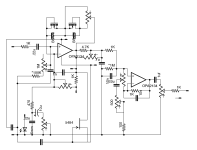
Try following one of the raw unedited VFE schematics. It looks exactly how it would look on my breadboard.

genXslacker
Well-known member
PassTry following one of the raw unedited VFE schematics.

Chuck D. Bones
Circuit Wizard
They give me a headache. They're not just tangled, some of the connections are ambiguous.Try following one of the raw unedited VFE schematics. It looks exactly how it would look on my breadboard.

jessenator
Well-known member
We're far enough along in the timeline that apart from the Boston man's patented stuff, there's very little a large corpo would even want to do about identical circuits. The biggest areas of infrigeable(?) elements is in trade dress. If I start putting crap in a klon-shaped box, with a klon-like name, and a klon-like mascot, I'm going to draw ire at best, and at worst a lawsuit. Same goes for nearly any other maker. If I go about mimicking JHS' entire line to a tee, I'm gonna get a C&D. That's something I'm a stickler about. For yourself? Do whatever the cr*p you want. For selling? C'mon, put a little effort into something remotely original.
</soapbox>
I'm looking forward to tinkering with this one, Chuck.
Also, Robert I've avoided saying too much about VFE in the past, since Peter's an actuall EE and what could I possibly say about his work, but what the actual h*ck is happening in that drawing?
</soapbox>
I'm looking forward to tinkering with this one, Chuck.
Also, Robert I've avoided saying too much about VFE in the past, since Peter's an actuall EE and what could I possibly say about his work, but what the actual h*ck is happening in that drawing?
Chuck D. Bones
Circuit Wizard
It's good enough to feed to an auto-router.
Chuck D. Bones
Circuit Wizard
Phill in Oz recommended this pedal to me and I thank him for that. He suggested trying red LEDs in place of the 1N4003s. Definitely louder. Less compression. At low bias settings, the LEDs don't conduct. So then I tried some low-leakage Ge diodes (ITT GD012). More compression, less volume and smoother. Smooth is not something I want in this pedal. I also tried 1SS98 low-leakage Schottky diodes. Similar to the GD012, but a bit more top-end. Still not nasty enough. I went back to the 1N4003s. Those are the ticket.

Ginsly
Well-known member
Well I’ll be… had no idea Mahoney (under the Jordan brand, which he now seems to own) also released his take on this, and the name is identical. I wonder if he also based his on an NPN/NPN Bosstone… https://www.mahoneyguitargear.com/product-page/spirit-inthe-sky

tegendemuur
Well-known member
Derail: I couldn't find it, and I know you've mentioned before of at some time doing a breadboard (and maybe even a boneyard edition) of the Pussy Melter? I caught a few details about it over the years, and am curious if the silly way of how they stuck two circuits together has any influence on the sound, which is quite awesome. Or if you could make it more awesome, A muff smelter or whatever.
Last edited:
Chuck D. Bones
Circuit Wizard
It's still on the list of things to do...
Chuck D. Bones
Circuit Wizard
Just to be clear, the Overcast is a clone of a the California version of the BossTone. Let's do a little circuit analysis.Well I’ll be… had no idea Mahoney (under the Jordan brand, which he now seems to own) also released his take on this, and the name is identical. I wonder if he also based his on an NPN/NPN Bosstone… https://www.mahoneyguitargear.com/product-page/spirit-inthe-sky
We'll start with the SUSTAIN knob dimed, its resistance at zero. R4 & R5 both connect to Vcc. Q1 has a little bit of local negative feedback via R2 and a little bit via R3. Q2 has a variable amount of local feedback thru the BIAS pot. Turning BIAS up reduces the feedback. Pretty simple so far.
Now let's see what happens when we set SUSTAIN to zero. From Q2's point of view, its collector resistor has increased from 10K to 20K (10K from R5 + 10K from the SUSTAIN pot). This increases Q2's gain and lowers Q2's collector voltage. DC feedback thru the BIAS pot mostly compensates for the increase in collector resistance and as a result, Q2's collector voltage doesn't change much. From Q1's point of view, it's a little more complicated. The DC voltage drop in the SUSTAIN pot lowers Q1's collector voltage. The negative feedback thru R3 compensates somewhat for that. The BIAS pot now affects Q1's bias as well. Another thing that happens is we now have a global AC feedback path from Q2's collector to Q1's collector because half of Q2's output signal is now fed back to Q1 thru R4. This reduces the overall gain by about 9dB. Not a lot, but it's noticeable. As Betty points out, the BIAS pot has the strongest influence over the gain & tone. The SUSTAIN pot may have been introduced into the circuit to simulate battery sag.
![Circle Electric Co. Spirit in the Sky Fuzz [Overcast Fuzz].png](https://pedalpcb-forum.nyc3.digitaloceanspaces.com/data/attachments/119/119870-f8b17fe55d5c4d1795294ce7c31893fb.jpg?hash=mo3aT8y0Ef "Circle Electric Co. Spirit in the Sky Fuzz [Overcast Fuzz].png")
The Nashville version of the BossTone replaced the two NPN transistors with a Sziklai pair for higher gain. The behavior and tone are quite different from earlier versions. Does anyone really know what was inside Norman Greenbaum's Tele? No one has produced any physical evidence, just faded memories and partial truths. Even if it was based on a BossTone, did it use the stock component values, or were the values tweaked to adjust the tone?
My $0.02 ±5%
Last edited:
Ginsly
Well-known member
First off, that is a great explanation of what's going on here - thanks Chuck!
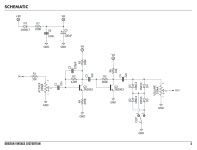
It really looks like the original version of the Bosstone (even before the Pasadena model that morphed into Nashville) has more in common with the SITS than you might think - they rearranged some things, but it's very clearly that early NPN/NPN Bosstone, essentially. Here's Aion's Oberon schematic, which I believe is the Alhambra Bosstone:

It really looks like the original version of the Bosstone (even before the Pasadena model that morphed into Nashville) has more in common with the SITS than you might think - they rearranged some things, but it's very clearly that early NPN/NPN Bosstone, essentially. Here's Aion's Oberon schematic, which I believe is the Alhambra Bosstone:
Last edited:
Chuck D. Bones
Circuit Wizard
Thanks, Ginsly, I had not seen that. Puts things in a completely different light. I edited post #32 accordingly.
I can see why they used a B-taper pot for ATTACK, because with A-taper, everything below noon would be useless.
I'd like to figure out a way to fiddle the 2nd stage bias without affecting the gain so much.
I can see why they used a B-taper pot for ATTACK, because with A-taper, everything below noon would be useless.
I'd like to figure out a way to fiddle the 2nd stage bias without affecting the gain so much.
Last edited:
Chuck D. Bones
Circuit Wizard
Over at General Guitar Gadgets we can find the Maestro FZ-1S, a silicon version of the FZ-1 (click on the link).
The circuits surrounding Q3, Q4 and diode clippers Q5 & Q6 look very familiar.
The circuits surrounding Q3, Q4 and diode clippers Q5 & Q6 look very familiar.
genXslacker
Well-known member
Mode four on the Big Cheese gets the spit/glitch closer than the SITS/Overcast circuit does. The SITS gets closer to the EQ. If some genius could marry the Overcast's EQ to the Big Cheese's glitch, I think that would be the closet thing yet to the record that I've heard.
Chuck D. Bones
Circuit Wizard
I'll have to look into the Big Cheese. I generally do not like the way Fuzz Faces behave when they are biased into a gating mode. But that one may be the exception.
genXslacker
Well-known member
I'm with you, though their EQ is usually too dark and muddy for me in addition to that.I'll have to look into the Big Cheese. I generally do not like the way Fuzz Faces behave when they are biased into a gating mode. But that one may be the exception.
I think you'll find The Big Cheese, however, can be dialed such that it consistently, but only mildly, gates.
If you do take a notion to experiment with it, you might find, as I did, that you have to have the tone knob on the guitar way farther up than with the Overcast to get anywhere near the record's EQ.
Chuck D. Bones
Circuit Wizard
C1 cuts treble right at the input. Maybe that should be smaller.

Cybercow
Well-known member
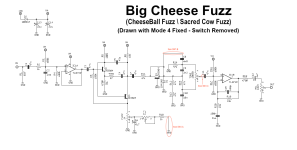
Interesting. Trying to grasp what you're on about, I pulled up a Big Cheese schematic and redrew it with the mode switch removed and circuit fixed at Mode 4.Mode four on the Big Cheese gets the spit/glitch closer than the SITS/Overcast circuit does. The SITS gets closer to the EQ. If some genius could marry the Overcast's EQ to the Big Cheese's glitch, I think that would be the closet thing yet to the record that I've heard.
Mode #4 is the only mode that grounds R10 (1K); essentially turning the Fuzz pot (1K) into a 666Ω to 500Ω pot - depending on the trimmer setting. The other three modes let R10 & the trimmer float.
Last edited: