What's the Deal with Pot Tapers? - part 3

Chuck D. Bones

Circuit Wizard
In this part, we'll discuss what happens when we put a resistor in parallel with a pot. We'll address the simple case where we use the pot as a variable resistor (as opposed to a variable divider) where we connect two pins together.

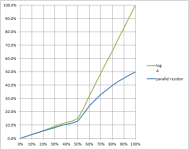
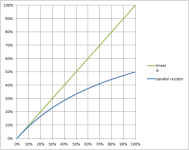
The first example is a B-taper pot. We'll connect pins 1 & 2 together and put a resistor of equal value across from pin 1 to pin 3. Let's say it's a 100K resistor in parallel with a 100K pot. The actual resistor value doesn't matter, only it's relationship with the pot value matters. The green line is the % resistance vs. % rotation with no parallel resistor. The blue line is the total % resistance vs. % rotation when there is a resistor in parallel. As we would expect, at 100% rotation we get 1/2 of the resistance because that's what you get when you put two equal resistors in parallel. Every other point on the blue line represents the total resistance we get when the pot resistance is less than the parallel resistor. Notice that below 10% rotation, the green & blue lines converge, indicating that the parallel resistor has little or no effect on the total resistance. Also notice the shape of the blue line, it curves so that the top side of the line is convex. This is the opposite direction of curvature compared to A- or C-taper. This is visual proof that we cannot make an A- or C-taper pot from a B-taper pot. The resulting curve bends the wrong way. It doesn't matter what value resistor you choose.

1767662872850.png

So what happens when we put a resistor in parallel with an A-taper pot? We get a less extreme A-taper. In the plot below, the green line is the resistance with no parallel resistor and the blue line is the resistance with an equal value resistor in parallel. Up to 50% rotation, there is very little difference between the two curves. But from 50% rotation on up, the blue curve is not nearly as steep as the green curve. I have done this on occasion, when I want a pot that behaves like A-taper at the bottom end of rotation, but is more like B-taper at the top end of rotation. C-taper works the same way, except the direction of rotation is reversed.

1767663501882.png
 
Great post as always! There’s one part that I’m not quite understanding your take on, though:
This is visual proof that we cannot make an A- or C-taper pot from a B-taper pot. The resulting curve bends the wrong way. It doesn't matter what value resistor you choose.
View attachment 108925
How so? The curve of a C taper pot has a generally similar shape to the blue curve there.

Depending on the manufacturer. Most C-taper pots that ive seen are around 90% resistance at 50% rotation. Sometimes I want a *slightly* more linear taper, where it’s closer to 80% (like 83% or something, off the top of my head) at 50% rotation. In the past I’ve used the following formulae for this, and it’s always seemed correct to me:
“True” C Taper (~90% anti-log) 10XΩ linear + 11/10XΩ resistor
~80% anti-log5XΩ linear + 5/4XΩ resistor

That means if I want a C100k, I can use a B1M pot in parallel with a 110k resistor. If I want it less steep, so more of an 80% anti-log, I can do a B500K pot in parallel with a 130k resistor (or a 120k and 5k in series if a 3% tolerance is unacceptable, though it’s never been critical for me given the tolerances of the pots to begin with)

Anything as high as 100k for the ~90% taper and as high as 250k for the ~80% taper is easily attainable since B1M pots are readily available, and frankly in many cases I prefer it over a “real” C taper pot since it results in a truly smooth curve instead of the three-point plot that a typical C-taper pot has.

Please correct me if I’m wrong— I did this math back in 2022, and while I remember plotting it at the time and it seeming correct when graphed out, I haven’t thought about it in a while until I saw this write-up of yours. I have used this in practice numerous times as well, and it’s always behaved exactly as a C-taper should.


As far as the part where you talk about parallel resistors on log taper pots, it’s very neat to see it plotted out like that. In a pinch, I’ve used an A1M pot in parallel with a 330K to approximate a 250K J-taper pot (log taper that’s closer to 25-30% resistance at 50% rotation, instead of the usual 10-15% at 50% rotation), which is my preferred tone pot value and taper for strats.
 
Great post as always! There’s one part that I’m not quite understanding your take on, though:

How so? The curve of a C taper pot has a generally similar shape to the blue curve there.

Depending on the manufacturer. Most C-taper pots that ive seen are around 90% resistance at 50% rotation. Sometimes I want a *slightly* more linear taper, where it’s closer to 80% (like 83% or something, off the top of my head) at 50% rotation. In the past I’ve used the following formulae for this, and it’s always seemed correct to me:
“True” C Taper (~90% anti-log) 10XΩ linear + 11/10XΩ resistor
~80% anti-log5XΩ linear + 5/4XΩ resistor

That means if I want a C100k, I can use a B1M pot in parallel with a 110k resistor. If I want it less steep, so more of an 80% anti-log, I can do a B500K pot in parallel with a 130k resistor (or a 120k and 5k in series if a 3% tolerance is unacceptable, though it’s never been critical for me given the tolerances of the pots to begin with)

Anything as high as 100k for the ~90% taper and as high as 250k for the ~80% taper is easily attainable since B1M pots are readily available, and frankly in many cases I prefer it over a “real” C taper pot since it results in a truly smooth curve instead of the three-point plot that a typical C-taper pot has.

Please correct me if I’m wrong— I did this math back in 2022, and while I remember plotting it at the time and it seeming correct when graphed out, I haven’t thought about it in a while until I saw this write-up of yours. I have used this in practice numerous times as well, and it’s always behaved exactly as a C-taper should.


As far as the part where you talk about parallel resistors on log taper pots, it’s very neat to see it plotted out like that. In a pinch, I’ve used an A1M pot in parallel with a 330K to approximate a 250K J-taper pot (log taper that’s closer to 25-30% resistance at 50% rotation, instead of the usual 10-15% at 50% rotation), which is my preferred tone pot value and taper for strats.
The slope of the A taper is small at first and then steep. The B taper with the resistor in parallel is almost exactly the opposite: steeper at first and then it goes down, becoming almost flat.
 
The curve of a C taper pot has a generally similar shape to the blue curve there.
I can answer this two ways:
1. When we connect an A-taper pot as a variable resistor, we use pins 1 & 2. We can ignore the fact that we usually connect pin 2 to pin 3 because it has no effect on the overall resistance. Clockwise rotation increases resistance. But when we connect a C-taper pot as a variable resistor, we use pins 2 & 3. Clockwise rotation decreases resistance. This effectively flips the resistance vs. rotation chart top to bottom. Which way does the curve bend now?
2. Reversing the pot taper (A vs C) does not change Ohm's Law. If putting a resistor in parallel with a B-taper pot doesn't make it behave like an A-taper pot, then it won't make it behave like a C-taper pot either in the case where we're using the pot as a 2-pin device.

I will discuss paralleling a pot using all three pins in part 4.
 
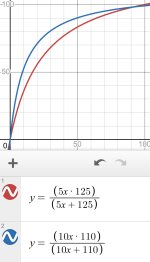
Just plotted my formulas (with the numbers scaled so x=100 is more or less y=100 so we can view the x axis as % rotation and the y axis as % resistance)
IMG_6176.jpeg
Do those not appear to be pretty solid Anti-Log/C-Taper plots?
If using with connections on lugs 1 and 2, it should function identically to an ideal C-taper pot, no?
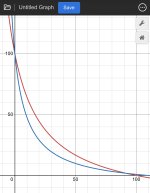
And transitively, if that’s the case then lugs 2 and 3 should behave like lugs 2 and 3 on an ideal C-taper pot as well, no? Below is the resistance curve you would see between lugs 2 and 3.
IMG_6177.jpeg
 
Last edited:
Back
Top