WIP Amp build - Deliverance 60 made 2 channels

Ahh good choice on the Wima caps. I have FKP1, MKP10 and MKP4s here. I've also got Vishay axials in the turret board JCM.

How much space do you have under those large power resistors?
I love my WIMA caps. iirc I made it so signal only goes through polypropylene too cause I am a snob. I tried avoiding axial caps here because my self imposed constraint was a small footprint (so it fits on my desk;) ).

Any resistor that could see more than 1W is installed 1mm high - or should be- and everything I could has been installed with 90degres kinks on the leads just in case.

As far as I could measure it the insides stay coolish - the main culprit for heating would be the LM317. The heatsink I chose is oversize though so no problem so far. I still could likely cook breakfast crispy bacon on those KT88 holy hell.

that crunch 🫶
Crunchiest distortion ever. Breaking it in, knowing how to dial it in better and for me changing the tubes made the top end slightly smoother and the low mid more present. I love it.
 
I've just been doing some ESR calculations for my tube compressor as the Vishay 0.1uF has an ESR at 62Hz of 7R7! I remembered you have a MKP10 in there and use MKP4. Looking carefully it looks like the MKP10 is C2 and on the first stage output. The MKP10 you have there is 630Vdc/400Vac, the equivalent ac matching MKP4 would be 1000Vdc/400Vac also being the same size (there's two package sizes for that value of mkp4).

The loss angle of the MKP4 at 1KHz is 3x10^-4 and the MKP10 is 6x10^-4. The short of this, at 62Hz-1.3KHz range, the ESR for that MKP10 is higher than the MKP4, which leads to a slower response than the MKP4 for the same value. It should be a better sound (I found the MKP4 a clearer cap vs the MKP10 in a hifi project).

I'm switching from the MKP1839 to the MKP4!
 
Last edited:
Interesting. Thanks for the information. To be perfectly frank, I just "fit the caps" aiming for values, small form factor, and PP on the signal path. I haven't dug at all in these important details for the non-electrolytic caps.

I'm currently building yet another guitar, but I was planning on fine tuning this amp afterwards (inclusion of a proper buffered FX loop, possibly playing with the bright cap of Gain I, slope resistor, or just mess around with the tone stack in general). I'll revisit the MKP10 I can have in there and try to see if I can get some MKP4 instead. Cheers!
 
Great project. I have played that amp and it is amazing.
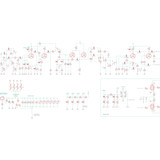
The schematic image is hard to read, even when I click on it, and in a different tab and browser. Is this everybody’s experience, and does anybody have it in a different format?

Thanks
 
Yes it seems the resolution wasn’t the best and it’s hard to read. I’ll reupload a proper one once I am back from holidays.
 
Great project. I have played that amp and it is amazing.
The schematic image is hard to read, even when I click on it, and in a different tab and browser. Is this everybody’s experience, and does anybody have it in a different format?

Thanks
Here you go. Had to upload to an external host as I can't upload a pdf here and there seems to be compression past a certain resolution. Some stuff needs to be connected by a wire but the naming should make it easy enough to figure out. (Obviously, click on the image).

 
Here you go. Had to upload to an external host as I can't upload a pdf here and there seems to be compression past a certain resolution. Some stuff needs to be connected by a wire but the naming should make it easy enough to figure out. (Obviously, click on the image).

Thank you so much!
 
That works! Or if you PM me (can't yet as I'm new) I'd be open to paying for the gerbers and offer the extras for others here.

I've never built an amp, but I'd love to, especially to have a D60.
 
Last edited:
That looks amazing! I've only ever built on tag or turret board, never PCB for an amp. I'm a tinkerer though so turrets really suit me. If I was to build something where I was certain of parts values something what you have done here would be killer.

As for drilling tube socket holes, you could use a sheet metal punch. I used one when enlarging a noval rectifier hole for an octal rectifier socket. You can get them for not too much $$. You just use a spanner to pull the punch into the receiver and it cuts a beautiful circular hole. It's way easier than I thought it would be and produced an excellent result.

I use JJ KT66s and KT77s a fair bit and like 'em. I don't really want to use Russian tubes. For one thing they are often distributed by New Sensor who I find to be a less than ethical business. The only JJs I have ever had issues with are the GZ34 rectifier tubes. I seem to have encountered a dodgy batch of those. But the power tubes, especially when biased at 60% as you have, have been very reliable for me and sound great.
 
Hoh wow that thread still lives! Thanks for the kind words.

That looks amazing! I've only ever built on tag or turret board, never PCB for an amp. I'm a tinkerer though so turrets really suit me. If I was to build something where I was certain of parts values something what you have done here would be killer.

As for drilling tube socket holes, you could use a sheet metal punch. I used one when enlarging a noval rectifier hole for an octal rectifier socket. You can get them for not too much $$. You just use a spanner to pull the punch into the receiver and it cuts a beautiful circular hole. It's way easier than I thought it would be and produced an excellent result.

I use JJ KT66s and KT77s a fair bit and like 'em. I don't really want to use Russian tubes. For one thing they are often distributed by New Sensor who I find to be a less than ethical business. The only JJs I have ever had issues with are the GZ34 rectifier tubes. I seem to have encountered a dodgy batch of those. But the power tubes, especially when biased at 60% as you have, have been very reliable for me and sound great.
Yeah for a close copy a PCB works well. And regarding the chassis, if I had to do it again I would just model it and have JLC cut it for me. I did it for my « VH4 » and it is stupidly cheap, even powder coated and thick.

Funnily enough I was playing this amp today and thought about a few things I might change if I ever do a v2. The More channel is still the best overdriven sound I had the pleasure to play, and very minimal changes would make the Less into a perfect clean channel…
 
Cool, I had the insane idea to have an fx loop for each channel so I could tailor my pedal choice for the best results. I would have to sit down and figure out the logistics.
 
Back
Top