
Betty Wont
Well-known member
I am all about infrared LEDs as clippers. They generally have the lowest fv of any LEDs. I feel it’s the most LED flavor and distortion available for clipping.Also yellow LEDs for clipping diodes kinda blew my mind.

I am all about infrared LEDs as clippers. They generally have the lowest fv of any LEDs. I feel it’s the most LED flavor and distortion available for clipping.Also yellow LEDs for clipping diodes kinda blew my mind.

I could be totally wrong but Say the root is C so the other 2 notes would be a G making it a Cmaj7?That's just adding the chord's 5th as the bass note, right? <Tries to remember some of them theory videos on SBL> Mind you, I have never thought to do this in any tuning, so thanks for gifting your epiphany to me.

No. A Cmaj7 chord has C, E, G, and B (technically the G is optional since the fifth is implied by the surrounding harmony.I could be totally wrong but Say the root is C so the other 2 notes would be a G making it a Cmaj7?
voice leading and counterpoint professors:Parallel 4ths > parallel 5ths.

No. A Cmaj7 chord has C, E, G, and B (technically the G is optional since the fifth is implied by the surrounding harmony.
if you’re playing a C power chord with a G in the bass, it’s still a C chord. Just a different inversion though (second inversion, but technically that’s debatable since a power chord is just a dyad with implied harmonic function— could you say it’s a quintal dyad in first inversion? Could you say it’s a quartal dyad in root inversion? Yeah to both of those. That’s just music theory nerd dumbness though.)


<Using the forum to have theory thoughts out loud>No. A Cmaj7 chord has C, E, G, and B (technically the G is optional since the fifth is implied by the surrounding harmony.
if you’re playing a C power chord with a G in the bass, it’s still a C chord. Just a different inversion though (second inversion, but technically that’s debatable since a power chord is just a dyad with implied harmonic function— could you say it’s a quintal dyad in first inversion? Could you say it’s a quartal dyad in root inversion? Yeah to both of those. That’s just music theory nerd dumbness though.)

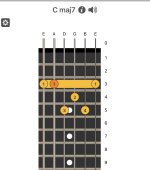
What makes this a maj7 chord isn't the G on the 6th string, it's the B on the 3rd stringView attachment 49876
I will have to refer to you on this because you are zooming way over my head on theroy, but to be a pain in the ass I will leave this here and say We were trying for a Cmaj7 but got tired.
I have no idea I just looked up voicings for CMaj7 and found a way to poke the the music theory hornets nest for a cheap laugh.What makes this a maj7 chord isn't the G on the 6th string, it's the B on the 3rd string
View attachment 49876
I will have to refer to you on this because you are zooming way over my head on theroy, but to be a pain in the ass I will leave this here and say We were trying for a Cmaj7 but got tired.
I refuse to give up the delusion.I'm not going to be a rock star; I know right? it was a shock to me too!
You guys take me entirely too seriously.Maybe just play it as the 2-string combo of the 3rd and 4th string.
Maybe. I'm just playing along, using it as a thought exercise, because I don't really know theory.You guys take me entirely too seriously.
I’m with ya I know enough about theory to know I don’t understand it… I just know the sound a guitar makes when someone lies “ I know theory.”Maybe. I'm just playing along, using it as a thought exercise, because I don't really know theory.
Pretty much, the gist of it is that unless you have a B somewhere, it’s not a Cmaj7. If you have from low to high:View attachment 49876
I will have to refer to you on this because you are zooming way over my head on theroy, but to be a pain in the ass I will leave this here and say We were trying for a Cmaj7 but got tired.


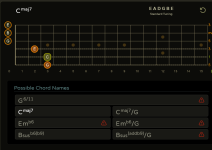
My fav Cmaj7. If you guys wanna play with chords and theory, check out https://www.oolimo.com/en/guitar-chords/analyzePretty much, the gist of it is that unless you have a B somewhere, it’s not a Cmaj7. If you have from low to high:
If there’s just C and G, it’s absolutely just a C5 “power” chord.
- CG: it’s a C power chord, aka “C5”
- CGC: still a C power chord, aka “C5”
- GCG or GCGC: still a C power chord, but an inversion of it. We could call this C5/G
- CEG: C major
- CGE: still C major. It doesn’t matter what order the upper notes are in
- CEGB: Cmaj7
- CGBE: still Cmaj7- it doesn’t matter what order the upper notes are in
- BGEC: C major in 3rd inversion. We could call it a C/B or Cmaj7/B
- EGBC: Cmaj7 in first inversion (aka Cmaj7/E), or Emb6. Which you call it depends half on preference and half on the function within the harmony. Minor flat-sixth chords aren’t all that common outside of chromatic line cliches so most times the better choice would be to call it Cmaj7/E
- CEB: Cmaj7— the fifth isn’t all that important
- CGB: debatable, but for all intents and purposes it’s still a Cmaj7 since the presence of a major 7th interval implies a major third— since the fifth is included, we know it can’t be a C+7 or C°maj7 chord (neither of which is common *at all* anyway) which leaves us with Cmaj7 or C-maj7, with the contexts of minor-major-seventh chords and major-seventh chords having virtually no overlap, so it’ll be very clear what the intent is.
Probably over complicated things quite a bit there, but hopefully I didn’t make things too confusing with my incessant rambling
If you ever need help with what to call a particular unusual chord or inversion, I’m here to help though— I promise not to get into debates with myself over technical minutiae that doesn’t have a name because it’s not quite significant enough for music theorists to care about
Wow that’s a lot man, not going to lie That’s a lot to try and absorb, but I did just learn something… I think….. I know who to hit up now for theory questions for sure.Pretty much, the gist of it is that unless you have a B somewhere, it’s not a Cmaj7. If you have from low to high:
If there’s just C and G, it’s absolutely just a C5 “power” chord.
- CG: it’s a C power chord, aka “C5”
- CGC: still a C power chord, aka “C5”
- GCG or GCGC: still a C power chord, but an inversion of it. We could call this C5/G
- CEG: C major
- CGE: still C major. It doesn’t matter what order the upper notes are in
- CEGB: Cmaj7
- CGBE: still Cmaj7- it doesn’t matter what order the upper notes are in
- BGEC: C major in 3rd inversion. We could call it a C/B or Cmaj7/B
- EGBC: Cmaj7 in first inversion (aka Cmaj7/E), or Emb6. Which you call it depends half on preference and half on the function within the harmony. Minor flat-sixth chords aren’t all that common outside of chromatic line cliches so most times the better choice would be to call it Cmaj7/E
- CEB: Cmaj7— the fifth isn’t all that important
- CGB: debatable, but for all intents and purposes it’s still a Cmaj7 since the presence of a major 7th interval implies a major third— since the fifth is included, we know it can’t be a C+7 or C°maj7 chord (neither of which is common *at all* anyway) which leaves us with Cmaj7 or C-maj7, with the contexts of minor-major-seventh chords and major-seventh chords having virtually no overlap, so it’ll be very clear what the intent is.
Probably over complicated things quite a bit there, but hopefully I didn’t make things too confusing with my incessant rambling
If you ever need help with what to call a particular unusual chord or inversion, I’m here to help though— I promise not to get into debates with myself over technical minutiae that doesn’t have a name because it’s not quite significant enough for music theorists to care about
I just mean that power chords in 99% of songs will still fit within the diatonic confines of the key center, and in 99% of those cases, the power chords will unambiguously imply the chord quality just by its role in the harmony. In song that’s in C major, a D power chord will almost always imply a Dm, because that’s the quality of chord that naturally resides as the ii of a major key. If the song is in C and I play the power chords D5, G5, C5, it’ll almost always be functioning as a typical ii-V-I turnaround, so Dm G C is implied— there is no D major chord naturally occurring in C major, nor is there Gm or Cm unless they’re examples of modal interchange (or are non-diatonic chords setting up a secondary dominant down the line), in which case the melody will likely clarify those outliers anyway.<Using the forum to have theory thoughts out loud>
I think all this means I might have been correct. Giving it some more thought, the "implied harmonic function" is because it has no third to make it deterministic?
All I know is a major chord is one containing the 1, 3, and 5. A minor has a flat third.Wow that’s a lot man, not going to lie That’s a lot to try and absorb, but I did just learn something… I think….. I know who to hit up now for theory questions for sure.

