Bricksnbeatles
Member known well
Unless it sounds good, but you want it to sound bad. That’s a real conundrum!Beyond that, if it sounds good, it is good.

Unless it sounds good, but you want it to sound bad. That’s a real conundrum!Beyond that, if it sounds good, it is good.

This is almost like a text adventure version of 12Tone on YouTube. I don't fully get it on the initial go-around, but it all kind makes sense in the end.I just mean that power chords in 99% of songs will still fit within the diatonic confines of the key center, and in 99% of those cases, the power chords will unambiguously imply the chord quality just by its role in the harmony. In song that’s in C major, a D power chord will almost always imply a Dm, because that’s the quality of chord that naturally resides as the ii of a major key. If the song is in C and I play the power chords D5, G5, C5, it’ll almost always be functioning as a typical ii-V-I turnaround, so Dm G C is implied— there is no D major chord naturally occurring in C major, nor is there Gm or Cm unless they’re examples of modal interchange (or are non-diatonic chords setting up a secondary dominant down the line), in which case the melody will likely clarify those outliers anyway.
If I play E5, C#5, A5, B5, it’s pretty clear that I’m doing a I-vi-IV-V in E major, so we can pretty confidently say that the E, A, and B chords are implicitly major, and that the C# is minor.

I call that the Rivers way. Instantly turns any power pop song into a Weezer tune
I was gonna say something about using dissonance on purpose, but I was thinking that "good" is subjective. I think Les Claypool or King Buzzo know what they are doing, for example.Unless it sounds good, but you want it to sound bad. That’s a real conundrum!

I frequently find myself referring people to 12Tone videos when my explanations of things wind up going on too many tangents, and I’m a big fan of his videos so I take that as a huge complimentThis is almost like a text adventure version of 12Tone on YouTube. I don't fully get it on the initial go-around, but it all kind makes sense in the end.

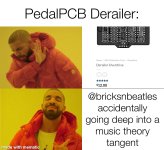
It’s how I be—We have derailed the shit outta this thread with theory. Guess that just means possible epiphanies in "real time".

Pearl Bailey I met when I was in college, she was retired and taking classes she never had a chance to when she was singing. I told her sometimes I play music I don't really like and I just can't get into it, but I play it because I feel it's popular. She got this look in her eye and said "Allen, I used to feel the same way. I told Louis Armstrong about it and he said "Pearl, you gotta play what you like. You can't please everyone. But if you're pleasin yourself, others that feel the same as you will like it."" So from Louis, to Pearl, to me to you: Exactly!Playing for people is far easier than I ever expected. They just want to hear something you are passionate about playing. If you don't enjoy what you are playing the crowd will not.

Hate it when that happens.Unless it sounds good, but you want it to sound bad. That’s a real conundrum!
Pretty sure Victor Wooten is on record as saying, "There are no wrong notes." So, I am going to write off any bad sounds as exploration of the musical landscape.Hate it when that happens.
Whenever I hit the wrong notes I call it "Jazz"Pretty sure Victor Wooten is on record as saying, "There are no wrong notes." So, I am going to write off any bad sounds as exploration of the musical landscape.


Yeah, me too. Year of the Monkey and all that jazzSo, what's YOUR latest Epiphany? It doesn't have to be who Killed Kennedy, or even where Elmo is!
I am 67 and I started playing guitar in 1967. I was born in 1956 and I've been playing guitar for 56 years.
</Insert> Twilight Zone Themesong </end>


Not exactly an epiphany, but I lost another old friend recently. Actually kind of an ex but we weren't really a couple, just a fling. And it turned out we were much better suited as friends. So we were, and I always admired her ability to let bygones be bygones. She was a good person. Smart and funny, with a big heart.
A year ago she was fine, until she wasn't. Turned out to be leukemia. She went through a shit ton of chemo, and that didn't work. Then they put her on an experimental drug, which helped for a while and then didn't. Then they told her she was done and sent her to palliative care. She lasted two days there. Now she's gone, and I'll miss her. They buried her on Friday.
So I bought an amp. Because, while I am far from rich and always on the edge of ruin, I have enough money saved that a nice amp isn't going to make a difference. And you're a long time dead so you might as well live a little.
Fender Tone Master Princeton, because I am done with valve amps. Maybe. Probably. Certainly don't want to carry them around. And I cannot fault the Tone Master - it really does sound amazingly nice. So now I have one. I'll be selling a couple of amps to clear out space, but that's a problem for later.
I've only tried it with overdrives so far - been busy with other things - but it works really well with them. I should have some more time tomorrow to try some more pedals with it.Good score on the TM Princeton. How does it take pedals?
I've only tried it with overdrives so far - been busy with other things - but it works really well with them. I should have some more time tomorrow to try some more pedals with it.

I am all about infrared LEDs as clippers. They generally have the lowest fv of any LEDs. I feel it’s the most LED flavor and distortion available for clipping.

Kinda pricey for LEDsMy latest epiphany is semi-related epiphany: I love the look of rectangular LEDs for clippers. They line up neatly with box film caps. Gotta see if there’s any IR ones now

I really like a barred Xsus2 (three ½ steps down) chord after an Xm7. The chords used in chorus stanza of "Ordinary World" (Duran Duran) . . . G | Dm7 | Bbsus2 | F | C . . . . really touches my soul.I just mean that power chords in 99% of songs will still fit within the diatonic confines of the key center, and in 99% of those cases, the power chords will unambiguously imply the chord quality just by its role in the harmony. In song that’s in C major, a D power chord will almost always imply a Dm, because that’s the quality of chord that naturally resides as the ii of a major key. If the song is in C and I play the power chords D5, G5, C5, it’ll almost always be functioning as a typical ii-V-I turnaround, so Dm G C is implied— there is no D major chord naturally occurring in C major, nor is there Gm or Cm unless they’re examples of modal interchange (or are non-diatonic chords setting up a secondary dominant down the line), in which case the melody will likely clarify those outliers anyway.
If I play E5, C#5, A5, B5, it’s pretty clear that I’m doing a I-vi-IV-V in E major, so we can pretty confidently say that the E, A, and B chords are implicitly major, and that the C# is minor.