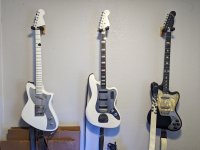
Baritone or conversion neck?

Went through this same thought process last year and ended up buying a new Fender "subsonic" neck to put on my older MIM tele. Thought about just getting a new squier baritone and honestly regret not going that route. For the price, going for a "real" Fender neck wasn't really worth it for me, especially for a shorter scale baritone. If I were to do it over again I'd get a longer neck and either splurge on a warmoth or cheap out on something from amazon. Or just buy one of those squier paranormal thingies.

To echo @drgonzo1969, single coils were the way to go for me as well. I'd originally had some high output pups on my tele that were totally overwhelmed by the chonkier strings. A set of low output tele pickups really improved things.
 
I've always been of the opinion that 27" is hardly different enough from 25.5" to be worth it.
I agree completely and have to remind myself of this everytime I eye a new bari that isn’t 30”.

I tune down to B standard without issue on 25.5” (although I prefer C# personally) its just a matter of string gauge and intonation. But my preference of string tension may not be a popular one.

Bass VI bari/30” scale is the way to go to actually feel like a different type of guitar. Harley Benton’s Bass VI model rules for $300.

I have emg humbuckers in my SG Bass VI and prefer them over the (also very good) emg alcino active singles in one of my HB VIs but I did have to do a fair amount of digging to feel comfortable pulling the trigger on the humbuckers, and the neck pickup is alcino as well. That said, swapping those humbuckers (60AX & 81X) into the rest of my guitars is on my short list.
 
As someone who has looked into buying a baritone for years, you have to ask yourself a few questions:
1. How picky are you about specs?
I am very picky about neck specs. I like larger neck profiles, vintage nut width, medium frets, and flatter(ish) fretboard. Those specs (especially the larger neck profile) aren't easy to come by off the shelf. I also don't love long scales. 27" is the largest I really want to go. Any larger and its hard to play chords across multiple frets.
2. What are you tuning to?
If you are tuning to B standard or drop A you really can get away with a 25.5" scale and a set of 12s. You might need to adjust your playing a little, but it will work and sound great.
3. How often do you plan to play in a down tuning?
For me, its not as often currently. But if I ever start playing in a band with a second guitarist it might be something I use more to give some different tonal flavors between bass and standard guitar.
 
As someone who has looked into buying a baritone for years, you have to ask yourself a few questions:
1. How picky are you about specs?
I am very picky about neck specs. I like larger neck profiles, vintage nut width, medium frets, and flatter(ish) fretboard. Those specs (especially the larger neck profile) aren't easy to come by off the shelf. I also don't love long scales. 27" is the largest I really want to go. Any larger and its hard to play chords across multiple frets.

I'm this way with necks, but I prefer the longer scales. DC Kunkle has full vintage thickness, but 13" radius fretboard- so, flat but full. These necks are super comfy to me, but I have larger hands. The Warmoth necks are nice, but they're on the thinner side, and I don't believe they offer any options as far as thickness or radius goes on the baritone conversions

2. What are you tuning to?
If you are tuning to B standard or drop A you really can get away with a 25.5" scale and a set of 12s. You might need to adjust your playing a little, but it will work and sound great.

Another thing to keep on mind- while you can, and many people do, downtune on a standard scale, it requires thicker strings, which usually means a sludgier, thicker timbre with softer pick attack.
I prefer longer ~30" scales and thinner strings, so that I get a ton of definition, twang and an immediate stabbing pick attack
 
Do like the looks and sounds of this Eastwood, who also have a bunch of humbucker baritones, including a version of the Airline map. I guess I like the retromodern/Tesco-style design stuff.

P-90 in the neck, and humbucker in the bridge, with coil-split and phase switching.

 
Last edited:
So, for background, I have a kit build that ive tuned down to B standard. I have no need to go lower that this unless I really want to try dropped A once in a while. The kit build has crap intonation, but has a wider neck which I like. Not looking to shred on a baritone; that seems silly to me. This won't be my main guitar, but just something to noodle with from time to time.
 
Do like the looks and sounds of this Eastwood, who also have a bunch of humbucker baritones, including a version of the Airline map. I guess I like the retromodern/Tesco-style design stuff.


I've been digging on their white Hooky 6 Shergold clone for a minute. I'll hopefully get one once I get settled in my new place
 
I have done a Warmoth Conversion on a Strat. I ordered the cheapest one I could get and finished it in tru-oil and added vintage style tuners. It was a great feeling neck and the only real complaints I had were that there was a high fret down at the 24th high E and to accommodate the extra scale length there is an indentation in the heel that looks a little weird and leaves a little overhang. I ended up selling the neck because I wanted the guitar back to stock. Also bought a Squier cabronita baritone from a friend and am not impressed. It’s ok, but the pickups are microphonic at high gain.
 
Yep, that's what Fender considers a short scale bass, not a baritone. A baritone is 27"


Are 26.5, 26.5, and 28 inch scales not baritones, then? Danelectro calls their 30" a baritone. There's no reason to not include Bass VI scale length in conversation with other baritone options. I agree the Bass VI is sometimes better considered a different beast but there were already discussions of scale length in this thread.
 
I haven't looked into baritone conversion necks for regular guitars. Wouldn't the body be too small?
 
I'm a humbuckers guy most of the time but I definitely prefer single coils for baritone. Humbuckers get really wooly and boomy on a baritone.
I've got the PRS 277 and it sounds incredible. Absolutely not boomy. Also has coil split option.

I don't play anything anywhere close to doom, more funk/jazz fusion, and a baritone has been such an inspirational instrument. It makes me play more rhythmic fills, almost like bass on guitar (ironically), and it's definitely influenced how I play guitar now as well.
 
Are 26.5, 26.5, and 28 inch scales not baritones, then? Danelectro calls their 30" a baritone. There's no reason to not include Bass VI scale length in conversation with other baritone options. I agree the Bass VI is sometimes better considered a different beast but there were already discussions of scale length in this thread.
You are right. I should have said "around 27" for baritone. I only point it out because Fender seems to be very, very opinionated in that article as to what it is.

So technically for tuning to B , you'd be up-tuning a bass and using lighter strings. 😁
 
Are 26.5, 26.5, and 28 inch scales not baritones, then? Danelectro calls their 30" a baritone. There's no reason to not include Bass VI scale length in conversation with other baritone options. I agree the Bass VI is sometimes better considered a different beast but there were already discussions of scale length in this thread.

Historically, Danelectro was first with their baritone, which was/ is 29.75".
But, really it's the same as comparing a Jag to A JM, just different scale lengths

You are right. I should have said "around 27" for baritone. I only point it out because Fender seems to be very, very opinionated in that article as to what it is.

So technically for tuning to B , you'd be up-tuning a bass and using lighter strings. 😁

It's funny that in that same article, they have a picture of their baritone Jazzmaster, which has a 30" scale.
 
Historically, Danelectro was first with their baritone, which was/ is 29.75".
But, really it's the same as comparing a Jag to A JM, just different scale lengths


It's funny that in that same article, they have a picture of their baritone Jazzmaster, which has a 30" scale.
Are you sure it is 30. The artical says...

In the few instances when Fender has offered true baritone electric guitars, they’ve been billed as just that; i.e., the Sub-Sonic Baritone Stratocaster of 2000-2002, the Jaguar Baritone Special HH of 2005-2010 and the Blacktop Telecaster Baritone of 2012-present. All three instruments have a 27” scale.
 
Are you sure it is 30. The artical says...

In the few instances when Fender has offered true baritone electric guitars, they’ve been billed as just that; i.e., the Sub-Sonic Baritone Stratocaster of 2000-2002, the Jaguar Baritone Special HH of 2005-2010 and the Blacktop Telecaster Baritone of 2012-present. All three instruments have a 27” scale.
I've owned three of them, I'm absolutely sure. In fact, spec-wise the JM baritone neck was identical to that of the VI. The original Antigua model even had the binding, the black one did not

They've also had Japanese exclusives in the 28-30" range in the past
 
I've owned three of them, I'm absolutely sure. In fact, spec-wise the JM baritone neck was identical to that of the VI. The original Antigua model even had the binding, the black one did not

They've also had Japanese exclusives in the 28-30" range in the past
Fair enough.

I think my point was probably something like....

27" is generally considered the median range for baritone, so one with a 30" scale is nearing an extreme. It would be like buying a 27" for standard tuning which nobody does, they just buy a bass.

Baritones are already hard to find, so I'm sure the 30" variety is super duper sparse.
 
Back
Top