High Voltage Hijinks

Hal Harvey

Well-known member
@Asdrael and I have been private messaging a bit about what our tube related current projects and we thought others would enjoy participating.

This thread is for sharing and discussing high voltage tube projects like amps, preamps, etc.

I'll start.

After I ordered parts for my up coming Sunn Model T build I had the shower thought that I didn't want to build any more full amps. But I want all the sounds. Also I want all the sounds to be as accurate as possible to the original. So real vacuum tubes, high voltages (accurate to the originals), all the good stuff.

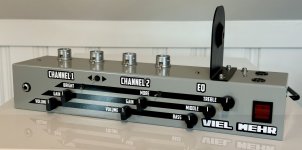
I started designing a mini-head format preamp template that I will reuse the design basics. My intent is I will plugin these preamps into the power amps of my Matamp GT120 clone, and the Model T clone. I have four planned so far: VH4 channels 2-3-4, Wizard MTL, Laney AOR, and Laney Supergroup.

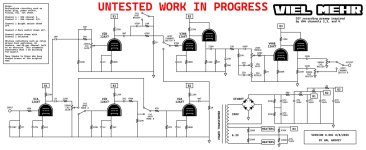
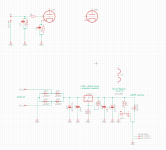
The first, and what I am currently working on, is the VH4 inspired one:
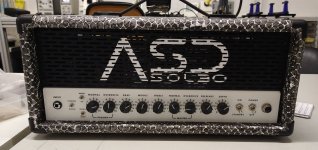
IMG_8511.jpg
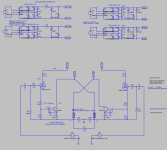
Viel Mehr Schematic Version 0.001 08082025.jpg

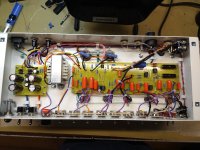
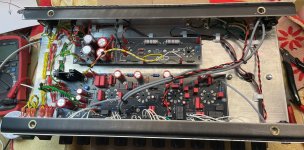
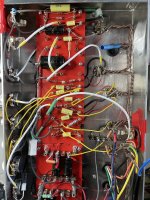
I am sloooooww here's my wiring current progress:
current.jpg
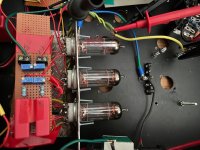
IEC mains socket, chassis ground, mains fuse, and power switch. Heater board and heaters. Tube socket wires.
 
Last edited:
Yay, more amp threads ;)

Came onto amp building after building a couple of pedals, which came after building guitars. Now I alternate between what I feel like building.

First project was a Rosamp SLO30 kit that I can really recommend. Not difficult, and a good training to work on something bigger than pedals. Also understanding the circuit is doable with different ressources available online like the robrobinette website.

I did a build report HERE and I didn't die. Also I built the headshell etc.

1754663983035.jpeg

1754663961201.jpeg


This gave me the confidence to do something stupid and build a slightly modified VHT Deliverance 60 clone recently, from almost scratch - got hold of some DL60 schematics, made a PCB out of those with some help (prototyping is overhyped) and... went to town. The build story is HERE. There are a few things that are not perfect and that I would have done differently (hindsight 20/20) but it is fully functionnal. Also did the headshell.

1754664177520.jpeg

1754664213378.jpeg


Now with @Hal Harvey tempting me, I am starting to dream up a VH2+2 by combining channels of a VH4 (1+2, 3+4) and use 2 KT77 in the power amp. This might be after I build my next two guitars and 3 pedals in queue though :ROFLMAO:
 
I have a couple of projects:

1. A now defunct tube hybrid headphone amp - a hybrid circlotron. I got one channel working but the cost was getting extortionate. It worked and drove a 50R headphone easily. This was one channel - and before build the maida regulator to quieten down the noise:
Screenshot 2022-06-11 at 07.46.04.png

IMG_0608.jpg

2. I then took Rob Robinette's build for a little JCM800 EF80 build and breathed on it - replacing the power and other sections so the prestages run at full big brother JCM800 2204 voltage, but the power had a second choke and B+ line for the lower voltage EF80s. The power supply also has a switchable EZ80/81(softer) or solid state rectification (harder/cleaner). There's a couple of microswitches for symmetric/asymmertric clipping diodes, a 1/2 Vpp front end attenuation switch, an optional additional gain stage (not used). I've also got plans for a JTM45/JCM800 switchable front end. To top it off it has a 90% attenuator socket for the speaker.
All in a nice little oversized 1x12 cab with a G12M-65.

IMG_4506 3.jpg

tempImagePwM7Vr.jpg
It's had a few updates and mods since that photo.. including upgrading the caps to 500V from 450V...

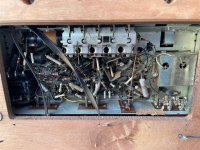
3. I have a Phillips 1957 receiver that I've recapped and brought back to life. It taught me alot about point to point wiring...
IMG_9696.jpg


The latest is what you've seen perhaps in the build threads - a 176 inspired tube compressor 'pedal'.
IMG_4912.jpg
 
Last edited:
I kept meaning to ask about that when I saw in the stereo setup thread. I saw it and thought "I bet there's something cool in that box". Turns out there was. I just found it in your build reports too. Very cool!
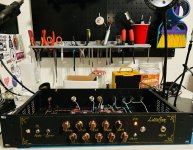
Thanks man! I would say I’m 90% happy with it, there are some things I would change with it if I could, the fx loop is kinda pointless and noisy, and the treble on the OD channel doesn’t have the authority you would hope but the bass and mids control on that channel are so powerful in an unexpectedly good way it really doesn’t matter, the clean channel is great goes from clean to crunch, with the gain cranked and boosted makes for a good heavy rhythm tone.
 
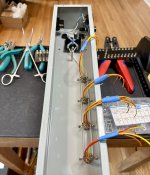
IMG_8600.jpeg

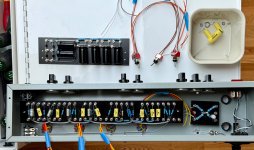
Boards are ready. Prewired the switches because I would throw myself off the roof if I had to wire them in the chassis. The pots should not be tooo bad. Next up mount the transformer, power board, and then wire that stuff up.

IMG_8607.jpeg

Not in the home stretch by any means but feels like I am making progress :)
 
Prewired the switches because I would throw myself off the roof if I had to wire them in the chassis.
Good idea!

The pots should not be tooo bad.
Famous last words. Especially in a VH4 configuration ;)

How do you guys decide on the voltage of your capacitors by the way? I have a vague idea for the ones around B+, but around the preamp tunes for example and the declouping ones, I have no idea. I could 630V everything and call it a day but it seems overkill, especially if I want to go PCB. I haven't found a good ressource yet.

(Edit: this post was written with a self built guitar playing through my self built Deliverance)
 
Famous last words. Especially in a VH4 configuration ;)
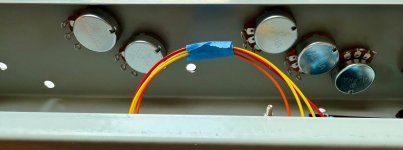
Photo Aug 11 2025, 5 06 52 PM.jpg

I hope I am right haha. I tried to angle them to give me the most access.

How do you guys decide on the voltage of your capacitors by the way? I have a vague idea for the ones around B+, but around the preamp tunes for example and the declouping ones, I have no idea. I could 630V everything and call it a day but it seems overkill, especially if I want to go PCB. I haven't found a good ressource yet.

I think in the preamp 400V is likely fine 99% of the time. For coupling post PI, 600V is probably a good plan. Psionic Audio on You tube has a couple of videos that cover a good bit of this.

I tend to be lazy and just decide on a brand line and single voltage spec and then hammer them into the cart rapid fire. Only switching to something else when something specific is missing. Also consider this:

Caps.png

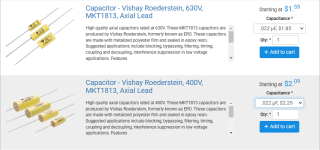
Same brand, same line... 400V is more?! The 400V must be significantly smaller right? 400V is 6x14mm. 630V is 7.5x14.0mm. Is that 1.5mm radius so much smaller really? I guess if you are packing that PCB tight. But if you are going the PCB route you might just be using Wima anyway :)
 
View attachment 100999

I hope I am right haha. I tried to angle them to give me the most access.


I think in the preamp 400V is likely fine 99% of the time. For coupling post PI, 600V is probably a good plan. Psionic Audio on You tube has a couple of videos that cover a good bit of this.

I tend to be lazy and just decide on a brand line and single voltage spec and then hammer them into the cart rapid fire. Only switching to something else when something specific is missing. Also consider this:

View attachment 101003

Same brand, same line... 400V is more?! The 400V must be significantly smaller right? 400V is 6x14mm. 630V is 7.5x14.0mm. Is that 1.5mm radius so much smaller really? I guess if you are packing that PCB tight. But if you are going the PCB route you might just be using Wima anyway :)

630V. For me there's a reason - caps have a max DC but also a max AC waveform (Vpp). The AC rating is lower than the DC rating. I prefer to remain below 75% of a cap rating if I can. In theory the larger cap will have more physical thermal surface and run cooler thus less noise.

So I just tend to stick to 630Vdc given they'll take 400Vac in general.
 
I've been a bit distracted by fuzz over the last couple of days, and that got me thinking about tubular fuzz. It's also a heat wave here, so it doesn't lend itself to hot tubes.

I know people comment on tubes being soft/soggy and ending up with an over drive sound but their circuits are typically gain stages.

Tubes can be built into Schmitt triggers, with a pair of triodes providing the a two state levels with set thresholds. If a signal is split and drives a gain stage but also a Schmitt trigger that then controls the cathode, you can create a hard edge for fuzz but retain the tube sound.

I have a couple of ecc99s still, the result could work at lower voltages.
 
In theory the larger cap will have more physical thermal surface and run cooler thus less noise.

Yes! Just to be pedantic, this is the same with resistors (of course). I do spend more time component selecting in the power section, the decision there can be a little more "fraught", but still it's not rocket science. There's some stellar choices like Nichicon's electro lines that have crazy endurance with great ripple current specs etc.
 
How do you guys decide on the voltage of your capacitors by the way? I have a vague idea for the ones around B+, but around the preamp tunes for example and the declouping ones, I have no idea. I could 630V everything and call it a day but it seems overkill, especially if I want to go PCB. I haven't found a good ressource yet.
630V for everything is a common way to do things in amp builds. Depending on how you're sourcing things, it can be cheaper (and easier to organize) to have fewer different types of caps lying around. For lower B+ projects like preamps where you don't need 500V+ for your power amp, you can run 400V or sometimes even 250V caps; let your B+ be your guide.

Typically when I'm designing things like C2CE projects I will use 50V or 100V caps for anything that isn't going to be seeing high voltage. Part of this is to keep the overall cost of the project down, but also some projects will start to get a little crowded, and a 50V film cap is typically a lot smaller than a 630V film cap.

The really tricky ones are things like plate bypass capacitors where one leg is touching B+ but the other is also touching some level of DC so you don't have the full B+ drop across it. Depending on the drop across the plate load resistor these can sometimes be lower like 50V or 100V, but that's another place where there's nothing wrong with staying on the safe side and sticking with 630V when you're not sure.
 
Back
Top