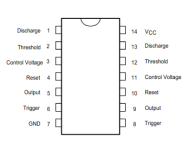
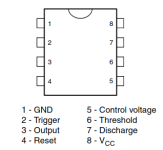
Curious if anyone who's done a dual-relay/switch board has ever used an NE556 to run both instead of two NE555 timers? Anything preventing one from going that route? the 556 is basically only in SMD footprint these days, though Tayda still has a few TH.
In terms of basic operation, or for more advanced functions? If I'm looking at the ppcb advanced relay as an example, the only thing that piques my interest from its features is the auto-power-on. At least now, but sell me on the other features.
At present I have a swath of non-latching relays and 555s that need to be used, but sell me on the MCU path for the future.
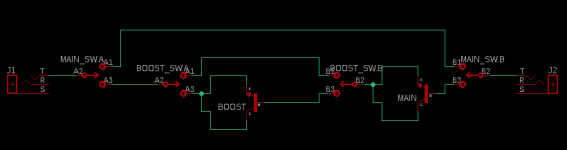
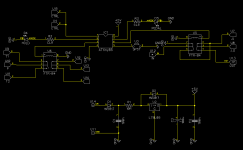
The current application is (forgive the shorthand for "circuit" being a PNP BJT...):
But really I'm just concerned that using a 556 will give me grief in the context of dirt simple switching; no frills.
Hey, I'm curious about the ease of use with an MCU. Do you have a specific post/thread I could dig into?
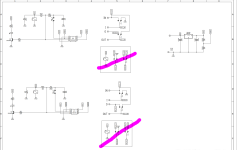
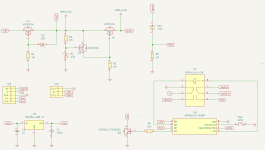
I think I might be running into complications with the design I've implemented---although I'm using two timers, not a dual timer. After talking to a couple of people I'm thinking that because I'm sharing VREF that it is triggering both relays at once. Here's the schematic; I took Robert's simple relay, modified and doubled it.
Modifications are to accommodate a second relay footprint (in the crossed off boxes) for a stock of relays I need to use up, and the pin numbers on the timers are for a combo TH SMD footprint.
For this, I'm wondering if two completely separate supplies are required: VCC, VREF, GND or if only VREF needs to be separate for each.
Again, interested in the post/thread about dual relays by MCU for future use. Thanks.
edit: clarification for the switching situation, either footswitch triggers both relays at once.
The MCU approach is just easier to implement. I did this 2 years ago, so my memory is a little fuzzy on it. It used a single footswitch, so you have to decide how you want to trigger the second channel. I decided on hold for X seconds, which means you trigger the relay on open of the footswitch instead of close. This is "ok" but ultimately I decided that two relays is better with two switches.