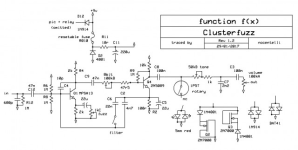
Clusterfuzz / Figbuster

ianmarks

Active member
Curious as to what makes the 8-bit control do what it does. Is the second transistor just "overloaded" by the first transistor and the resistance of the control prevents it from doing so? If so, is that due to the first transistor's gain? I want it to do what it does but more.

1769028074733.png
 
I'm still wonderin' about that 47r5 resistor! Why that exact value?

I also love that 8-Bit control, and I'm not sure why it hasn't been incorporated into any other fuzz designs... maybe it has..? @bean may have the answers!
 
I'm still wonderin' about that 47r5 resistor! Why that exact value?

I also love that 8-Bit control, and I'm not sure why it hasn't been incorporated into any other fuzz designs... maybe it has..? @bean may have the answers!

IIRC, it's 47R. The R5 might have been the component designation. Forrest designed the circuit and it's a banger. My one contribution was adding the two filter caps in the feedback path of the first two transistors. Everything else was him and it's still one of my favorite buzzes.

The 8-bit controller reduces current flow to the base of the 2n5089 so it ends up being a crude bias control (but in a good way). It's a similar effect to adding additional resistance in the feedback path of a traditional Fuzz Face.
 
Thanks Brian. I know at minimum resistance on the 8bit control is where the misbias happens the most, so can't really make the pot bigger to achieve more. I guess I will fiddle with the collector resistor a bit and see if there is some wiggle room there. That's funny about r5. I read it as a 47.5ohm too and was like no way I'm ordering a special resistor for that, lol. I was really pleasantly surprised with this build and will probably try for another filter capacitor to use with on/off/on toggle and narrow down the clipping options to do an on/off/on with resistors to even out the volume when changing.
 
Thanks Brian. I know at minimum resistance on the 8bit control is where the misbias happens the most, so can't really make the pot bigger to achieve more. I guess I will fiddle with the collector resistor a bit and see if there is some wiggle room there. That's funny about r5. I read it as a 47.5ohm too and was like no way I'm ordering a special resistor for that, lol. I was really pleasantly surprised with this build and will probably try for another filter capacitor to use with on/off/on toggle and narrow down the clipping options to do an on/off/on with resistors to even out the volume when changing.

I haven't tried this but you could mess with the collector/base feedback resistor (1M). Try both higher and lower values to skew the overall "feel" of the 8bit control.

We toyed around with redesigning the Filter switch to make it produce more of a "parked wah" tone but it never went anywhere. This was just a couple years ago but I haven't spoken to the team in a while since everyone is doing their own thing right now.
 
My one contribution was adding the two filter caps in the feedback path of the first two transistors.
I really need to add that Filter to a Fig Buster at some point - always felt like I was missing out! That parked wah idea sounds pretty cool...

The 8-bit controller reduces current flow to the base of the 2n5089 so it ends up being a crude bias control (but in a good way). It's a similar effect to adding additional resistance in the feedback path of a traditional Fuzz Face.
Ah so it is kinda like the Mammoth's Pinch control - the difference being that a FF usually has this control between Q1's base and Q2's emitter, whereas the Clusterfuzz has it between Q1's collector and Q2's base.

*I'll also add that Brian gave me tips to reduce some noise on the circuit, and they were very helpful (I don't have the link handy, but it's on the forum... somewhere). You might sacrifice a tiny bit of "edge", but if you live in a noisy environment they're worth considering at least.
 
@Feral Feline I don’t really know what Gerbers are, no computer, but I gonna thank you anyways my friend. Starting to think I finally may be missing out by not having a computer lol.
I'm pretty sure gerbers work on a phone too - they're basically the files you send to a PCB fabricator (a lot of people here use JLCPCB but there are others) so they print the PCB. That means you can download the gerbers, upload them to JLCPCB, and get your very own set of PCB's printed like that.

You get to pick the color too, and it's pretty cheap for a first time user at least, and even afterwards if you order multiple ones at a time to save on shipping. The downside is that it's usually 3 or 5 minimum, so you end up with extras, but if you have friends who also build pedals it might not be a bad thing.

 
I'm pretty sure gerbers work on a phone too - they're basically the files you send to a PCB fabricator (a lot of people here use JLCPCB but there are others) so they print the PCB. That means you can download the gerbers, upload them to JLCPCB, and get your very own set of PCB's printed like that.

You get to pick the color too, and it's pretty cheap for a first time user at least, and even afterwards if you order multiple ones at a time to save on shipping. The downside is that it's usually 3 or 5 minimum, so you end up with extras, but if you have friends who also build pedals it might not be a bad thing.
Is there an app needed to read or open Gerber files?
 
Is there an app needed to read or open Gerber files?
I assume so - if you have a machine that can print PCB's.

But if you're asking about it here, I assume you don't, so like most of us we don't do anything else with gerbers than download them from somewhere (or export in a PCB layout program) and then upload the files to a PCB fabrication site (like JCLPCB).
 
Back
Top