Abyss/The Depths Build

genXslacker

Member
Build Rating
3.00 star(s)
I put this one together over the weekend. It might wind up in Troubleshooting, because of rampant LFO issues, but I've read some pointers from @Chuck D. Bones regarding capacitor swap outs and higher gain transistors I'll try first. That said, in the narrow range that it works properly, I'm getting some lovely '60s tones out of it.

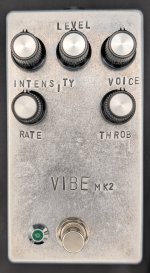
The cosmetics are my standard Fairfield poach. I'm glad Fairfield has normalized imperfect stamping, otherwise that wayward second "I" in "intensity" would drive me to distraction. It may still.

I usually get a little more creative with the naming, but I wasn't feeling it this time.

Vibe Mk2 overhead.jpg

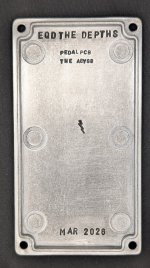
Inside lid:
Vibe Mk2 lid.jpg

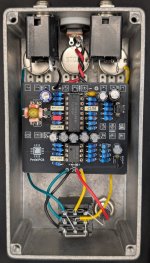
Posting the guts now before I butcher them with re-work:
Vibe Mk2 guts.jpg

My phone camera warps perspective when I take closeups. It's irritating when I know that some things are parallel or right angles and the photos don't reflect it. Oh well.

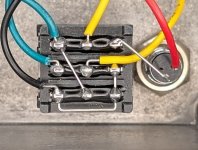
I've been working on upping my 3PDT game. Here's a better shot:

Vibe Mk2 footswitch.jpg

It's not perfect, but I feel like they're getting better every time I wire one. As I'm sure others can attest, straightening wire is a maddening endeavor. If anyone would like to offer their tips and tricks in that regard, I'm all ears.
 
Nice! I keep buying breakout boards but maybe I will graduate to this. Yours is very well done

Muchas gracias! I have stacks of those from multiple different vendors. I still use them sometimes, but I dig the look of the hand-wired switch.

And overdrive is definitely glorious. I'd build them all if I had the resources.
 
The stamps are so clean. Do you use just a punch and a hammer? Mine never look that good.

Thanks! Yeah, I use a punch set and hammer. I've definitely improved at it over time. Part of it is paying attention to how hard you're hitting the punches. For example, an "I" doesn't need as much force as a "B" due to the shape of the letters. The "I" goes in like a knife if you don't watch it. I'm still working on that. Also, larger sets require more force than smaller sets. I'm not getting any of that perfect, but at least I know that I need to be paying attention to that stuff now.

Another thing I've learned is that, if you didn't get an even stamp — like, one side is deeper/heavier than the other — you can carefully line the punch back up and restamp with a little more force on the shallower side. You line them up more by feeling that they're sliding back into the same "slots" than by eyeing them.
 
Looks stellar! Really specific question: how are you measuring the distance between lug 3 and lug 9? The connecting wire is really clean and the bends are precise.

Ah, shucks. Thank you. Usually I use a scrap piece of vero that is cut or snapped about halfway through one row of holes. Put a good right angle bend in one side of the jumper with pliers, then put that end through a hole of the vero that's the right distance from the snapped edge. Bend the previously unbent side around the snapped edge, through what was previously a hole before it was snapped. Remove the jumper from the vero and crisp that end up with tweezer pliers. It usually won't be quite as square as the first bend until you work it with pliers a bit.
 
Ah, shucks. Thank you. Usually I use a scrap piece of vero that is cut or snapped about halfway through one row of holes. Put a good right angle bend in one side of the jumper with pliers, then put that end through a hole of the vero that's the right distance from the snapped edge. Bend the previously unbent side around the snapped edge, through what was previously a hole before it was snapped. Remove the jumper from the vero and crisp that end up with tweezer pliers. It usually won't be quite as square as the first bend until you work it with pliers a bit.
Genius! Going to try that next time. Cheers!
 
The LFO on these by design will stall at either end of the rotation of the rate knob. I put a 2.7k ohm resistor on either end of the rate knob to establish a hard limit on its range. This solved the LFO issue. I did a bunch of research and found that EQD themselves acknowledge this is a design fault of the LFO circuit they used
 
The LFO on these by design will stall at either end of the rotation of the rate knob. I put a 2.7k ohm resistor on either end of the rate knob to establish a hard limit on its range. This solved the LFO issue. I did a bunch of research and found that EQD themselves acknowledge this is a design fault of the LFO circuit they used

Thanks for chiming in. I've actually been reading through your experiences with it since I built it. I've already replaced Q1 with an MPSA13 and the relevant 1μf caps with tantalum.

You will not be shocked to know that those things didn't eliminate the problem, though they did mitigate it some. I may be trying your resistor fix next.

I'm also getting more hiss out of it than I'd like, especially when getting the Voice knob past noon. In your experience should I be look for a culprit there, or is that just the circuit? It was there before I put the higher gain MPSA13 in Q1, but that certainly didn't help.
 
Back
Top