Old Fashioned (Skreddy/Animals Major Overdrive)

MattG

Well-known member
Build Rating
5.00 star(s)
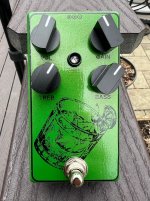
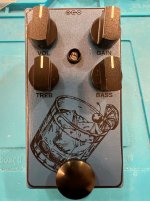
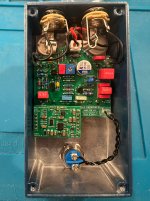
Here's my take on the @HamishR & @Chuck D. Bones collaboration, the Old Fashioned, which is a tweaked Animals/Skreddy Major Overdrive. It's a YASF (Yet Another Skreddy Fuzz), based on the same topology as the Lunar Module (PPCB Aldrin Fuzz), Screwdriver, Hybrid Fuzz Driver, etc. My long-running favorite YASF is Chuck's Modified Animals Diamond Peak (also sold as the Skreddy Hybrid Drive, not to be confused with the Hybrid Fuzz Driver). I actually bought the COTS Animals Major Overdrive many years ago with the intent of tracing it, but never got around to it. My laziness paid off, because @HamishR did the work for me!

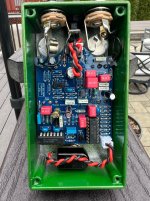
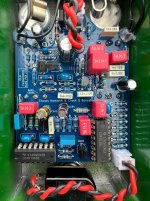
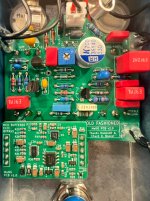
Like the Churl of Toan I posted last night, the actual effect doesn't have a lot of components, and the majority of the PCB is cluttered with the overkill features I like to include: P-MOS reverse polarity protection, extra PSU filtering, buffered electrical bypass. Since this is a transistor-based circuit, instead of using an opamp for the buffer, I opted for a bootstrapped NPN BJT (i.e. the Cornish buffer). I didn't make room for the RF filter that I used on the Churl of Toan.

For the "money" transistors Q2 and Q3, I used 2n3903 with HFEs of 140 and 94, respectively. The actual Major OD that HamishR traced, as well as the one I never got around to tracing, used 2n5172 transistors. I have some 2n5172 that I got from AliExpress, and their HFEs are all over the map. It's possible this is the nature of these particular transistors, or it's possible I have fakes or factory seconds, given the source. Neither Mouser USA nor DigiKey stock these. In other YASF designs, we use low-gain silicon or germanium transistors for Q2/Q3. @MichaelW used 2n3904 in his Old Fashioned build (per this comment). I actually used 2n3903 because I mis-remembered what Mike used - I only now realize he used 2n304. Whatever, it sounds great with 2n3903!

Everything worked perfectly on first power-up. I put it side-by-side with my Hard Rock Pinnacle (i.e. modified Diamond Peak), which has been on my board longer than any other overdrive, by a huge margin. It's such a great circuit. To my ears, the Major OD has a more distinct mid-emphasis. I wouldn't call the Diamond Peak transparent, but to my ears, it is more EQ-neutral than the Major OD. The actual distortion character seems smoother in the Major OD, where it's a bit raspier in the Diamond Peak. The core topology of these circuits is essentially a treble booster pushing a fuzz, but it's really versatile in terms of voicing. With the gain of the Major OD rolled back below 10:00 or so, it actually gets in the neighborhood of a Bluesbreaker/Prince of Tone voice (I noticed this because I was testing it right next to my just-built Churl of Toan). With single coils, using similar drive levels, the Major OD is a bit noisier than the Diamond Peak.

The obvious question is, which do I like better, the Diamond Peak or the Major OD? Too soon to tell! The Diamond Peak is a long-time favorite, it's going to be hard for me to replace it. But I really like the Major OD too, it feels familiar but has a different-enough vibe that I might rock for a while.

I have spare PCBs, I'm happy to send one to anyone who asks, just DM me.

Edit: I forgot to mention: the enclosure was last year's limited-edition St Pat's day green enclosure from @StompBoxParts. I'm a year late, but right on time for this enclosure! I used a Sunnyscopa waterslide decal for the graphics. It took two tries, as I mentioned here. I still didn't get 100% transfer on the second try, but I had basically zero transfer on the first try. The little bit that didn't transfer gives it a bit of a relic'ed look.

Edit2: Fix dumb typo: YASZ -> YASF.
 

Attachments

  • IMG_2753.jpg
    IMG_2753.jpg
    503.4 KB · Views: 38
  • IMG_2755.jpg
    IMG_2755.jpg
    440.3 KB · Views: 39
  • IMG_2756.jpg
    IMG_2756.jpg
    412.3 KB · Views: 39
Last edited:
Looks great! Glad you got your pcb ready. Not gonna lie I’ve been wanting to build this for the longest but all that extra circuitry looks a little intimidating!
 
Looks great! Glad you got your pcb ready. Not gonna lie I’ve been wanting to build this for the longest but all that extra circuitry looks a little intimidating!

It's basically just more parts. It actually makes the build quicker/easier in my opinion, as having the bypass mechanism integrated into the actual effect PCB means less off-board wiring (which I always find tedious and overly time-consuming). Wire up the I/O jacks, power and the footswitch, and you're done! Even simpler if you use the JST headers like did (for power and the switch). The electrical bypass uses CD40106 and CD4053 integrated circuits, which are current production, readily-available, cheap parts.

Wiring it for true bypass with a 3PDT switch is doable, i't just a matter of identifying the PedalPCB "IN GND SW OUT"-equivalent points on the PCB. If you do that, it would eliminate roughly half the parts (maybe slightly more). @MichaelW did exactly that with a different PCB I sent him. Looks weird, but works just fine!
 
Here's my take on the @HamishR & @Chuck D. Bones collaboration, the Old Fashioned, which is a tweaked Animals/Skreddy Major Overdrive. It's a YASZ (Yet Another Skreddy Fuzz), based on the same topology as the Lunar Module (PPCB Aldrin Fuzz), Screwdriver, Hybrid Fuzz Driver, etc. My long-running favorite YASZ is Chuck's Modified Animals Diamond Peak (also sold as the Skreddy Hybrid Drive, not to be confused with the Hybrid Fuzz Driver). I actually bought the COTS Animals Major Overdrive many years ago with the intent of tracing it, but never got around to it. My laziness paid off, because @HamishR did the work for me!

Like the Churl of Toan I posted last night, the actual effect doesn't have a lot of components, and the majority of the PCB is cluttered with the overkill features I like to include: P-MOS reverse polarity protection, extra PSU filtering, buffered electrical bypass. Since this is a transistor-based circuit, instead of using an opamp for the buffer, I opted for a bootstrapped NPN BJT (i.e. the Cornish buffer). I didn't make room for the RF filter that I used on the Churl of Toan.

For the "money" transistors Q2 and Q3, I used 2n3903 with HFEs of 140 and 94, respectively. The actual Major OD that HamishR traced, as well as the one I never got around to tracing, used 2n5172 transistors. I have some 2n5172 that I got from AliExpress, and their HFEs are all over the map. It's possible this is the nature of these particular transistors, or it's possible I have fakes or factory seconds, given the source. Neither Mouser USA nor DigiKey stock these. In other YASZ designs, we use low-gain silicon or germanium transistors for Q2/Q3. @MichaelW used 2n3904 in his Old Fashioned build (per this comment). I actually used 2n3903 because I mis-remembered what Mike used - I only now realize he used 2n304. Whatever, it sounds great with 2n3903!

Everything worked perfectly on first power-up. I put it side-by-side with my Hard Rock Pinnacle (i.e. modified Diamond Peak), which has been on my board longer than any other overdrive, by a huge margin. It's such a great circuit. To my ears, the Major OD has a more distinct mid-emphasis. I wouldn't call the Diamond Peak transparent, but to my ears, it is more EQ-neutral than the Major OD. The actual distortion character seems smoother in the Major OD, where it's a bit raspier in the Diamond Peak. The core topology of these circuits is essentially a treble booster pushing a fuzz, but it's really versatile in terms of voicing. With the gain of the Major OD rolled back below 10:00 or so, it actually gets in the neighborhood of a Bluesbreaker/Prince of Tone voice (I noticed this because I was testing it right next to my just-built Churl of Toan). With single coils, using similar drive levels, the Major OD is a bit noisier than the Diamond Peak.

The obvious question is, which do I like better, the Diamond Peak or the Major OD? Too soon to tell! The Diamond Peak is a long-time favorite, it's going to be hard for me to replace it. But I really like the Major OD too, it feels familiar but has a different-enough vibe that I might rock for a while.

I have spare PCBs, I'm happy to send one to anyone who asks, just DM me.

Edit: I forgot to mention: the enclosure was last year's limited-edition St Pat's day green enclosure from @StompBoxParts. I'm a year late, but right on time for this enclosure! I used a Sunnyscopa waterslide decal for the graphics. It took two tries, as I mentioned here. I still didn't get 100% transfer on the second try, but I had basically zero transfer on the first try. The little bit that didn't transfer gives it a bit of a relic'ed look.
Hey Matt, I used 2n3904's just because. I did not think to dig deeper into the NPN spec's. But now I'm thinking about building a second one with sockets and try some lower gain NPN's. It made a pretty big difference on the Diamond Peak, I'm guessing it's going to make a difference on the Major as well. I have some 2N3903's as well but I think they're a little lower gain than yours. I also have a crap load of other lower gain NPN's when I fell down that rabbit hole building the Sheepy version of the Diamond Peak. (@Chuck D. Bones sent me the trannies for the DP build with your board.)
 
Yeah, I’m sure it’s worthwhile to do some transistor rolling in this Major/Old Fashioned circuit, given how they make such a noticeable difference in the Diamond Peak. I too have a collection of low gain silicon transistors that I amassed during my Diamond Peak building spree. The DP sounded good with everything I tried, but I did like some more than others.

I’ve already got a revision to this board queued up, when I build it, I plan to put multiple q2/q3 trannies on the casting couch. 😉
 
Hey man that's a pretty clean build. Is the polarity protection and electrical bypass proprietary?

Thank you! IMO, reducing offboard wiring makes for a cleaner build.

The polarity protection and electrical bypass are not proprietary; I credit RG Keen with their design. See Advanced Power Switching and Polarity Protection for Effects, and Bypassing and Switching with the CD4053 CMOS Analog MUX.

There's a great write-up on all kinds of reverse-polarity protection schemes (including RG Keen's P-channel mosfet scheme) on Rod Elliott's (ESP) site, see Reverse Polarity Protection.

I started a couple threads that have some more detail on the electrical bypass scheme, Buffered Electrical Bypass Module, and Plug-n-Play Buffered Electrical Bypass Using CD4053 and Momentary SPST.
 
Nice build! Also thanks for all those links. I was also interested in that polarity protection / bypass stuff you do in all of your builds. I've got some reading up to do 😁
 
@MattG
What MOSFET did you end up using? I keep getting conflicting info about BS250P and IRF9540.

For the reverse polarity protection, I'm using IRFU5305PBF. The specific mosfet doesn't matter too much, as long as it's p-channel. I picked the IRFU5305 because it had very low RDSon (resistance between drain and source when the transistor is "on"): 65 milliohms, and at the time, was one of the cheaper low-RSDon options. (To be fair, that RDSon is quoted at 16 amps which is at least 100x what it will see in a pedal!) I basically went to Digi-Key, mosfets, filter by p-channel, TO-92 or TO-251 packages, and then sort by increasing RDSon. Pick the lowest RDSon in your budget. Repeating that exercise just now, looks like today I'd probably buy this Alpha & Omega Semiconductor AOI21357, as it has lower RDSon and is cheaper than IRFU5305PBF.

Looks like the cheapest right now would be the Microchip VP2106N3-G with an RDSon of 12R. I usually have a series resistor on the power supply, anywhere from 10 to 100 ohms, depending on how much voltage drop I can tolerate... but I prefer that voltage drop to be a function of the series resistor (which is part of the PSU RC filter), rather than a function of a different part of the circuit. (On the other hand, there's an argument for a reduced component count when individual components can do multiple jobs.)

I first discussed this PMOS-based reverse polarity protection scheme in this build report.
 
Last edited:
Yeah, I’m sure it’s worthwhile to do some transistor rolling in this Major/Old Fashioned circuit, given how they make such a noticeable difference in the Diamond Peak. I too have a collection of low gain silicon transistors that I amassed during my Diamond Peak building spree. The DP sounded good with everything I tried, but I did like some more than others.

I had a HELL of a time breadboarding this one (6 iterations). Couldn't remember how to do the circuitry inline of the power rail (the 5.2 and 6.8 K resistors & etc.), kept making wiring and other dumb mistakes.

But after all that, I think Skreddy built a pretty bombproof circuit. The transistors I tried ranged from 20-85 hfe, I even installed some (metal can that I initially measured at 50-60 hfe but maybe I messed up and were in the 20s) backwards in Q3, and it still sounded pretty good and oddly clear.

Here's what I noticed were some trends: higher gain transistors as well as higher bias works, but it makes the circuit less organic/amp-like and more synthetic/ effect-like. (Also, one of my transistors at higher gain was creating amp-like feedback). The 4.35 bias for Q3 collector Chuck identified is a great baseline.

I ended up with a 48 hfe at Q2 [edit MPS 2369] and a 63 hfe [5330 185 PI] at Q3. I can relate the actual part # when I get home. To me it sounds very Marshall-ey. Like, I can find the * exact * AC/DC back in black tone (gain at 10:00, bass 12:00, treble 2:00).

To me, I like a lower Q2 because it gives a nice organic (maybe uneven or asymmetric?) quality to the distortion decay which sounds good to me, and doesn't lead to sudden crackly cut off to the clipping with gain at max.
 
Last edited:
Back
Top