For those of you who have breadboarded and/or built a bunch of circuits, please recommend a simple boost circuit that uses a single op-amp, and a simple boost circuit that uses a dual op-amp. I want to vero board those with ZIF sockets to pre-test op-amps before builds (I pre-test all other components with DMM or Peak).

You are using an out of date browser. It may not display this or other websites correctly.
You should upgrade or use an alternative browser.
You should upgrade or use an alternative browser.
Simple boost circuits to test op-amps
- Thread starter DDad
- Start date
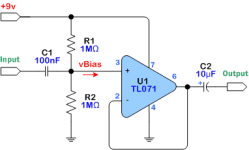
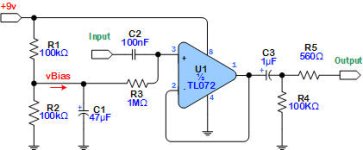
Thank you! So I could add a 3PDT switch to the 2nd schematic to flip between op-amps, correct?View attachment 117474
View attachment 117475
For the dual, swap pins 321 with 765 to test both channels
Source
But now that i think about it, why are the circuits different as far as bias resistors if I am just testing one op-amp in a dual at a time? Couldn't I test a half of dual with the 1st schematic also? I am assuming that one op-amp of a TL072 is the same as a TL071, maybe that is incorrect.
Last edited:

Robert
Reverse Engineer
My question is, why is the biasing different?
There is no reason you couldn't bias them both using either method.
With the TL072 you can bias the second stage by adding a single 1M resistor from the VREF voltage, rather than needing another pair...

Erik S
Well-known member
If you're just looking to weed out faulty components, I have one of these and have been happy with it.

 synthchaser.com
Synthchaser Op Amp Tester
By popular demand, I’ve made a run of the op-amp testers that I built and use in many of my videos. This tests many single, dual, and quad op-amps with standard pinouts. Each working op-amp…
synthchaser.com
Robert
Reverse Engineer
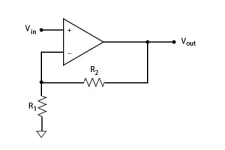
And another question - this is a buffer circuit. If I replace the direct connection between the output and the inverting input with a potentiometer, is that all I need to do to be testing with some gain instead of unity gain?
You'll also need to add a resistor to ground (or VREF).
The gain is 1 + (R2/R1).
Thank you!You'll also need to add a resistor to ground (or VREF).
The gain is 1 + (R2/R1).
View attachment 117477
Thanks, that looks nice, but I am full-on DIY mode as I enter partial retirement. I want to build something that I can hear an audio signal from, not just lights indicating it's good - even though I bet that unit tests for more than what I can hear.If you're just looking to weed out faulty components, I have one of these and have been happy with it.
Synthchaser Op Amp Tester
By popular demand, I’ve made a run of the op-amp testers that I built and use in many of my videos. This tests many single, dual, and quad op-amps with standard pinouts. Each working op-amp…
Oh ok my bad. I misread and thought you thought the tl071 was a dual op amp as well and were going to try the other half of that for some reason.Thanks, I understand that. My question is, why is the biasing different?
Biasing isn't really different.
10k/100k/1meg bias resistors all results in 1/2 Vcc. The dual opamp just has smoothing caps added
You will need two setups, one for single opamps and one for dual, unless you want to get into more jumpers and switches.
If you build these on vero and they are just out on the desk, you're likely going to pickup some noise. Having something like a grounded back plate or putting them in a grounded enclosure will help. Even something like an altoids tin will do.
Then again, if you're just doing a functional check and not testing thing like slew rate and GBW, it may not matter to you.
It may be worth adding in some headers/sockets for comp caps on your single opamp board.
10k/100k/1meg bias resistors all results in 1/2 Vcc. The dual opamp just has smoothing caps added
You will need two setups, one for single opamps and one for dual, unless you want to get into more jumpers and switches.
If you build these on vero and they are just out on the desk, you're likely going to pickup some noise. Having something like a grounded back plate or putting them in a grounded enclosure will help. Even something like an altoids tin will do.
Then again, if you're just doing a functional check and not testing thing like slew rate and GBW, it may not matter to you.
It may be worth adding in some headers/sockets for comp caps on your single opamp board.
Thank you! I think for now I just want to make sure they are not dead and can amplify a signal. Not that I have had a dead one yet, but I like to make sure all parts are correct values/working so that I know I can focus on my assembly and soldering if I run into an issue. And it's another project to add to my retirement hobby list  This forum is way cool, love it!
This forum is way cool, love it!