Where to go next? Wanting to expand my knowledge

Itsmedant

Member
I've been slowly learning how to build pedals by doing the clones here from PedalPCB, reading though a bunch of threads and trying to get my soldering and wiring skills down as good as possible. I've gotten 5 builds done and they've all worked perfectly right away, except one which I quickly realized I put a transistor in backwards!

I've been slowly teaching myself about each of the components and what they actually "do" to the sound/circuit but want to go deeper to fully understand pedals and gear like this. I probably would be totally lost in troubleshooting and tracking down issues on my own so I know I need to learn that skill alot more.

My question is: Where do I go from here? What resources should I start looking into? How do I push myself to get more efficient and learn more about pedal building?
My end goal: Design my own pedal circuits eventually.


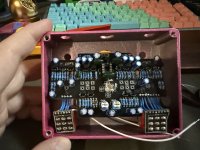
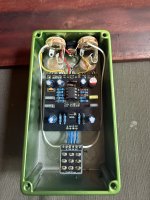
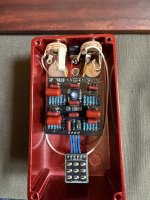
Here are a few gut shots of the last 3 pedals I finished:
Almost finished Echovibe
IMG_4856.jpg
Bellum Fuzz
IMG_4855.jpg
Muroidea Distortion
IMG_4854.jpg
 
DOWNLOAD LTSPICE

LTSPICE allows modelling of circuits and IMO is a great way to follow what ifs and have fun "playing" with electronics

Some Books and Websites

Small Signal Audio Design by Douglas Self is a great resource for familiarizing oneself with circuits.

If you like tedium, Art of Electronics is VERY informative.

https://www.electronics-tutorials.ws/ Everything here is useful for designing circuits.

https://www.allaboutcircuits.com/video-tutorials/ Another website

Khan Academy LOL.....

https://sound-au.com/articles/index.htm My personal favorite

Electrosmash website

GEO FX website


Study the schematics on here.


In terms of curriculum, there's obviously more to bite off than can be chewed at one time. Pace yourself.


I would reccommend learning topologies first such as

Buffer opamps
Non inverting opamp (think tubescreamers and Rats)
Inverting opamp (think summers and MFB filters)
common emitter amplifier (BJT, big muffs)
Common source amplifier (FET, every AIB on pedalpcb LOL)
Source follower (FET, buffer)
Emitter follower (BJT, buffer)

For filters:
Baxandalls and James
Fender style passive stacks
Bridged T and Twin T notches
Gyrator EQs GYRATORS are VERY USEFUL
Big muff stacks

Musical Clipping can be done many ways but most commonly:
Shunt diodes to "gnd"
Diodes in feedback loop of opamp (big difference depending on non inverting or inverting opamp)
JFET stages
Vacuum tube stages
Opamp clipping (🤮)
MOSFETs (diode connected mosfets too, think zen drive)
OTAs
 
Thanks for the advice!! I think I'll start going through the topologies and breadboard them all out one by one to see what they are doing on there.

I'm going to get LTSPICE too and start learning that.

You've added alot to my reading list!
 
The JHS youtube channel has a series called Short Circuit where they explain and breadboard a few of the classic basic circuits. He goes thru it slowly and in detail and it's easy to follow. He explains what different parts do and how they change the signal. I'd watch a few of those and get a breadboard for yourself so you can follow along.
 
Some useful back pocket theory/equations

Ohms law
Kirchoffs voltage and current laws
F_-3db = 1/(2*pi*r*c)

Impedance of capacitor goes to infinity as frequency decreases, goes to 0 as frequency increases

Inductor impedance is opposite of capacitor
 
Oh dang I never saw that playlist before! This will be fun!

I have the BB1 from Wampler so it’s quick and easy to plug into a breadboard now
it's what got me into building. I was ready to shell out 279 for a Skreddy lunar module and then came across that series where he builds a fuzz face really simply and for like a dollar and I was like :unsure:
 
If you don't have an oscilloscope think seriously about getting a decent one and learning to use it.

Troubleshooting, very simplified, is basically knowing what a circuit should do, and figuring out where and why its not. You are already working on the first part. Don't worry, as you breadboard and/or build you'll have ample opportunities to do the second part.
 
If you don't have an oscilloscope think seriously about getting a decent one and learning to use it.

Troubleshooting, very simplified, is basically knowing what a circuit should do, and figuring out where and why its not. You are already working on the first part. Don't worry, as you breadboard and/or build you'll have ample opportunities to do the second part.
I would love a scope but I'm intimidated by the up front cost. Is there a "value" one out there that would have the features I'd need for a pedal but is less expensive? It's hard to justify as a "sometimes" tool.
 
If you don't have an oscilloscope think seriously about getting a decent one and learning to use it.

Troubleshooting, very simplified, is basically knowing what a circuit should do, and figuring out where and why its not. You are already working on the first part. Don't worry, as you breadboard and/or build you'll have ample opportunities to do the second part.
I bought a cheap component tester that has a scope built in but not sure how great it is. From the advertised ranges of frequencies, it seems like it would work?

 
I would love a scope but I'm intimidated by the up front cost. Is there a "value" one out there that would have the features I'd need for a pedal but is less expensive? It's hard to justify as a "sometimes" tool.
It depends on what you consider "value" cost wise. The o'scope I got, a FNIRSI, is around $200 now on Amazon and it's a pretty capable scope considering the price. I also build Tube Amps so it was easier for me to justify. When used in conjunction with an audio probe, especially when breadboarding, you can both see and hear what's going on with a circuit, as well as see and hear what a change in the circuit does.

I bought a cheap component tester that has a scope built in but not sure how great it is. From the advertised ranges of frequencies, it seems like it would work?

It certainly will work frequency-wise. Human hearing goes up to ~20KHz, that scope up to 10MHz which = 10,000KHz. But that is a small screen so you will be limited on the details you will see compared to a larger screen. I will say it is better than nothing and if it works for YOU isn't that what really matters? The signal generator can be very useful. After looking at the specs closer, it looks to be a pretty capable scope considering the price. My biggest gripe about it would be screen size with my 60 year old eyes LOL.
 
It depends on what you consider "value" cost wise. The o'scope I got, a FNIRSI, is around $200 now on Amazon and it's a pretty capable scope considering the price. I also build Tube Amps so it was easier for me to justify. When used in conjunction with an audio probe, especially when breadboarding, you can both see and hear what's going on with a circuit, as well as see and hear what a change in the circuit does.


It certainly will work frequency-wise. Human hearing goes up to ~20KHz, that scope up to 10MHz which = 10,000KHz. But that is a small screen so you will be limited on the details you will see compared to a larger screen. I will say it is better than nothing and if it works for YOU isn't that what really matters? The signal generator can be very useful. After looking at the specs closer, it looks to be a pretty capable scope considering the price. My biggest gripe about it would be screen size with my 60 year old eyes LOL.
My eyes have been able to see everything else on it so far. I used it to pick out some GT402 transistors for a fuzz I'm building for the first time the other day and it works pretty quickly!

I'll try to breadboard something out tonight and scope some stuff to see how it works
 
If you upgrade, get a high voltage one so you can do tubes if you want!
That';s the exact reason I wanted to upgrade! I have a Son of Yeti kit from Ceriatone that I've been slowly putting together, I'm at the step where I need to start wiring up the transformer so I'll need a decent meter for that! I think it needs to be Class III, and mine is just a class II.
 
My question is: Where do I go from here? What resources should I start looking into? How do I push myself to get more efficient and learn more about pedal building?
My end goal: Design my own pedal circuits eventually.
DIYers these days are both blessed and cursed with access to hundreds if not thousands of amazing and well-documented pedal projects, where all you have to do is buy the PCB and put it together. This makes it incredibly easy to build a functional pedal, even a reasonably complex one, on your first try.

The downside is that it's become increasingly easy to build pedals without understanding how pedals work. You can become a skilled assembler with no knowledge of what's going on in the circuit, building loads of pedals without even reading a schematic. There's nothing inherently wrong with this if building pedals is your end goal, but if you want to understand enough to design your own pedals, you're going to need to reach past available projects.

My first piece of advice if you haven't already, learn to read a schematic. You need to know what the components are and what they look like, acknowledging that there can be variations based on software and whoever drew them. Once you've done that, the next step would be to devour all the schematics you can get your hands on. This does the same thing for you that reading books does in learning a language: you'll start to recognize patterns, see common ways to do things, and when odd things do present themselves you'll recognize them as being odd so you can look them up and figure out what's going on. Granted this isn't as easy as grabbing a dictionary, but the aforementioned Ohm's and Kirchoff's laws are a great starting point for general circuit analysis and will never stop being pertinent.

Once you've consumed enough schematics to start recognizing patterns and common circuit blocks, a logical next step would be to combine some blocks into something you might like. Maybe you're a big fan of the Rat but want to try a different tone control, maybe you want a Tubescreamer with a boost on the front end. Take building blocks of circuits you've seen and smash them together into something else. Compare your schematic with schematics you've seen that have common building blocks and compare how you implemented it with how it was done before.

Once you have a schematic that makes some sense, take it to the breadboard. Now breadboarding can be considered a skill all its own, as there are tips and tricks that make the process more convenient, but with your schematic as a guide you should be able to put some things together and make some noise. One benefit to breadboarding is that you're not constrained to using the input or output as drawn in the schematic, you can try just putting together one piece at a time to hear how that piece sounds, then add blocks in until you like the sound. It's important though that any changes you make during breadboarding also make their way back to your schematic so you can revise it to match the circuit you actually built.

Once you have a breadboarded design that's been verified, the next reasonable step would be to swing a PCB design, but the details of that are way out of scope for this already-too-long reply.

As you continue to do mashups of other circuits you'll start to understand more of how things work in the abstract, and at that point you can stop saying "I want this to sound like a Muff" and start saying "I think cascading another NPN stage here would give me the saturation I'm looking for." And at that point, my dude, the world is your oyster. That's when the hobby starts to get reeeaaalllly expensive. 💸

Hopefully something in there is useful, I like talking about pedal stuff and I get carried away sometimes :rolleyes:
 
DIYers these days are both blessed and cursed with access to hundreds if not thousands of amazing and well-documented pedal projects, where all you have to do is buy the PCB and put it together. This makes it incredibly easy to build a functional pedal, even a reasonably complex one, on your first try.

The downside is that it's become increasingly easy to build pedals without understanding how pedals work. You can become a skilled assembler with no knowledge of what's going on in the circuit, building loads of pedals without even reading a schematic. There's nothing inherently wrong with this if building pedals is your end goal, but if you want to understand enough to design your own pedals, you're going to need to reach past available projects.

My first piece of advice if you haven't already, learn to read a schematic. You need to know what the components are and what they look like, acknowledging that there can be variations based on software and whoever drew them. Once you've done that, the next step would be to devour all the schematics you can get your hands on. This does the same thing for you that reading books does in learning a language: you'll start to recognize patterns, see common ways to do things, and when odd things do present themselves you'll recognize them as being odd so you can look them up and figure out what's going on. Granted this isn't as easy as grabbing a dictionary, but the aforementioned Ohm's and Kirchoff's laws are a great starting point for general circuit analysis and will never stop being pertinent.

Once you've consumed enough schematics to start recognizing patterns and common circuit blocks, a logical next step would be to combine some blocks into something you might like. Maybe you're a big fan of the Rat but want to try a different tone control, maybe you want a Tubescreamer with a boost on the front end. Take building blocks of circuits you've seen and smash them together into something else. Compare your schematic with schematics you've seen that have common building blocks and compare how you implemented it with how it was done before.

Once you have a schematic that makes some sense, take it to the breadboard. Now breadboarding can be considered a skill all its own, as there are tips and tricks that make the process more convenient, but with your schematic as a guide you should be able to put some things together and make some noise. One benefit to breadboarding is that you're not constrained to using the input or output as drawn in the schematic, you can try just putting together one piece at a time to hear how that piece sounds, then add blocks in until you like the sound. It's important though that any changes you make during breadboarding also make their way back to your schematic so you can revise it to match the circuit you actually built.

Once you have a breadboarded design that's been verified, the next reasonable step would be to swing a PCB design, but the details of that are way out of scope for this already-too-long reply.

As you continue to do mashups of other circuits you'll start to understand more of how things work in the abstract, and at that point you can stop saying "I want this to sound like a Muff" and start saying "I think cascading another NPN stage here would give me the saturation I'm looking for." And at that point, my dude, the world is your oyster. That's when the hobby starts to get reeeaaalllly expensive. 💸

Hopefully something in there is useful, I like talking about pedal stuff and I get carried away sometimes :rolleyes:

Dude, this is awesome advice. Everything everyone has given me on this thread is super helpful.

I've been printing off every schematic with the PPB builds I've done and have been comparing everything, I know all the symbols and such, I understand Ohm's law but never heard of the other one so looking into that! I think I'm going to try and trace through a simple schematic and draw on it "This resistor drops the voltage by X amount" and work my way through it.

I started watching the JHS short circuit videos last night, the first one where he goes over the boost really broke down alot even though it was a simple schematic. Like for example, I had no clue that the transistor takes 1/2 the circuits voltage, so those first resistors right after input split the voltage in half to feed into the base.
 
Back
Top