Where to go next? Wanting to expand my knowledge

In my first few years, I included some type of mod on the original circuit (extra switch, knob, change clipping diodes, etc) on every single pedal I built. That's a way to learn a bit at a time as you go.

The Electrosmash Tube Screamer article was very helpful for me. The non-inverting op amp block comes up so frequently, often with bass cut, so it's helpful to be really familiar with that.
 
Once you've consumed enough schematics to start recognizing patterns and common circuit blocks…
This is something that hasn’t totally happened for me just from looking at regular schematics.

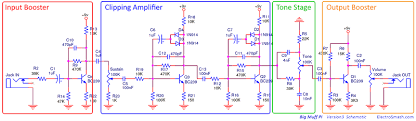
I definitely prefer the Electrosmash style ones with the different circuit chunks marked out:
IMG_0679.png

Wish there was a big repository of those somewhere.
 
Last edited:
I've been slowly learning how to build pedals by doing the clones here from PedalPCB, reading though a bunch of threads and trying to get my soldering and wiring skills down as good as possible. I've gotten 5 builds done and they've all worked perfectly right away, except one which I quickly realized I put a transistor in backwards!

I've been slowly teaching myself about each of the components and what they actually "do" to the sound/circuit but want to go deeper to fully understand pedals and gear like this. I probably would be totally lost in troubleshooting and tracking down issues on my own so I know I need to learn that skill alot more.

My question is: Where do I go from here? What resources should I start looking into? How do I push myself to get more efficient and learn more about pedal building?
My end goal: Design my own pedal circuits eventually.
IMO, building any pedal from a PCB with a build document or even building vero/stripboard circuit projects are little more than painting by numbers. Little understanding of "electronics" is required and only needs to know bit about the various components and how to source them.

So, to "expand your knowledge" we would need to know at what level you're at with a fundamental understanding of electronics. Especially when it comes to designing your own pedal circuits. That will give us a better idea of where you're at, electronically speaking. But for the most part, reading books on 'basic electronics', 'power supplies', 'audio circuits', 'opamps', and a whole assortment of electronic "Cookbooks" is a good place to continue your sojourn.
 
I'm surely disappointed..... Out of all the people here behaving and giving decent advice and not one of us smartasses are telling you where to really go.... :ROFLMAO:
 
IMO, building any pedal from a PCB with a build document or even building vero/stripboard circuit projects are little more than painting by numbers. Little understanding of "electronics" is required and only needs to know bit about the various components and how to source them.

So, to "expand your knowledge" we would need to know at what level you're at with a fundamental understanding of electronics. Especially when it comes to designing your own pedal circuits. That will give us a better idea of where you're at, electronically speaking. But for the most part, reading books on 'basic electronics', 'power supplies', 'audio circuits', 'opamps', and a whole assortment of electronic "Cookbooks" is a good place to continue your sojourn.
I have a basic understanding of electronics, I understand what resistance is, capacitance, I understand ohms law (adding a resistor changes the voltage etc etc) I’ve messed with a lot of LEDs and arduinos in the past like building LEF structures, powering them and then programming them with the arduino. Big fan of IoT stuff (it’s what I actually specialize in at my job), but once it gets to full audio circuits and the “why” behind things, like why you use a certain cap at a certain spot or why a certain transistor/diode causes a certain sound. Basically breaking them down into those blocks like @pricklyrobot posted I would imagine would be my end goal. And then how do I change things or build things to sound the way I want them to sound.
 
I have a basic understanding of electronics, I understand what resistance is, capacitance, I understand ohms law (adding a resistor changes the voltage etc etc) I’ve messed with a lot of LEDs and arduinos in the past like building LEF structures, powering them and then programming them with the arduino. Big fan of IoT stuff (it’s what I actually specialize in at my job), but once it gets to full audio circuits and the “why” behind things, like why you use a certain cap at a certain spot or why a certain transistor/diode causes a certain sound. Basically breaking them down into those blocks like @pricklyrobot posted I would imagine would be my end goal. And then how do I change things or build things to sound the way I want them to sound.
Sounds like you just need more time & experience. I think breadboarding, with its ease of component swapping, is an excellent path to pursuing greater understanding of more complete circuits in your case. Troubleshooting broken pedal circuits is also an excellent way to learn more. Collecting the information provided by schematics & circuit layouts, and hearing what is happening with our ears is what builds the information we store in our heads to achieve greater understanding. I think you're goona do just fine by continuing to read and do. ;)
 
Sounds like you just need more time & experience. I think breadboarding, with its ease of component swapping, is an excellent path to pursuing greater understanding of more complete circuits in your case. Troubleshooting broken pedal circuits is also an excellent way to learn more. Collecting the information provided by schematics & circuit layouts, and hearing what is happening with our ears is what builds the information we store in our heads to achieve greater understanding. I think you're goona do just fine by continuing to read and do. ;)
I do have an MXR carbon copy that isn’t delaying anymore! I can try to see if I can fix that one soon!

I got my breadboard set up and built the boost in JHS’s first video and it worked out fine
 
I do have an MXR carbon copy that isn’t delaying anymore! I can try to see if I can fix that one soon!

I got my breadboard set up and built the boost in JHS’s first video and it worked out fine
Once you a solid working circuit on the breadboard, check the schematic and start futzing with different values in places to hear what happens. The 'whole circuit' will slowly start to make sense, and soon you'll be able to suss out the different sections of a schematic just by looking at it. Still, that will take time to get good (more accurate) at it. You're on the right track.
 
Once you a solid working circuit on the breadboard, check the schematic and start futzing with different values in places to hear what happens. The 'whole circuit' will slowly start to make sense, and soon you'll be able to suss out the different sections of a schematic just by looking at it. Still, that will take time to get good (more accurate) at it. You're on the right track.
I have a few fuzzs I’ve made too so I plan on breadboarding the pickup simulator tomorrow too to see how it changes the sound of the fuzzs.

This is exciting to see some progress on the horizon!
 
I have a basic understanding of electronics, I understand what resistance is, capacitance, I understand ohms law (adding a resistor changes the voltage etc etc) I’ve messed with a lot of LEDs and arduinos in the past like building LEF structures, powering them and then programming them with the arduino. Big fan of IoT stuff (it’s what I actually specialize in at my job), but once it gets to full audio circuits and the “why” behind things, like why you use a certain cap at a certain spot or why a certain transistor/diode causes a certain sound. Basically breaking them down into those blocks like @pricklyrobot posted I would imagine would be my end goal. And then how do I change things or build things to sound the way I want them to sound.
Sounds like you have a decent comprehension of DC theory. Analog and AC is where the magic of sound happens. If you haven’t already, I suggest studying AC theory.
 
I've been slowly learning how to build pedals by doing the clones here from PedalPCB, reading though a bunch of threads and trying to get my soldering and wiring skills down as good as possible. I've gotten 5 builds done and they've all worked perfectly right away, except one which I quickly realized I put a transistor in backwards!

I've been slowly teaching myself about each of the components and what they actually "do" to the sound/circuit but want to go deeper to fully understand pedals and gear like this. I probably would be totally lost in troubleshooting and tracking down issues on my own so I know I need to learn that skill alot more.

My question is: Where do I go from here? What resources should I start looking into? How do I push myself to get more efficient and learn more about pedal building?
My end goal: Design my own pedal circuits eventually.


Here are a few gut shots of the last 3 pedals I finished:
Almost finished Echovibe
View attachment 120809
Bellum Fuzz
View attachment 120808
Muroidea Distortion
View attachment 120807
Looks like you're well on your way already. I'll second the LTspice recommendation, but also be sure to lean on the excellent unofficial support forum and dig into lots of other circuits than just pedals too.

Then there's the swerve to toob theory, this forward looking site can keep you busy for a minute or two: https://www.tubecad.com/

And the mother lode for old school texts: http://www.tubebooks.org/technical_books_online.htm

My first Pedal PCB build had no documentation at the time so I just traced it myself and did an LTspice model. I could instantly see improvements for my use cases and never bothered to build to the original spec. It still needed some mods andt I already knew excactly what to change, but sometimes it's more fun to just swap in other parts and see what happens too. Finding your own work flow is a grand adventure, hope you enjoy the ride!
 
I have a basic understanding of electronics, I understand what resistance is, capacitance, I understand ohms law (adding a resistor changes the voltage etc etc) I’ve messed with a lot of LEDs and arduinos in the past like building LEF structures, powering them and then programming them with the arduino. Big fan of IoT stuff (it’s what I actually specialize in at my job), but once it gets to full audio circuits and the “why” behind things, like why you use a certain cap at a certain spot or why a certain transistor/diode causes a certain sound. Basically breaking them down into those blocks like @pricklyrobot posted I would imagine would be my end goal. And then how do I change things or build things to sound the way I want them to sound.
The beautiful thing about audio electronics is the blending of sound engineering/mixing into an otherwise objective field.

We forget how much of the field is using your ears and having an understanding of the circuit architecture as a signal chain; same as adding EQ and clipping in the DAW, just done with transistors and passives. I sometimes draft signal chains using Ableton stock plugins to determine shaping before I go to schematic. To me the fun part is that now everything becomes a "knob" to twist.

A lot of audio circuits are about deliberately breaking components and "bad" engineering such as the slew rate limiting in LM308s applying an amplitude dependent low pass.
 
I have a few fuzzs I’ve made too so I plan on breadboarding the pickup simulator tomorrow too to see how it changes the sound of the fuzzs.

This is exciting to see some progress on the horizon!
The pickup sim doesn't change the sound, rather it preserves the input impedance of the circuit. So when another pedal is in front of it, the guitar's volume control cleanup remains unaffected. Remember a proper fuzz circuit will cleanup a good bit when the guitar's volume is turned down. When you bread board the pickup sim, bypass it with another pedal in front of it and listen to what happens with the guitar's volume pot when turned down while the fuzz circuit is active.
 
Back
Top