Aleph Null
Well-known member
This all started with @jessenator giving me the business for using an enclosure larger than his preferred 1590B. I threatened to put a mosfet boost in a 1590XX just to spite him. That's not where I ended up, but the idea for this circuit did come to me while contemplating mosfets and revenge.

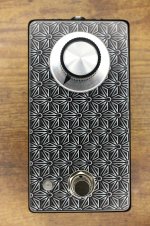
Polyphemus is a one-knob overdrive/distortion with internal voicing options that allow it to be tailored to a variety of rigs and use cases. The idea was, to do all the dialing in up front, then screw the thing shut and just rock! As it's built around a Super Hard On of sorts, it only seemed appropriate to name it after the original one-eyed monster!
The circuit consists of three gain/eq stages. The first stage is a high shelf filter that boosts everything above a set frequency by 20dB. Everything below that frequency stays at unity gain. The second stage is a simple mosfet boost, which is pushed by the first stage into clipping. The final stage is a low shelf, set at a similar frequency to the first. This flattens out the eq again. This makes for a “transparent” overdrive that emphasizes harmonics and retains clarity, since higher frequencies are saturated more and sooner. It also greatly lowers the noise floor!
Switches 1 and 2 set the capacitance/cut-off frequency in the HPF stage. Switches 3 and 4 set the capacitance/cut-off frequency in the LPF stage. HPF and LPF interact to shape the character of the gain, as well as the frequency response. Flat, transparent overdrive, various kinds of mid boost or treble boost, mid scoop, even distortion/fuzz is achievable. Heat sets the range of the Gain control. This is so that the headroom can be adjusted to suit your pickups and maximize the range of the Gain Control. Output is a volume control. With Heat dialed in, there is a moderate change in volume from the lowest to the highest Gain setting (maybe 6dB). I like to set Output so that the lowest Gain setting is about unity with bypass, but you could attenuate or boost to taste.
Here's a demo:
There's a little dedication to Jessenator on the PCB. I built mine in a 125B, as is my preference, but it'll fit into a 1590B with top mount jacks. Side jacks are possible, but you'd have to push the Gain knob up to accommodate them. And, of course, it's in green, Jessenator's preferred solder mask color.
As always, I have extra PCBs. If you're interested in building your own, just DM me.

Polyphemus is a one-knob overdrive/distortion with internal voicing options that allow it to be tailored to a variety of rigs and use cases. The idea was, to do all the dialing in up front, then screw the thing shut and just rock! As it's built around a Super Hard On of sorts, it only seemed appropriate to name it after the original one-eyed monster!

The circuit consists of three gain/eq stages. The first stage is a high shelf filter that boosts everything above a set frequency by 20dB. Everything below that frequency stays at unity gain. The second stage is a simple mosfet boost, which is pushed by the first stage into clipping. The final stage is a low shelf, set at a similar frequency to the first. This flattens out the eq again. This makes for a “transparent” overdrive that emphasizes harmonics and retains clarity, since higher frequencies are saturated more and sooner. It also greatly lowers the noise floor!

Switches 1 and 2 set the capacitance/cut-off frequency in the HPF stage. Switches 3 and 4 set the capacitance/cut-off frequency in the LPF stage. HPF and LPF interact to shape the character of the gain, as well as the frequency response. Flat, transparent overdrive, various kinds of mid boost or treble boost, mid scoop, even distortion/fuzz is achievable. Heat sets the range of the Gain control. This is so that the headroom can be adjusted to suit your pickups and maximize the range of the Gain Control. Output is a volume control. With Heat dialed in, there is a moderate change in volume from the lowest to the highest Gain setting (maybe 6dB). I like to set Output so that the lowest Gain setting is about unity with bypass, but you could attenuate or boost to taste.
Here's a demo:
There's a little dedication to Jessenator on the PCB.
I built mine in a 125B, as is my preference, but it'll fit into a 1590B with top mount jacks. Side jacks are possible, but you'd have to push the Gain knob up to accommodate them. And, of course, it's in green, Jessenator's preferred solder mask color.As always, I have extra PCBs. If you're interested in building your own, just DM me.