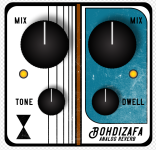
Available soon: Bodhizafa analog reverb

jubal81

Well-known member
Back in the olden days, there was a DIY project for a solid state version of the Fender 6G15 reverb unit. The company stopped selling the kits and PCBs, but the one I built is still my all-time favorite.

The Bodhizafa is a spin on that idea with some key reconfigurations. It's still very early in development, so the values you see in the schematic snippets I post are still in flux.

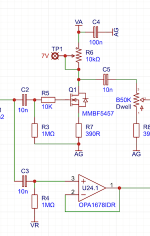
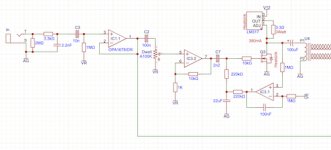
At the input, the dry signal is handled by an opamp to ensure maximum headroom, and the JFET boosters in the effect signal have trim pots for biasing.


Screenshot 2026-04-09 at 10.55.35 AM.png

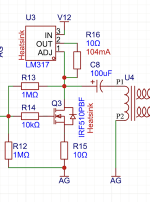
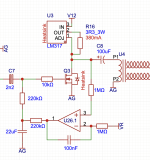
After some biasing tips from Chuck, I reconfigured the tank driving stage to use an LM317 and a single resistor as the constant current source on the drain of the power mosfet. It saves some parts and boosts performance.


Screenshot 2026-04-09 at 11.06.45 AM.png

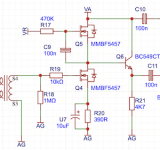
The recovery stage is a JFET mu-amp with a DC-coupled BJT buffer.

Screenshot 2026-04-09 at 11.10.11 AM.png

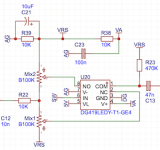
Instead of an effect bypass, I've got an electronic switch to select between two mix pots. You can always turn one fully off for a "bypass" setting. I plan to use RCA jacks for an external connection to a reverb tank, but the momentary switch makes it suited for mounting springs inside the enclosure. A "true bypass" switch can always be added by inserting it between the audio jacks and the PCB.

Screenshot 2026-04-09 at 11.16.11 AM.png

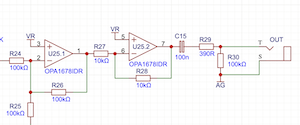
The mixing stage is active with the other half of the opamp correcting the output phase for the dry signal.


Screenshot 2026-04-09 at 11.19.32 AM.png

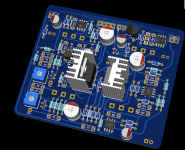
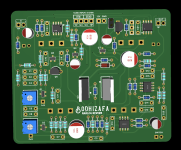
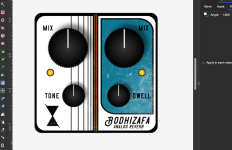
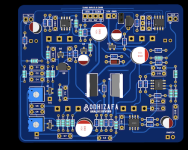
And here's a 3D render of my first draft of a PCB. It's sized to fit a 1590BB in portrait (hot dog) layout.

Screenshot 2026-04-09 at 11.24.32 AM.png
 
I built the kit from that company and of course it sucks tone like the Fender units. I read somewhere it's possible to soplit wet and dry with their own pot and avoid crosstalk with resistors but I've never gotten around to doing that mod.

This looks great. I think RCA jacks are a must because it's all in the 2-spring long pan.
 
I love it! Is this a project you'll be sharing or selling boards for, Jubal81?
Yeah, my hope is for DIYers to be able to build this.

I built the kit from that company and of course it sucks tone like the Fender units. I read somewhere it's possible to soplit wet and dry with their own pot and avoid crosstalk with resistors but I've never gotten around to doing that mod.

This looks great. I think RCA jacks are a must because it's all in the 2-spring long pan.
I modified mine a bit and added an output buffer, which helped a lot.

With the opamp buffer and active mixer design, this reverb won't "suck tone" at all.
 
PCB ordered.

Some of the parts require SMD. Once I get everything worked out, I'm thinking I'll just have JLC take care of that and have a pre-sale signup for those who want one.

Fingers crossed the mosfets and heatsinks will have enough headroom in a 1590BBS ...

Screenshot 2026-04-13 at 5.29.57 PM.png
 
Got it running today and it sounds great after some tweaking. Extremely low noise.
Hooked it up to my long, 2-spring tank and the boing is there.

A few obervations:
There is a huge gulf of power between nice, lush reverb and surfy boing.
With a bit of source and drain feedback and the current source set to 100mA, it gives a very lush reverb. The TO-220s only got a bit warm.

To get it surfing, I had to ditch the source feedback and crank the current up to 380mA. That meant manually dialing in the bias on the gate of the power mosfet. It also meant swapping input caps to get the high-pass filter to the low 300s Hz. That cutoff is very important. Having those low frequencies hitting the tank sounded awful.

Since the Mosfet needs biasing, I'm working on using opamps to servo bias all the things. Two more opamp ICs only adds 50 cents to the cost of each PCB, and it's worth it to me to not have to deal with trim pots.

I haven't tested the switching yet, so that's the next hurdle. It's looking REALLY good, though, and I had a blast playing with it today.


Screenshot 2026-05-05 at 5.24.39 PM.png
 
One of the things I love about DIY is doing things that would make an engineer spit coffee on his computer screen.
All those JFETs and support parts were just way over the top, though.
Besides, using a space heater to run audio through a guitar pedal is plenty high on the spit-take scale as it is.

Screenshot 2026-05-06 at 5.09.03 PM.png
 
Been poking at this thing all evening and I think I'm done. Hopefully I'll be able to test the code and switching tomorrow, along with breadboarding the servo bit.

View attachment 116744
No idea what any of that means but if this allows me to put a 1590bb pedal on my board and a 2-spring long pan off to the side, as opposed to my SB kit built in an old school toolbox that requires a separate wall wart and is not true bypass, I'm in.
 
No idea what any of that means but if this allows me to put a 1590bb pedal on my board and a 2-spring long pan off to the side, as opposed to my SB kit built in an old school toolbox that requires a separate wall wart and is not true bypass, I'm in.

Prepare to be happy.

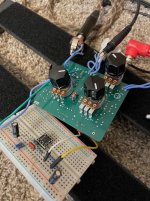
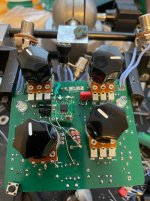
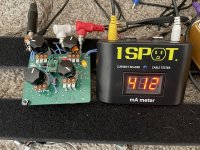
The bias voltage is very unstable as the temperature changes, but the servo keeps it steady at all times. I've got it on a mini breadboard sidecar.

I made a few other tweaks, but it works perfectly with a simple 9V OneSpot plug. Haven't tried it yet, but I'm sure it would also work fine if you parallel the two 9V/500mA outputs from a C12 OneSpot Pro.

Don't bother with any cheap SMPS wall warts. the 12V 1.5A one I have isn't even stable at half that power output. Stick to the OneSpots.


IMG_2376.jpeg
 
Back
Top