jubal81
Well-known member
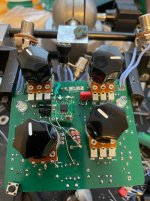
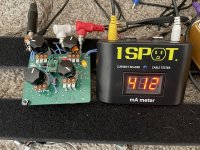
Back in the olden days, there was a DIY project for a solid state version of the Fender 6G15 reverb unit. The company stopped selling the kits and PCBs, but the one I built is still my all-time favorite.
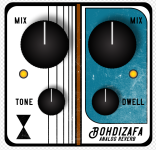
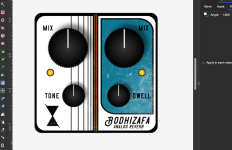
The Bodhizafa is a spin on that idea with some key reconfigurations. It's still very early in development, so the values you see in the schematic snippets I post are still in flux.
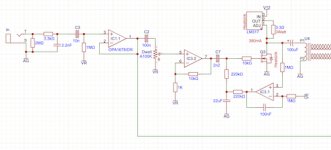
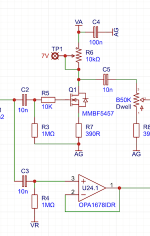
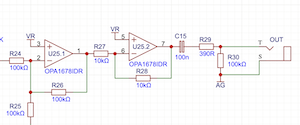
At the input, the dry signal is handled by an opamp to ensure maximum headroom, and the JFET boosters in the effect signal have trim pots for biasing.

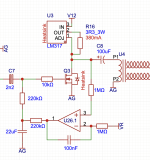
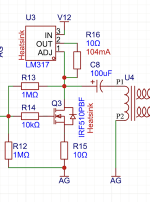
After some biasing tips from Chuck, I reconfigured the tank driving stage to use an LM317 and a single resistor as the constant current source on the drain of the power mosfet. It saves some parts and boosts performance.

The recovery stage is a JFET mu-amp with a DC-coupled BJT buffer.

Instead of an effect bypass, I've got an electronic switch to select between two mix pots. You can always turn one fully off for a "bypass" setting. I plan to use RCA jacks for an external connection to a reverb tank, but the momentary switch makes it suited for mounting springs inside the enclosure. A "true bypass" switch can always be added by inserting it between the audio jacks and the PCB.
The mixing stage is active with the other half of the opamp correcting the output phase for the dry signal.

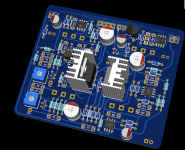
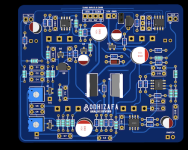
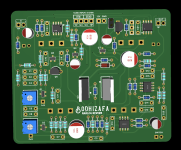
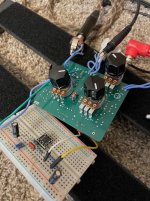
And here's a 3D render of my first draft of a PCB. It's sized to fit a 1590BB in portrait (hot dog) layout.

The Bodhizafa is a spin on that idea with some key reconfigurations. It's still very early in development, so the values you see in the schematic snippets I post are still in flux.
At the input, the dry signal is handled by an opamp to ensure maximum headroom, and the JFET boosters in the effect signal have trim pots for biasing.
After some biasing tips from Chuck, I reconfigured the tank driving stage to use an LM317 and a single resistor as the constant current source on the drain of the power mosfet. It saves some parts and boosts performance.
The recovery stage is a JFET mu-amp with a DC-coupled BJT buffer.
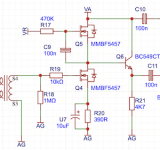
Instead of an effect bypass, I've got an electronic switch to select between two mix pots. You can always turn one fully off for a "bypass" setting. I plan to use RCA jacks for an external connection to a reverb tank, but the momentary switch makes it suited for mounting springs inside the enclosure. A "true bypass" switch can always be added by inserting it between the audio jacks and the PCB.
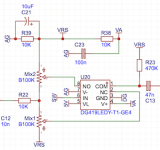
The mixing stage is active with the other half of the opamp correcting the output phase for the dry signal.
And here's a 3D render of my first draft of a PCB. It's sized to fit a 1590BB in portrait (hot dog) layout.