You are using an out of date browser. It may not display this or other websites correctly.
You should upgrade or use an alternative browser.
You should upgrade or use an alternative browser.
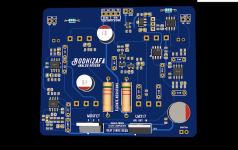
Available soon: Bodhizafa analog reverb
- Thread starter jubal81
- Start date

jubal81
Well-known member
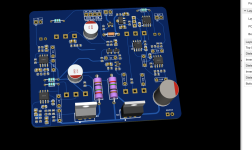
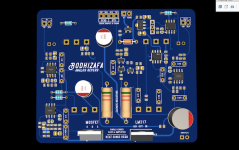
OK, here's the latest. I used my function generator and oscilloscope to fine tune the auto-bias and reworked the input booster to squeeze every little bit of headroom out of that power mosfet.
Running it at 9V sounds absolutely awesome, but you're gonna need a good (ahem - OneSpot) 1A power supply.
The two power resistors should be rated for at least 2 watts and soldered elevated off the PCB so heat can dissipate under them. I'm thinking about just including them with the PCB.

Running it at 9V sounds absolutely awesome, but you're gonna need a good (ahem - OneSpot) 1A power supply.
The two power resistors should be rated for at least 2 watts and soldered elevated off the PCB so heat can dissipate under them. I'm thinking about just including them with the PCB.

anevilspar7an
Well-known member
I will put my name down for one of these once you get it rolling. Reverb is one those effects that be finicky to dial in. I have high hopes for this. Will it play nicely with bass as is?
jubal81
Well-known member
Bass? Really hard to say. The effect needs a good bit of low cut up front, which could be good or bad for bass, depending on exactly how you want to use it.I will put my name down for one of these once you get it rolling. Reverb is one those effects that be finicky to dial in. I have high hopes for this. Will it play nicely with bass as is?

Fama
Well-known member
I'm interested in this. What impedance tanks can you use with it? It would be a bonus if I could use my existing tank (600 ohm input, 2250 ohm output impedance) with it, but it's probably not a dealbreaker. I am a little horrified about what shipping it to Europe might cost these days :F
anevilspar7an
Well-known member
I could always use a crossover circuit to use it on the high pass frequencies. I tend to do that with chorus.
jubal81
Well-known member
I'm interested in this. What impedance tanks can you use with it? It would be a bonus if I could use my existing tank (600 ohm input, 2250 ohm output impedance) with it, but it's probably not a dealbreaker. I am a little horrified about what shipping it to Europe might cost these days :F
The tank must be 8 or 10 ohms.
jubal81
Well-known member
With it working pretty well at 9V, I want to try a different type of mosfet to see if we can get another volt or two of headroom out of it - and maybe make it a bit more efficient.
The VG(th) of the IRF510 is 2 to 4 volts and the RDS(on) is 0.54 ohms.
I found a "logic level" Hexfet, the IRLZ44NPBF, with a VG(th) of 1 to 2 volts and RDS(on) of 0.022 ohms.
Another volt or two of headroom would make a big difference on a 9V supply.
Also, the Hexfet has a much larger transconductance factor, which should help it drive the tank more efficiently.
The downside to the Hexfet is a higher input capacitance. It's listed as 1.7n on the data sheet, but that should be no big deal since I'm driving the mosfet with a low-impedance output from an opamp. I'd already added a 470pF from drain to gate to tame the high end a bit going into the tank.
The VG(th) of the IRF510 is 2 to 4 volts and the RDS(on) is 0.54 ohms.
I found a "logic level" Hexfet, the IRLZ44NPBF, with a VG(th) of 1 to 2 volts and RDS(on) of 0.022 ohms.
Another volt or two of headroom would make a big difference on a 9V supply.
Also, the Hexfet has a much larger transconductance factor, which should help it drive the tank more efficiently.
The downside to the Hexfet is a higher input capacitance. It's listed as 1.7n on the data sheet, but that should be no big deal since I'm driving the mosfet with a low-impedance output from an opamp. I'd already added a 470pF from drain to gate to tame the high end a bit going into the tank.
anevilspar7an
Well-known member
When you write up the BOM would it be easy to make this run off of 12V or 18V with some part swaps? I use Cioks for my pedalboards so I would have no issue with clean isolated power.
jubal81
Well-known member
When you write up the BOM would it be easy to make this run off of 12V or 18V with some part swaps? I use Cioks for my pedalboards so I would have no issue with clean isolated power.
You won't need to build it any differently to run it at higher voltages. Just make sure you're using 25V capacitors and don't plug in anything over 18V.

andare
Well-known member
Not 35V?You won't need to build it any differently to run it at higher voltages. Just make sure you're using 25V capacitors and don't plug in anything over 18V.
jubal81
Well-known member
Well, I guess I should have said rated for "at least" 25 volts.Not 35V?
jubal81
Well-known member
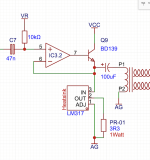
While I'm waiting for parts, I've got a couple BD139 power audio transistors to play with. I'm going to try making a power buffer with that and the LM317 constant current source in the feedback loop of an opamp.
The power mosfet amplifier setup sounds awesome as-is. It genuinely beats the reverb in my hand-built Deluxe Reverb. Since I've got that in pocket, I'm going to see if I can get the same results with something even a little more efficient.
The power mosfet amplifier setup sounds awesome as-is. It genuinely beats the reverb in my hand-built Deluxe Reverb. Since I've got that in pocket, I'm going to see if I can get the same results with something even a little more efficient.
jubal81
Well-known member
Reverb tanks are just voodoo.
The low-on mosfet showed much more bad distortion and didn't have as much headroom as the irf510. It's output was lower impedance, but hitting a tank "hard" is not the same as it sounding good.
I've tried:
The Elliot Sound circuits with the tank in a feedback loop.
Several chip amps in single-ended and bridge-tied load.
The class A buffer configuration with the IRF510 and BD139.
None of those sounded as good as the Class A mosfet boost.
I've rebuilt it with the IRF510 and fine tuned the bias. With the opamp servo "autobias", there will be no adjustments necessary when you build it. The plan now is to take a day or two to check the layout for defects and send it off to JLCPCB for them to do their magic. I hope the faceplates turn out. I had a lot of fun designing those.
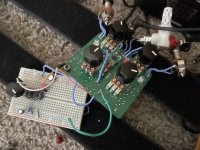
Here it is in its tack soldered glory with a new breadboard sidecar:

The low-on mosfet showed much more bad distortion and didn't have as much headroom as the irf510. It's output was lower impedance, but hitting a tank "hard" is not the same as it sounding good.
I've tried:
The Elliot Sound circuits with the tank in a feedback loop.
Several chip amps in single-ended and bridge-tied load.
The class A buffer configuration with the IRF510 and BD139.
None of those sounded as good as the Class A mosfet boost.
I've rebuilt it with the IRF510 and fine tuned the bias. With the opamp servo "autobias", there will be no adjustments necessary when you build it. The plan now is to take a day or two to check the layout for defects and send it off to JLCPCB for them to do their magic. I hope the faceplates turn out. I had a lot of fun designing those.
Here it is in its tack soldered glory with a new breadboard sidecar:
If you happen to know much about reverb tanks I could use some help actually. I have an ampeg vh140c with what seems to be the appropriate spec reverb tank. I've tried it both ways and smacked the tank and both sides sent audio which should mean both half of the tanks are working correctly I think. I've tried both cables going straight from the in and out to check the cables and turning the reverb knob and they both work. By testing it that way it does some phasing stuff to the sound which means the amp is definitely sending and receiving signal.
Yet somehow it doesn't work when I actually play through the tank.
It just makes no sense to me. Sorry I don't mean to derail the thread btw I just haven't been able to find any help in other places.
added https://forum.pedalpcb.com/threads/reverb-tank-issue.29345/
Yet somehow it doesn't work when I actually play through the tank.
It just makes no sense to me. Sorry I don't mean to derail the thread btw I just haven't been able to find any help in other places.
added https://forum.pedalpcb.com/threads/reverb-tank-issue.29345/
Last edited:

Aentons
Well-known member
Start a thread about it and link it in your post above so anyone who wants to help can reply on your thread and not derail this one even more.If you happen to know much about reverb tanks I could use some help actually. I have an ampeg vh140c with what seems to be the appropriate spec reverb tank. I've tried it both ways and smacked the tank and both sides sent audio which should mean both half of the tanks are working correctly I think. I've tried both cables going straight from the in and out to check the cables and turning the reverb knob and they both work. By testing it that way it does some phasing stuff to the sound which means the amp is definitely sending and receiving signal.
Yet somehow it doesn't work when I actually play through the tank.
It just makes no sense to me. Sorry I don't mean to derail the thread btw I just haven't been able to find any help in other places.
SpringReverbFan1234
Member
In my personal testing/opinion, the ESP current-drive style (tank in the loop) really should have at least 10x gain before it. Otherwise it won't get driven fully. When driven hard it can sound more "hi-fi" compared to a surf-y style drive using IRF510/9510. Which isn't better or worse, just different.I've tried:
The Elliot Sound circuits with the tank in a feedback loop.
Several chip amps in single-ended and bridge-tied load.
The class A buffer configuration with the IRF510 and BD139.
Anyway, your Bodhizafa design looks awesome. Best of both worlds. Very relevant to my interests. I'll stay tuned.
jubal81
Well-known member
In my personal testing/opinion, the ESP current-drive style (tank in the loop) really should have at least 10x gain before it. Otherwise it won't get driven fully. When driven hard it can sound more "hi-fi" compared to a surf-y style drive using IRF510/9510. Which isn't better or worse, just different.
Anyway, your Bodhizafa design looks awesome. Best of both worlds. Very relevant to my interests. I'll stay tuned.
The tanks definitely react differently. When driving them in a bridge-tied-load configuration, I got a similar response as from the ESP current drive.
I also noticed a substantial difference in the attack and feel between Class A and A/B.