2024 Pedalboard Build/Renovation…

Joben Magooch

Well-known member
I should preface by saying that I really intended to put together a nice step by step pictorial of my process...and I did get started doing as such, but then kinda got caught up in just getting stuff done so pictures got fewer and farther between...alas...

I have been fairly locked-in to the same rough size board for probably 5+ years now - years ago I got a pelican type case that was almost an exact fit for a Temple Trio 21 pedalboard, so approx. 17x21 interior dimensions. Had a Temple Board for a while but didn't love it and ended up moving on from it. But I've stuck with that approximate size; it's not hugely unwieldy (prior to this I had a loaded PT-Pro that was pushing 60+lbs) but covers all that I need it to do.

And I've gone back and forth in the past between flat boards and angled/elevated. I really like the aesthetic of a nicely organized flat board, but I feel like I end up having too much going on and it just ends up looking a bit crowded/cluttered/"busy" - for me the flat board vibe works better with smaller/simpler boards. Nonetheless I had a cool flat board for a while, all home-built with an upper riser that was attached with hinges I fabricated myself for that specific application. I was pretty proud of that feature.

So anyways… some of you may recall me posting about a board build a year or so ago. I was again working on an angled board of those same 17x21 dimensions and had got a good start on making it out of some nice hardwood. After getting fairly deep into it, I had a freak error occur and long story short ended up scrapping the whole project. I didn't want to spend any more money on wood so I just ended up making the frame out of some scrap 3/4" ply and covering in Tolex...except the "tolex" I got was actually caramel-colored faux leather from the fabric store. It didn't glue terribly well and was extremely thin/flimsy, but it held up respectably for a time. I grew tired of it and stripped the tolex off. Sprayed it black and with some bedliner for added durability and tbh this looked even worse to my eye. So after about a year I decided I'd just be ready to try and build a nice hardwood board again.

So, here we go...
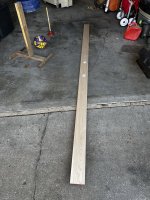
 
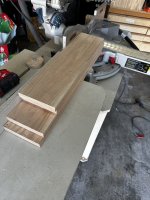
My local area doesn't have a great selection of reasonably-priced hardwoods, but I found a great deal on some red oak that I couldn't pass up so I went with that. It was only $6 for about 5 board feet which is pretty hard to beat.

IMG_2564.jpeg

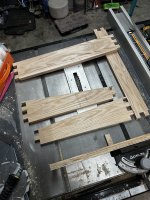
I start by chopping it down to rough length to make it a bit more manageable, then rip those sections down to their final thickness. The back and sides are ripped to 4", and the front rail is I think 2-1/4". The sides then of course taper from 4" to 2-1/4". Once they're ripped, I trim to final length, too. 16-1/2" on the sides and 21" on the front/back. I'm just doing box joints, so the final dimension stays the same despite the joinery.

IMG_2565.jpeg

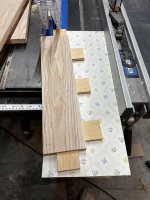
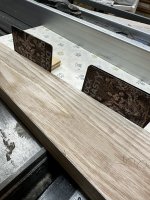
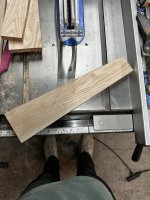
Next is to cut the tapers for the side rails. There are a few different ways to accomplish this. I've done it with just a square and circular saw, which is not my favorite. Track saw has worked reasonably well in the past. But my preferred method is honestly just to make a quick sled and cut them on the table saw. I take a scrap of lumber and set my fence to just a hair under its width and run it through. Now as long as I don't move my fence I know the edge of this piece of wood is going to be exactly on my cut line. Line up my workpiece cut line to the edge of the "sled" and it will cut right where you want it. I use a pin nailer to tack a few cleats onto the sled to hold my workpiece right where I want it and make a test cut. It's close but needs shimmed out just a hair. That's where these goofy Duck Dynasty trading cards I keep in the shop come in to play. After shimming out, it's perfect and I can slap the other side piece in the jig with the same amount of cards and it'll be exactly as the first. I really should get around to making a proper tapering jig someday but for smaller projects this works okay.


IMG_2572.jpeg
IMG_2573.jpeg

IMG_2574.jpeg
 
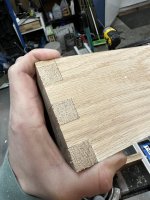
After cutting the tapers it's time to cut the box joints. I do have a dovetail jointing jig but it is so fiddley to get set up I just didn't want to mess with it. Box joints are simple, sturdy, and IMO still relatively attractive. I meant to get more photos here...like my tapering "jig," I make a simple one-off finger jointing jig for this process too. I don't know how well it will explain via text, but basically you attach a fence to your table saw's miter gauge, cut a slot in it with your dado blade, glue a guide-finger into that slot, and bump it over by the width of your joint's fingers. Line up your workpiece against the fence/guide-finger and make a pass, then pump the cutout over the top of the guide finger and repeat all the way over. Like I said, not the easiest thing to explain in words but it is easy, fast, and relatively hard to mess up too much as long as you pay attention and measure carefully and make sure you have your parts lined up in the order you want them to go. There's a little fine-tuning to be done but without much trouble I have some very nice fitting joints.

IMG_2575.jpeg
IMG_2576.jpeg

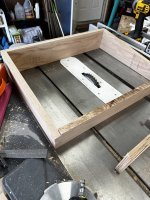
You can see here where I've test fit everything together. Obviously there's a bit of scorching on the front rail but this is fine. It's intentionally left a bit proud as I'll rip it down a hair further to match the angle of the side rails. It's coming together!
IMG_2582.jpeg
 
From this point is where the pictures dried up a bit, in no small part because this is where everything got flubbed up last time... I decided to jump ahead a few planned steps to get this part out of the way. That way if it went south I wouldn't be so far in... It's the cutouts/routes for my D-pane jacks on the side. I wanted to cut out a recessed area to accommodate three jacks on both sides (they can't stick out too proud or the case won't fit). I measured my area carefully and used double-stick tape to put down some 1/4" MDF to create a template for my cutouts. I used a mortising bit and removed about 1/4". I worked very slowly on this portion but it worked great and came out very clean. I was most nervous about this section for sure so I was super relieved and got a bit of a confidence-boost for it to go well. After the recessed area is routed out, I drill the holes for the D-panel jacks themselves. They're kind of an awkward size. I believe it's a 24mm hole, about 0.944 inches. 15/16" is 0.9375, which is close enough, but neither are a terribly common size drill bit for most to have. 7/8" will generally be too small, and 1" is slightly oversized where you might have a tiny gap. You can go small and file out to fit, or go big and deal with the gap or find something to cover it up. I opted to go a bit bigger (even 1/16" inch difference takes an annoyingly long amount of time to evenly file out of 6 holes. Redco makes some nice custom labels for D-panels that I've used before; they look pro and will cover the tiny gap made by the 1" hole. Holes are drilled and all the pieces are sanded before finally gluing it all together!

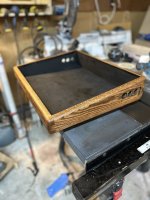
Next is the bottom panel. I have a few pedals I'll mount on here, and I like it being closed up a bit more than the "open-frame" type angled boards - it conceals wiring better, allows for more flexibility in mounting pedals, adds some strength, and keeps the frame nice and even and square. So I use a rabbetting bit to cut a rabbet into the rails and cut a sheet of 1/2" plywood to fit. It gets glued in and weighed down for a strong bond. I mask off the outsides and spray the entire interior black. I think this looks cleaner this way.

Getting closer now... time to roundover the edges. I start with a super light 1/8" roundover, pretty much just to break the edges and avoid tearout. All the exterior edges are ran over on my router table and from here I work my way up, 1/8" at at a time until I'm at a 1/2" roundover. After roundovers are done, I sand at 120g and collect the dust. I use this to mix up some matching filler and touch up any small spots that need any attention. Then the whole thing's sanded at 150, 180, and 220g for the finish.

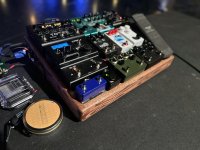
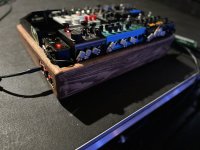
Tried-and-true Special Walnut stain goes on next. I think I did three coats total. It looks pretty decent to me and takes down a bit of the redness of the oak. And I like the contrast with the black interior and top. Once the stain's finished, I just use paste wax to finish the whole thing. Feet are attached to the bottom, D-panel jacks are installed, top and hinges* are installed, and it's done!

IMG_2639.jpeg

*I'm reusing the same top surface from my previous angled build. The dimensions hadn't changed and it still works just as I need it to. It's roughly 15x20" baltic birch with slots cut into it and painted black as well.
 
WrBSHRLE9gEgM.webp
8-1Lp0.gif
e4086d479cf81ac94363fd3779513b84_w200.webp


Superb project- thanks for sharing!
 
First, just a quick overview of some of the connections. The right-hand side has three D-panels installed. One for guitar input, one for headphone output, and a third auxiliary input/output that I haven't decided on just yet. Could patch in for an extra expression pedal or something potentially.m

The left-hand side also has three: Left Output, Right Output, and Powercon Input (which is just a female Powercon jack patched to a right-angle Male IEC connection that goes to my Truetone CS12. The CS12 powers everything!)

All the signal cable is Mogami 2314. Most of the plugs are Squareplug SP400 at this point, though I do have a few GLS pancakes left over that I'm in the process of gradually replacing. There's a few TRS cables (favorite switch, headphones, aux switch for Bigsky) that are also Mogami cable (forget the model number) and Squareplug SP550-S plugs. As above, the Truetone CS12 powers everything. I'm in the process of making all custom power cables too, but that's really more or less just an aesthetic/organizational thing - the stock cables of course work just fine.

Now, the "Dry" effects, listed in signal order….
 
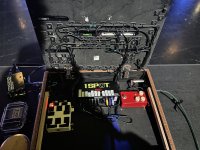
Straight from the guitar input on the board we go first to General Tso's Compressor / ThorpyFX Fat General. This is my favorite compressor I've ever used, and honestly probably my favorite pedal I've built. I have had a Diamond comp on my board for over a decade and it had previously been my "most-established" pedal and the General kicked it off. It sounds fantastic and is awfully quiet for me. I keep most the controls right around noon, sometimes bumped up to about 1 o'clock on the compression/blend controls and tweak the treble/tone a bit depending on the guitar. But pretty much all three controls stay in the 11-1 o'clock range. It never gets turned off (It's the red pedal underneath the top surface).

Mach One / Greer Lightspeed: I really like this pedal. I've used a Timmy for AGES (a Timmy was the first pedal I ever made) and the Lightspeed is awfully closely aligned there, to say the least. It sounds really nice and adds a slight push to the low-mids, to my ear. That said, I am finding that sometimes IMO that push causes it to get a little lost in the mix or "indistinct". And I find it a bit redundant when looking at my other drive options...this is one that I'm looking to replace. I'm thinking of either a clean boost or a fuzz...I know those are kind of opposite ends of the spectrum but I feel like I could make space for either one...

Paragon / King of Tone: I've owned a couple of real KoT's, a couple of real PoT's, and built a couple of Paupers and a Paragon Mini. And I've owned a ton of other Bluesbreaker variants... I really like that circuit. This one I built with some of the "warmer" mods listed elsewhere here. I really like it with humbucker-equipped guitars. I think I put BAS33s in it, which are some of my favorites for Bluesbreakers. High gain on both sides; the yellow side is set to clean boost and the red side to OD mode.

Pro-10 Dual / Protein: This has quickly become a favorite and a "modern classic" for me. I built one a year or so ago and fast fell in love. For some reason I sold it and immediately regretted it. I've made another and am super glad to have it back on board. In contrast with the Paragon/KoT, I find this one better with single coils. It's probably my most frequently used drive.

Dynamic Haircut / Barber Gain Changer: Special thanks to @MattG for this one! I need to put together a proper build report, but man, I love this pedal. It has SUCH a wide range that it works at and no "bad" setting that I can find. I am currently using it for my "higher gain" sound and it rips. I'm really impressed. I had my kiddos (one is just about three and the other ~18mo) provide the "artwork" and I'm really fond of it.

Clandestine / Chase Tone Secret Preamp: Another one that's quickly become a mainstay for me. It's under the board and always on, too. I keep it around 1pm or so on the boost knob and tweak the toggle switch a bit depending on guitar but I am typically gravitating to the "dark" setting. A lot of my other stuff leans somewhat "bright" so I feel this provides decent balance. I highly recommend this one to anyone, it really is that magic "secret sauce" for so many.

Ernie Ball "40th Anniversary" VPJR: Had it for quite a while. I just like the sweep of the EBVP better than most others. This "anniversary" one came with a Kevlar string, but I eventually wore through that one, somehow. It's been replaced with a "lifetime string" from Shnobel Tone. The pot wore out a while back, too; I replaced the original 250k pot with a 25k one as I was using it for an expression pedal here and there so and it worked better with 25k for expression. It has enough buffers before/after that i don't notice any difference in regular usage between 25/250k.
 
And now some of the more "wet" effects, I guess you'd call it...

Line 6 M5: My catch-all Swiss Army Knife type of thing. I use it for mostly modulation, and some pitch and random delay/reverb effects. I modded it with the extra footswitch for "scene select". The stock footswitches weren't bad, but they have a reputation for being not particularly reliable, so I went ahead and replaced them as well while I was in there. And I installed an onboard expression control, too. It works really nice! Great for the sounds that I don't really use enough to justify investing the space/cost in to getting standalone versions of.

Keeley Halo: This is a really cool delay. I try to avoid using tone-buzzwords, but it's just really "musical" sounding with a lot of "character" to it. Keeley and co have done a great job of getting it dialed in to where it's hard to get a bad sound out of it. It's just voiced in a really pleasing way. The type of pedal that makes you want to play more. I'm a big fan!

Strymon El Capistan: My favorite delay of all-time. I have owned probably close to a dozen at this point. Generally, I buy an El Cap...then convince myself I need to "upgrade" to the Timeline for more sounds and preset management and so on, so I sell my El Cap and get a Timeline (which I've also probably owned a dozen of). Then a few months later I realize I'm using the same dTape preset on the Timeline for 99% of my needs and "downgrade" back to the El Cap. It works great for pretty much anything I could throw at it and just sounds spectacular.

Strymon Bigsky: Best reverb pedal ever. Now that General Tso has knocked off the Diamond Comp...this is my longest-standing pedal on board (and I've sold a few too; in terms of cumulative ownership-time this is probably king for me) and the first one I'd replace if I had to start from scratch. It has every sound I could need and makes me sound like a way better player than I really am. I pretty much never turn it off and use the little blue 1590A to bank up and down between presets. I have tried every "big name" reverb out there and nothing has been able to displace this one. Most every pedal I own has a point where I think "I could probably swap this out for XYZ;" not so with the Bigsky. I have no intention of replacing or trying out anything new or anything like that.

Tonex: What a cool pedal. I've been pretty exclusively on modelers for a few years now. With the exception of Tonemaster Pro and Quad Cortex I've tried just about every other big modeler and Tonex takes the cake. It feels super amp-like and realistic, cleans up great, and covers every sound I could want. I generally gravitate towards Vox-voiced amps, but my favorite currently is Amalgam Audio's Tone King Imperial.

My only gripe is that it's a single mono input. I like running my wet effects in stereo, but also like running them into the front of the amp. Can't do both with Tonex - either it's stereo effects post-amp or mono - effects into front of amp. I'm set up for the latter at the moment but may change that around. The only other alternative is to pick up a second Tonex - which I've done in the past - but didn't think the cost and space/power requirements were worth it for the benefit it provided. Still, one is really nice - best sounding modeler i've played so far.
 
Overall, I'm very happy with how it turned out. This rig has me sounding as good as I ever have, and I think it looks really nice, too! I do have a few small changes on the radar still, but for the most part I'm pretty content with this.
 
Straight from the guitar input on the board we go first to General Tso's Compressor / ThorpyFX Fat General. This is my favorite compressor I've ever used, and honestly probably my favorite pedal I've built. I have had a Diamond comp on my board for over a decade and it had previously been my "most-established" pedal and the General kicked it off. It sounds fantastic and is awfully quiet for me. I keep most the controls right around noon, sometimes bumped up to about 1 o'clock on the compression/blend controls and tweak the treble/tone a bit depending on the guitar. But pretty much all three controls stay in the 11-1 o'clock range. It never gets turned off (It's the red pedal underneath the top surface).

Mach One / Greer Lightspeed: I really like this pedal. I've used a Timmy for AGES (a Timmy was the first pedal I ever made) and the Lightspeed is awfully closely aligned there, to say the least. It sounds really nice and adds a slight push to the low-mids, to my ear. That said, I am finding that sometimes IMO that push causes it to get a little lost in the mix or "indistinct". And I find it a bit redundant when looking at my other drive options...this is one that I'm looking to replace. I'm thinking of either a clean boost or a fuzz...I know those are kind of opposite ends of the spectrum but I feel like I could make space for either one...

Paragon / King of Tone: I've owned a couple of real KoT's, a couple of real PoT's, and built a couple of Paupers and a Paragon Mini. And I've owned a ton of other Bluesbreaker variants... I really like that circuit. This one I built with some of the "warmer" mods listed elsewhere here. I really like it with humbucker-equipped guitars. I think I put BAS33s in it, which are some of my favorites for Bluesbreakers. High gain on both sides; the yellow side is set to clean boost and the red side to OD mode.

Pro-10 Dual / Protein: This has quickly become a favorite and a "modern classic" for me. I built one a year or so ago and fast fell in love. For some reason I sold it and immediately regretted it. I've made another and am super glad to have it back on board. In contrast with the Paragon/KoT, I find this one better with single coils. It's probably my most frequently used drive.

Dynamic Haircut / Barber Gain Changer: Special thanks to @MattG for this one! I need to put together a proper build report, but man, I love this pedal. It has SUCH a wide range that it works at and no "bad" setting that I can find. I am currently using it for my "higher gain" sound and it rips. I'm really impressed. I had my kiddos (one is just about three and the other ~18mo) provide the "artwork" and I'm really fond of it.

Clandestine / Chase Tone Secret Preamp: Another one that's quickly become a mainstay for me. It's under the board and always on, too. I keep it around 1pm or so on the boost knob and tweak the toggle switch a bit depending on guitar but I am typically gravitating to the "dark" setting. A lot of my other stuff leans somewhat "bright" so I feel this provides decent balance. I highly recommend this one to anyone, it really is that magic "secret sauce" for so many.

Ernie Ball "40th Anniversary" VPJR: Had it for quite a while. I just like the sweep of the EBVP better than most others. This "anniversary" one came with a Kevlar string, but I eventually wore through that one, somehow. It's been replaced with a "lifetime string" from Shnobel Tone. The pot wore out a while back, too; I replaced the original 250k pot with a 25k one as I was using it for an expression pedal here and there so and it worked better with 25k for expression. It has enough buffers before/after that i don't notice any difference in regular usage between 25/250k.
Funny you mention using the buffer in front of the volume pedal. When I was with my last band, I installed an MXR MicroAmp inside of a Vox volume pedal, and added a stomp switch. Bypassed it would obviously be out of circuit, bu Lt when kicked on, at the top of its travel, I’d set it for a good volume boost. Of course I never used the lower sections for volume control, only for swells etc, but it worked well, and didn’t load the guitar down with the 100k pot that came in it.
 
Back
Top