

You are using an out of date browser. It may not display this or other websites correctly.
You should upgrade or use an alternative browser.
You should upgrade or use an alternative browser.
Acoustic Preamp Design - Preamp & EQ
- Thread starter Rpschultz13
- Start date
Rpschultz13
Well-known member
Spent an hour playing it. First impressions, it has a TON of gain between gain (first) and volume (last), not to mention boost. Anyway loads of headroom. Drives me crazy when I’m plugged into a system and the sound guy wants more gain than I have.
Sounds real clean with the TLO74s. I’ve got some OPA4134s I want to try and measure if there’s any noise difference.
Sounds real clean with the TLO74s. I’ve got some OPA4134s I want to try and measure if there’s any noise difference.
Rpschultz13
Well-known member
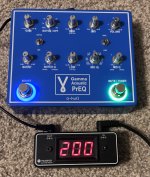
I was checking the current because I'm using a Traco TEC 3-0923 DC-DC converter that takes 9vdc to 2 legs of +/-15vdc. It's rated for 100 mA per leg and 3W total. It's applying +/-15 v to the 4 op amps, or 30v across each. I have 1R resistors inline to measure the voltage and calculate the current (easy math and low voltage drop).
Above, I measure total current draw to be 200 mA at 9.44v using a current meter. I measure 0.195v across the 1R. So that makes sense. On each leg, I measure 0.038v across a 1R, or 38 mA, I can't use a current meter here so that's why I have 1R's.
200 mA at 9.44v is 1.9W, or 0.95W per side.
Divided by 30v is 32 mA per side. I measure 0.038v across the 1R on each leg, or 38 mA. So again, that math checks. The 1R's probably aren't exactly 1.0 Ω.
38 mA/side seems like I have roughly a safety factor of 3 on it's 100 mA/side capacity. But the 1.9W on the input looks like only about 50% headroom compared to the 3W rating. I was wondering if I need the 100mA/leg version, or if I could use the 2W - 67mA version, the Trace Tec 2-0923. It's $10 each instead of $15. If I look at current/leg, I have lots of room, but if I look at the Watt rating, I should stick with the 3W version.
CORRECTION:
The wattage rating is on the output.
So for the 2W version. 38mA @ 30v is 1.14W
38 mA is 57% of the rated 67 mA/side Also 1.14W about 57% of 2W.
I think the 2W version will work, and someone on AAC said the 2W version may be quieter than the 3W version.
Above, I measure total current draw to be 200 mA at 9.44v using a current meter. I measure 0.195v across the 1R. So that makes sense. On each leg, I measure 0.038v across a 1R, or 38 mA, I can't use a current meter here so that's why I have 1R's.
200 mA at 9.44v is 1.9W, or 0.95W per side.
Divided by 30v is 32 mA per side. I measure 0.038v across the 1R on each leg, or 38 mA. So again, that math checks. The 1R's probably aren't exactly 1.0 Ω.
38 mA/side seems like I have roughly a safety factor of 3 on it's 100 mA/side capacity. But the 1.9W on the input looks like only about 50% headroom compared to the 3W rating. I was wondering if I need the 100mA/leg version, or if I could use the 2W - 67mA version, the Trace Tec 2-0923. It's $10 each instead of $15. If I look at current/leg, I have lots of room, but if I look at the Watt rating, I should stick with the 3W version.
CORRECTION:
The wattage rating is on the output.
So for the 2W version. 38mA @ 30v is 1.14W
38 mA is 57% of the rated 67 mA/side Also 1.14W about 57% of 2W.
I think the 2W version will work, and someone on AAC said the 2W version may be quieter than the 3W version.
Last edited:
Rpschultz13
Well-known member
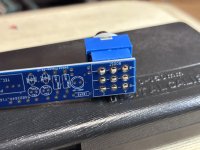
The biggest problem with pcb v3, is the 3PDT footprints, I had to modify the 3PDT's for them to fit. In hindsight, I could have simply drilled out the holes to 2.5mm, like this, now they fit.

If anyone wants to built this, it all seems to work and with this modification shouldn't be any trouble.
I'll eventually print pcb v4 when I'm done playing/testing v3. Besides the 3PDT footprint, the inductors are mislabeled 100 uH instead of 10 uH (or even 4.7uH is better). I also am switching the position of the mid gain and frequency knobs for v4 so the double pot (frequency) hangs off the top edge of the board like the notch/HPF frequency pot. And I want to make all the polarized caps the same direction to avoid confusion. That's it, minor stuff.
Nevertheless, v3 works great. I have 3 sets left of v3. If you want one, and you actually WILL build it, I'll send you a set if you pay for shipping ( probably $10 conus). I have Tayda drill/UV templates and a BOM I can send you. It's probably $90 in parts, the most expensive being the Traco DC DC converter ($15) and the 1590XX enclosure from Tayda ($13 bare or $26 drilled/UV). 3 of the pots are center detent (though not necessary) I get from StompBoxParts. There are 3 inductors that you may not have, but cheap from Mouser when you buy the Traco. Some of the film caps might be odd values, but again, mouser. It uses 3 TL074's and 1 NE5532, though I currently have OPA4134's in for the TL074's. An LM4562 is a high performance alternative to the NE5532 (for about $9).
PM me if interested.
If anyone wants to built this, it all seems to work and with this modification shouldn't be any trouble.
I'll eventually print pcb v4 when I'm done playing/testing v3. Besides the 3PDT footprint, the inductors are mislabeled 100 uH instead of 10 uH (or even 4.7uH is better). I also am switching the position of the mid gain and frequency knobs for v4 so the double pot (frequency) hangs off the top edge of the board like the notch/HPF frequency pot. And I want to make all the polarized caps the same direction to avoid confusion. That's it, minor stuff.
Nevertheless, v3 works great. I have 3 sets left of v3. If you want one, and you actually WILL build it, I'll send you a set if you pay for shipping ( probably $10 conus). I have Tayda drill/UV templates and a BOM I can send you. It's probably $90 in parts, the most expensive being the Traco DC DC converter ($15) and the 1590XX enclosure from Tayda ($13 bare or $26 drilled/UV). 3 of the pots are center detent (though not necessary) I get from StompBoxParts. There are 3 inductors that you may not have, but cheap from Mouser when you buy the Traco. Some of the film caps might be odd values, but again, mouser. It uses 3 TL074's and 1 NE5532, though I currently have OPA4134's in for the TL074's. An LM4562 is a high performance alternative to the NE5532 (for about $9).
PM me if interested.
Curious about this. I'm currently working on a preamp design and will be using a Traco Tec series converter because I've had good experience with them in a couple of Aion FX PCBs. I would have just copied the Aion FX pi filter on the input, which uses a 100uF, 10uH and 47uF. Always open to suggestions for improvements though.the inductors are mislabeled 100 uH instead of 10 uH (or even 4.7uH is better).
Rpschultz13
Well-known member
Yeah I did the same thing, copied L5 preamp. Take a look at the Traco tech notes, they aren’t exactly like the Aion schematic, they only suggest 1 inductor on the input, not both output legs.
The question is whether it could hurt to put those LC filters there. Wish those tech notes weren't as bare bones and had some real life measurements. I came across some notes by Texas Instruments on filtering DC-DC converters today but haven't had a chance to check it out yet.Yeah I did the same thing, copied L5 preamp. Take a look at the Traco tech notes, they aren’t exactly like the Aion schematic, they only suggest 1 inductor on the input, not both output legs.
Rpschultz13
Well-known member
Well, Aion does it, and my prototype does it. Seems fine. Maybe it’s not necessary.

Passinwind
Well-known member
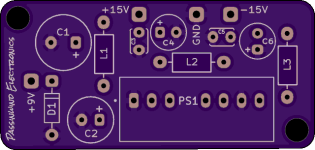
I did it that way for my PEQ/HPF pedal which uses a Traco DC-DC brick as well:Well, Aion does it, and my prototype does it. Seems fine. Maybe it’s not necessary.
Last edited:
Rpschultz13
Well-known member
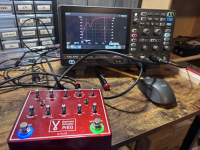
A recent picture of this project, a Bode plot of the parametric mid.
This version of the PCB is a 4-layer I designed in EasyEDA, much improved over previous version. I made mistakes converting the schematic from Eagle to EasyEDA, fixed them. Now re-printing. Should have the final version here in a few weeks.
This version of the PCB is a 4-layer I designed in EasyEDA, much improved over previous version. I made mistakes converting the schematic from Eagle to EasyEDA, fixed them. Now re-printing. Should have the final version here in a few weeks.
Rpschultz13
Well-known member
The question is whether it could hurt to put those LC filters there. Wish those tech notes weren't as bare bones and had some real life measurements. I came across some notes by Texas Instruments on filtering DC-DC converters today but haven't had a chance to check it out yet.
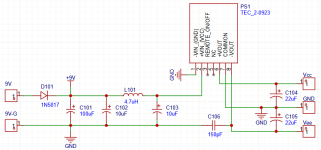
I settled on this for the power section. It seems fine. And using the 2W version has plenty of current capacity, I don't think the 3W is even remotely necessary for my application, about 200mA at 9v. Currently mouser has the 2W for $11 and the 3W for $15 (+tariffs), but the 3W is often out of stock, seems that the 2W is more available.

notTHEwillienelson
Member
When you have the final version, could I order a couple boards?
Rpschultz13
Well-known member
Cool. Here's the BOM and cost estimate (minus boards). The part costs don't include shipping (mouser, stompboxparts, Tayda, etc), so factor that in. It's not a cheap build. I could sell the 2 PCB's only or do the whole kit (except enclosure at this point).
Google Sheets BOM
Google Sheets BOM

Feral Feline
Well-known member
... to reiterate.I'm interested in a PreQ-PCB.
Rpschultz13
Well-known member
Rpschultz13
Well-known member
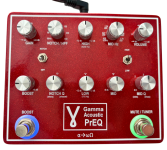
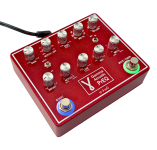
Boards came in a few days ago, assembled one and it tested as expected. Web site as a LOT of details and documentation to dig through. I'm happy to answer any questions here, or hit the contact button.
I started this project in fall of 2023... because I was annoyed at how expensive a Grace Designs ALiX was at the time (was $649, now $842). I thought I could design my own for a lot less - the goal has always been to have similar functionality to an ALiX. Along the way I've had both setbacks and luck, other projects (Q-Tune), family stuff and other life distractions. So, it's great to have gotten this far even if it took me 2-1/2 years. And wow have I learned a ton along the way, that's why we do this, right?
I'm pretty proud of the Gamma PreQ. While it doesn't have as many features as some of the commercial preamps, functionally (preamp, EQ) it is among the top 2-3 preamps available and you can build it for a fraction of the cost. If you build it, I sincerely hope you love it as much as I do.

 www.molinellomusic.com
I started this project in fall of 2023... because I was annoyed at how expensive a Grace Designs ALiX was at the time (was $649, now $842). I thought I could design my own for a lot less - the goal has always been to have similar functionality to an ALiX. Along the way I've had both setbacks and luck, other projects (Q-Tune), family stuff and other life distractions. So, it's great to have gotten this far even if it took me 2-1/2 years. And wow have I learned a ton along the way, that's why we do this, right?
I'm pretty proud of the Gamma PreQ. While it doesn't have as many features as some of the commercial preamps, functionally (preamp, EQ) it is among the top 2-3 preamps available and you can build it for a fraction of the cost. If you build it, I sincerely hope you love it as much as I do.
Gamma PreQ - Acoustic Guitar Preamp, EQ & Boost
The Gamma PreQ is a DIY acoustic guitar preamp, EQ, and boost pedal. Plenty of clean gain, flexible EQ, and a dedicated boost.

anevilspar7an
Well-known member
Could this be tweaked to work on an acoustic bass? Since I'm sure it makes some difference mine is an ESP LTD Thinline TL-4, which doesn't have a lot of resonance. It is pretty much dependent on the internal piezo pickup to function.
Rpschultz13
Well-known member
Theoretically, sure. But it wouldn't be simple. The set HPF could easily be removed to allow full range into the first gain stage. But most/all the EQ stages would need to have the frequency range adjusted. At the very least, the HPF/Notch range would obviously need to be lowered since right now the bottom drops out around 68 Hz... and for bass you need 35 Hz or so. All the other knobs would work as-is, they just wouldn't be ideal.Could this be tweaked to work on an acoustic bass? Since I'm sure it makes some difference mine is an ESP LTD Thinline TL-4, which doesn't have a lot of resonance. It is pretty much dependent on the internal piezo pickup to function.
If I was doing this, I'd start in LT Spice (I have models) and do simulations to get an idea on what values to change to what. Then try those values in a completed assembly and run Bode plots in REW and/or an oscilloscope. Rinse and repeat. I'm not interested in that right now, but if you are I could guide you. It’d be a fair bit of work, but you'll learn a lot along the way (no offense if you know all this stuff already).
As for your bass, maybe pick up a MXR M80/M81... it's pretty good for the price.
Last edited:
