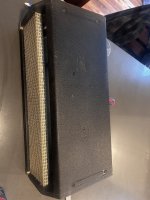
Adventures with the dirty Bassman.

@RetiredUnit1 @HamishR

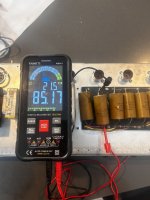
Does this mean my output transformer bad. And would it be why it was getting low output the few minutes I had it hooked up.

1A6E01C6-D24E-45FC-8939-0C7A9EB93145.jpeg 1B6B8079-0DD0-472D-A9B2-30306CB10FE8.jpeg

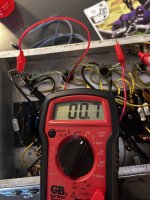
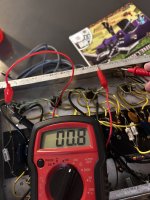
That is reading continuity between chassis and the green and black secondary wires.
 
@RetiredUnit1 @HamishR

Does this mean my output transformer bad. And would it be why it was getting low output the few minutes I had it hooked up.

View attachment 66001View attachment 66002

That is reading continuity between chassis and the green and black secondary wires.
Well I just checked an OT for a Champ and there is no continuity between the secondaries on anything. There is .264k resistance between the two leads of the secondary. I tried touching all three of the primary wires while hooked to the secondary and there is also no continuity.
:cry: 🤯
 
Well I just checked an OT for a Champ and there is no continuity between the secondaries on anything. There is .264k resistance between the two leads of the secondary. I tried touching all three of the primary wires while hooked to the secondary and there is also no continuity.
:cry: 🤯
Yea I’m thinking it’s bad from what I read on rob robs page just wanting a second opinion. Not a big deal, would like to not spend the 100$ for a new one but im still in good shape overall for this project. Would explain the low volume output
 
Output Transformer

If the output transformer shorts between windings it can lead to no output, weak output or funky sounding output. You can test the transformer by measuring the resistance between its leads. Drain the filter caps and remove the rectifier and power tubes before making the following resistance measurements:

For push-pull transformers you should see approximately the same resistance between each secondary wire at each power tube and the center tap--typically somewhere between 10 to 200 ohms.

A shorted primary winding will have much lower resistance compared to the other winding and typically measure at less than 10 ohms.

The secondary windings will often measure less than 1 ohm between all the secondary leads so it is difficult to detect a shorted secondary.

If a transformer winding is open (break) it will show a very high resistance between the primary leads or between the secondary (speaker) leads (typically 500k or higher).

A short between the primary and secondary windings will typically show less than 10 ohms resistance between the primary and secondary leads.

Measure the resistance between all the leads and chassis ground--low resistance of less than 10 ohms indicates a short to the transformer's iron core.

For comparison my healthy Hammond 125C push-pull output transformer measured: red center tap to brown 150 ohms, red center tap to blue 116 ohms, brown to blue 268 ohms. All secondaries measured .2 to .6 ohms between them. A Hammond 125GSE single-ended output transformer measured 53 ohms between the two primary wires. All of the secondaries measured .2 to .3 ohms. Both transformers measured an open circuit (no connection) between their primary and secondary wires and between all wires to the transformer outer metal shell.

If any of the above faults are present your best bet is to just replace the output transformer. For valuable vintage transformers it is possible to have them rewound.

From rob robs page.

 
That's a pain. Still, there are plenty of options. Mojotone have a suitable OT for $98. I'd probably go for the vastly more $$ Mercury Magnetics FBFBM-OM though. On their website it's $239 (!) but you can generally get it for less through a reseller.

The Mojo is probably made by Heyboer, who make excellent transformers. However the Mojo spec can make for a slightly less exciting result - It will work and sound great but possibly not as detailed as the MM. However the price difference might not be worth the slight audible difference for you!

FWIW Heyboer can make a transformer every bit as good as MM - it's down to the spec. GDS and Marstran sell fantastic Marshall style transformers which are (I believe) made by Heyboer. But they generally cost more than the Mojo.

Hammond transformers are very affordable but again, you get what you pay for. They're well made, will work perfectly but I haven't found them to sound quite as good as the better ones. Other guys will disagree I'm sure!
 
That's a pain. Still, there are plenty of options. Mojotone have a suitable OT for $98. I'd probably go for the vastly more $$ Mercury Magnetics FBFBM-OM though. On their website it's $239 (!) but you can generally get it for less through a reseller.

The Mojo is probably made by Heyboer, who make excellent transformers. However the Mojo spec can make for a slightly less exciting result - It will work and sound great but possibly not as detailed as the MM. However the price difference might not be worth the slight audible difference for you!

FWIW Heyboer can make a transformer every bit as good as MM - it's down to the spec. GDS and Marstran sell fantastic Marshall style transformers which are (I believe) made by Heyboer. But they generally cost more than the Mojo.

Hammond transformers are very affordable but again, you get what you pay for. They're well made, will work perfectly but I haven't found them to sound quite as good as the better ones. Other guys will disagree I'm sure!
I’ll have to look around, looked like electro Harmonix also offered a replacement. Though I’m guessing it’s just a rebranded something
 
I'm really sceptical of anything EHX. But that's just me!
Yea likely I won’t get that one. I was just looking earlier.

Bummed my electros come tomorrow was looking forward to hopefully having this up to try out with the cab this weekend but now I get the experience of changing out a transformer. Yay? :)
 
I might be real dumb. So it’s switchcraft jack where the sleeve is connected to ground through the chasis. Of course the ot is reading continuity to ground on the secondary the sleeve is littkerally attached to the chassis from the jack. 🤦‍♂️

Mistakes are learning opportunities right? :)
 
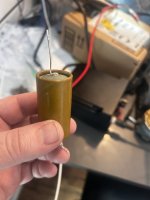
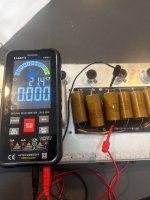
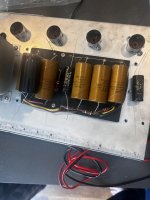
Exciting day. The postman brought me filter caps and resistors for the dog house! I hadn’t measured these since I knew I was going to replace them. I measured and took the cap out that looked like it blew


B6CF5805-FF11-45D7-8D2B-ACBC9D8273C1.jpeg

98488B22-B5AE-421E-995E-410C53ACB771.jpeg

Compared to the one with the visible electrolytic oozed out

C20E6610-232C-4980-AA47-454A905AEA55.jpeg

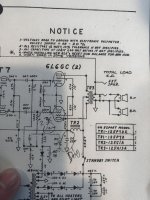
Also the resistor attached to the dead cap a 1k 1w was reading 2k3. Here they are in the schematic.

AE159D34-8E76-4C14-812E-7CA3FFDE84C9.jpeg

talked some more to the guy I got this from. He stated he was playing it one day 20 years ago ish it made a loud pop noise, had a god awful smell and the fuse blew along with some smoke.

Since after replacing the fuse it powered and passed signal I have to wonder if it was that cap popping that he heard.

Today I’ll be replacing all the filter caps and resistors in dog house except those 220k’s as I didn’t order those in this order and they won’t be here until Friday. However they are both within tolerance. I will also replace the bias caps that were at the edge of tolerance. I have the rest of the electrolytics on hand but am going to hold off on replacing those for now. I will check grounds make sure everything is good and power it up.

Quite the size difference.
CFF660C4-1DD4-40CC-8D32-DC697080B691.jpeg
 
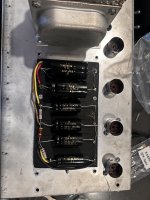
Filter caps changed. Resistors I changed the ones I have more are coming Friday I misread the schematic and ordered 47k instead of 4k7 oops so they’re three in the doghouse that I need to change out.

Checked all the grounds all were good.

Plugged it in….

Volume good, sounds good no weird pre amp tube noise. It seems solid. Going to change out what I have and focus on some clean up of the cabinet until the rest of the resistors come.

I’ll try and get a decent recording this weekend 37CCD84D-64D7-4B05-8E1B-FC9C2898B6ED.jpeg
 
I did some ESR testing on various eCaps today.... guess which won? But I'll tell ya, F&T DO look the best. That counts in my book. But I'm using MOD on the 5F6-A.... Tomorrow I'm going to put them on my SPRAGUE TEL-OHMIKE T0-6A capacitor analyzer and test them at max rated voltage to see which leaks the most DC to ground.

1705468572787.png
 
just noticed as I was going through the bias caps I thought were reading way low are actually measuring a bit high for the 50mfd caps they are even though the schematic clearly says they should be 80.
 
just noticed as I was going through the bias caps I thought were reading way low are actually measuring a bit high for the 50mfd caps they are even though the schematic clearly says they should be 80.
It's not unusual for fender schematics to be wrong, lol. Plus mistakes were made during assembly. 5 and 8 look a lot alike in mimeograph quality which is all they had for duplication in the 50's.

edited: As I think about it, I've seen 47uf and 50uf more often in Fender bias designs.
 
Last edited:
"talked some more to the guy I got this from. He stated he was playing it one day 20 years ago ish it made a loud pop noise, had a god awful smell and the fuse blew along with some smoke."

That sounds about right - except the pop was probably more of a BANG!! Maybe inside the doghouse the sound was muffled a bit? And yeah they do stink, but not as badly as a blown transformer. I once played an outdoor gig where they had assured that the power was coming from the mains but after I fried the transformer in my Matchless Hotbox OD/preamp I found out the power was coming from a diesel generator. That thing stank like crazy. Fortunately I was able to get a replacement from Mercury and it was fine.
 
Back
Top