Amek Mozart MZ15-RN

RhPf Electronics

Well-known member
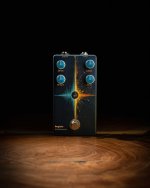
Regista - The Midfield Maestro.jpg
I have been obsessed with this console EQ for a a couple of decades and finally put a mid section in a box.

Long story short: Herr Neve was hired as a consultant by Amek in the 90's with unlimited budget and zero constraint to come up with a channel strip to integrate into their flagship console, the Mozart.

It was not the easiest to work with to say the least... Weighed about a ton, could have melted Greenland in less than 24 hours, and starting price was at around 300k$...
On top of that, it came with a crazy overkill automation system that no one ever understood, needed regular maintenance (As soon as I had brought one strip back to life, another channel would give in...). I actually never met one of these console with every strip functioning at once.

You would have needed to be an electrical engineer, a coder and a mad scientist to just be able to keep it alive.

Pro tools came at about the same time, recalls, etc.

The only thing the MZ15-RN did was to sound great, but that was not enough at the time and that's how it ended for the Mozart.

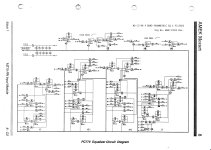
I will share more of the story in the next posts but for now, here are the schematics for the EQ section. Both pages are extracts of the actual technical manual, a different revision than the 300 pages one I own. The only diference is that in my later revision, the opamps are mainly MC33078. All values and tolerances of other components are pretty much the same, or little impact on the sound itself.
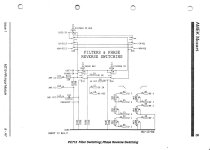
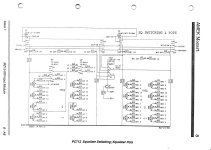
Amek Mozart - MZ15-RN_Input_module schems_Page23.jpg
Amek Mozart - MZ15-RN_Input_module schems_Page24.jpg
Amek Mozart - MZ15-RN_Input_module schems_Page45.jpg
I cannot find the schematics anywhere on the web anymore and besides a few paper versions that I know exist around the world, there are only very few traces of these. So, safekeeping :)
 
We had a 40 channel Mozart at the studio I used to work at. I never used the automation, nor did I see anyone else use it. It was probably the last thing on our tech’s list.

I did see people use the automation on the SSL J series. The manual was kind of funny, they accuse you of being stupid if you don’t understand it.

Anyway, this is impressive and really cool. Will be following along.
 
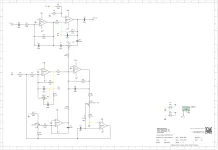
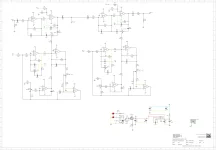
Now, if we skip the overwhelming switching systems and merge all these pages that give you a bit of it all in odd places and isolate MF1 for example, we get a better picture of what is going on in this circuit...

Add an output load, a footswitch and a power supply (the original ran at +/- 17.5V but +/- 9V works fine with a less headroom) and you got yourself Rupert Neve's last parametric mids design in a box!

A couple of notes:
  • The 4.7k gain control says it is logarithmic which I doubt cuz as far as I remember it was unity at noon, so I'd use a linear taper here (5k is fine)
  • The Freq potentiometer (VR7) is a dual gang.
  • The Q and Gain potentiometers were originally concentric pots, thus the reference being the same (VR6), but separating them is more fun.
  • Replace C40 and C41 by 56nF and you got yourself the MF2 section of the strip.
On the next posts, I will get back into the history of the strip itself and then into measurements and spice fun stuff, before to move on to the other sections of the EQ :)

amek-mz15-rn-mf1-schematic.webp
 
We had a 40 channel Mozart at the studio I used to work at. I never used the automation, nor did I see anyone else use it. It was probably the last thing on our tech’s list.

I did see people use the automation on the SSL J series. The manual was kind of funny, they accuse you of being stupid if you don’t understand it.

Anyway, this is impressive and really cool. Will be following along.5
Was there any MZ15-RN channels in it? The one I worked on had mostly MZ10 and 11 and only a few 15 sadly...
 
So... throughout these years of obsession, I never really could find much documentation about this console and its "magic" Rupert Neve strips. As far as I know, only three "major" recordings happened to have used a Mozart:

Nine Inch Nails and the Downard Spiral, Buensa Vista Social Club, and Blur for Think Tank.

I am sure the "Le Pig" studio must have some crazy backstories but the real hassle the engineers went through to strip down these consoles and put them back together in Havana and Marrakech made me feel like I was not the only one to adore the sound of it.

If you want to dig more about these, here is all I could ever find online about it (besides forums discussions):
  • REP Magazine, July 1991 - Jim Williams (Hands-On: Amek Mozart RN) The only contemporary trade press review of the MZ15-RN at its 1991 launch, written by Jim Williams of Audio Upgrades, Los Angeles, and tested on a newly installed console at the Bakery studios in North Hollywood. Williams documents the EQ section in detail: a fully parametric design with adjustable bandwidth and frequency. On listening, he describes the EQ as "very musical" with no nasal or ringing characteristics, and concludes: "The Mozart RN is an impressive performer if you consider the RN modules and the magic touch of Mr. Rupert Neve."
  • Music Week, 25 September 1999 - Jerry Boys (Buena Vista Social Club / Ruben Gonzalez) Jerry Boys places the Mozart at the top of his sonic hierarchy for recording Buena Vista Social Club, describing the Rupert Neve modules as the closest analog to the live original, and the Mozart sounding "like an analogue machine" against the SSL sounding "like an Adat."
  • Resolution Magazine, May/June 2003 - Ben Hillier (Blur / Think Tank) Additional detail on the Marrakesh studio build. Hillier specifies "40-channel Amek Mozart with Rupert Neve channels." Barker confirms the console was bought in Paris, stripped, rebuilt, and flight-cased by four technicians in one week.
  • Sound on Sound, July 2003 - Ben Hillier (Blur / Think Tank) Ben Hillier describes hiring a 40 channel Amek Mozart from Tickle for the Marrakesh sessions. Includes Tad Barker sidebar confirming Tickle flew to Paris to acquire and fully rebuild the console.
  • Sound on Sound, September 2012 - Classic Tracks: Nine Inch Nails 'Closer' Sean Beavan's firsthand account of recording The Downward Spiral at Le Pig. Direct quote on the Mozart: the studio was equipped with a 56-input Amek Mozart with Rupert Neve modules, and "if you EQ'd a Minimoog it would make it sound kind of cooler."
  • Dave Denyer interviews Jerry Boys on March 2025 where Jerry Boys discusses the recording console in detail during the interview. He emphasizes that having the right console was crucial to achieving the specific, open sound of the Buena Vista Social Club record.
    • The Egrem Studios in Havana used an Amek Mozart console equipped with Rupert Neve modules (07:27-07:33). Jerry specifically sought out a console with the same design when mixing in Los Angeles because other boards did not capture the right sense of space (22:36-23:02).
    • After initial mix attempts in Los Angeles failed to sound like their original Cuban rough mixes, they located a studio owned by a religious organization that had the correct Amek board with Rupert Neve modules (23:31-24:13). Once they set up the tracks on that desk, the sound matched what they were looking for immediately (24:06-24:13).

That is for the history part, next up is the spice fun!
 
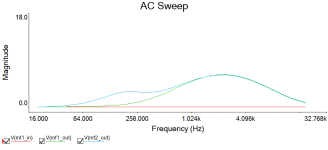
Let's get into spice and have a look at the +/- knob, I'll call it gain just because.
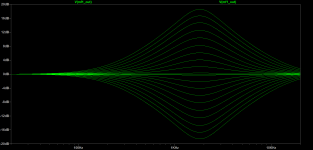
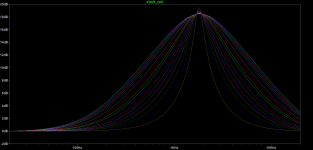
First of all, here is the gain mapped with the original logarithmic taper:
1783971252336.png
As you can see, it is not very linear (pun intended) and unity is at 70% clockwise.

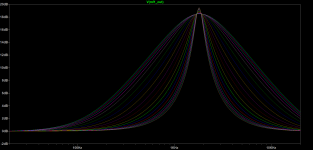
Now with a linear taper, unity is at noon and it seems a bit more even, but then we lose finesse in the extreme settings:
1783971548095.png

Now, and that's what I use in my Regista, the ideal one I found for a better increment (and cutting less bass) is 25k with a 3B taper (somewhat between W and B tapers):
1783971750937.png

Wow, look at that.

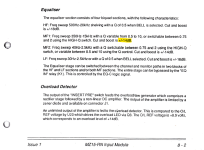
Ok, now, in the Technical Manual, there is a bit of marketing blurb because why not, and we will just compare with what is measured here for fun.
1783972176357.png

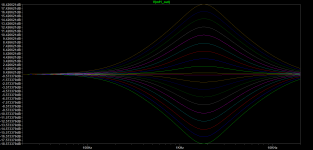
Without any clipping, it actually goes up to a little above 18dB (-18.573379dB to 18.57253dB to be obsessively precise) for MF1, weird choice to state 14dB here:
1783972279516.png

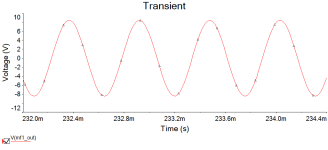
And even at +/-9V, there is no reason for it to clip with a 500mV AC coming in at 1.8kHz (which is the center frequency for MF1, or again, if obessively precise: 1810.19336029709Hz), weird choice of statement.
1783972752258.png

Next, we will look at the Q factor.
 
Last edited:
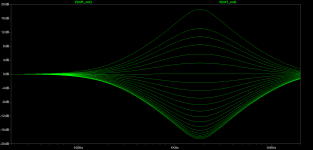
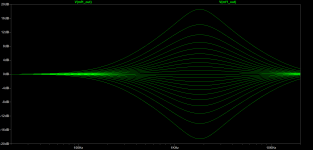
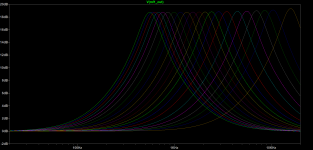
Looking at the Q with the gain all the way up, we see a nice range of useable settings. Much more fun that a switch, come one!
1783973983655.png
The center frequency does not move and the gain goes from 18.48 dB ccw to 19.44 dB cw at center frequency.

Now the interesting thing is the marketing claim once again, it states above that MF1 has a "Q variable from 0.5 to 10"...

Let's check this out:
The formula to get the Q is Q=fc/(f2-f1), fc being your center frequency, f2 being your higher freq at -3dB and f1 being your lower freq at -3dB.

Fully CCW we have:
our center frequency is 1810.20Hz, with a gain of 18.48dB.
15.48dB at 896.17Hz for f1.
15.48dB at 3688.99Hz for f2.

So our minimum Q is 1810.20/(3688.99-896.17)=1810.20/2792.82=0.6482... a little above the 0.5 stated in the specs.

Fully CW we get:
fc is 1810.20Hz at 19.44dB.
f1 = 1601.02Hz at 15.44dB
f2 = 2027.94Hz at 15.44dB

So our max Q is 1810.20/(2027.94-1601.02)=1810.20/426.92=4.24... slightly below the 10 stated in the specs.

Oh and swapping to a reverse log pot for Q, gives you a bit less finesse around noon and is a bit more precise around extreme settings, matter of preferences:
1783976391482.png


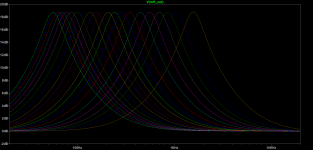
Next we'll look at the frequency range.
 
Back
Top