
jhaneyzz
Well-known member
I won't repost my build report for Autistic Andy, but here is an Instagram link if anyone wants to forward it around to spread the word for autism awareness.


Here a reverb I have been working on based off the Effects layouts Vorticity board (EQD levitation) with a switchable pre/post decay effects loop (Originally I was trying to find a good buffer but never quite came up with a good enough one that worked well in the pre decay position) Naming it the Echolalia for my Daughter as part of her condition has pathological Echolalia.
View attachment 45239
Many children on the autism spectrum use echolalia, which means they repeat others’ words or sentences. They might repeat the words of familiar people (parents, teachers), or they might repeat sentences from their favourite video.
View attachment 45240
When children repeat words right after they hear them, it’s known as immediate echolalia. When they repeat words at a later time, it’s known as delayed echolalia. As a result of the time delay, delayed echolalia may seem very unusual because these sentences are used out of context. For example, a child might enjoy a song his teacher sang at circle time, and then later ask to sing it at home by saying “It’s circle time” instead of saying the name of the song.
While it might be difficult to figure out what a child is trying to say when he or she uses echolalia, learning a little bit about this type of speech can help you figure out the meaning behind his or her message.
View attachment 45241
Children on the autism spectrum use Echolalia because they learn language differently.
Typically developing children tend to begin learning language by first understanding and using single words, and then they gradually string them together to make phrases and sentences.
Children on the autism spectrum often follow a different route. Their first attempts at language may be longer “chunks” of language (phrases or sentences), which they are not able to break down into smaller parts. These chunks are more grammatically complicated than they could put together themselves, and they don’t understand what the individual words mean.
View attachment 45242
There may be times when children use echolalia to soothe themselves when they’re upset or to rehearse something, and in those cases echolalia may not be intended to send a message to someone. But there are also many reasons why children use echolalia for a communicative purpose,
I hope to see some cool stuff this month! Hopefully I can get a demo of this done in the near future.

My son is high functioning, but has anxiety disorder too. Echolalia is definitely a thing at my house, even though I never actually knew the term for it before today. He also watches the same chunks of videos over and over again, which I think is a coping mechanism because he latches onto those speech/song snippets repeating them immediately and later, sometimes even acting them out.Here a reverb I have been working on based off the Effects layouts Vorticity board (EQD levitation) with a switchable pre/post decay effects loop (Originally I was trying to find a good buffer but never quite came up with a good enough one that worked well in the pre decay position) Naming it the Echolalia for my Daughter as part of her condition has pathological Echolalia.
View attachment 45239
Many children on the autism spectrum use echolalia, which means they repeat others’ words or sentences. They might repeat the words of familiar people (parents, teachers), or they might repeat sentences from their favourite video.
View attachment 45240
When children repeat words right after they hear them, it’s known as immediate echolalia. When they repeat words at a later time, it’s known as delayed echolalia. As a result of the time delay, delayed echolalia may seem very unusual because these sentences are used out of context. For example, a child might enjoy a song his teacher sang at circle time, and then later ask to sing it at home by saying “It’s circle time” instead of saying the name of the song.
While it might be difficult to figure out what a child is trying to say when he or she uses echolalia, learning a little bit about this type of speech can help you figure out the meaning behind his or her message.
View attachment 45241
Children on the autism spectrum use Echolalia because they learn language differently.
Typically developing children tend to begin learning language by first understanding and using single words, and then they gradually string them together to make phrases and sentences.
Children on the autism spectrum often follow a different route. Their first attempts at language may be longer “chunks” of language (phrases or sentences), which they are not able to break down into smaller parts. These chunks are more grammatically complicated than they could put together themselves, and they don’t understand what the individual words mean.
View attachment 45242
There may be times when children use echolalia to soothe themselves when they’re upset or to rehearse something, and in those cases echolalia may not be intended to send a message to someone. But there are also many reasons why children use echolalia for a communicative purpose,
I hope to see some cool stuff this month! Hopefully I can get a demo of this done in the near future.

Lovely build and an excellent description of echolalia dude. Thomas uses echolalia to learn to speak. It's tough figuring out what he means when it sounds like he's using an out of context phrase but it always means something to him.
Everyone on the spectrum is a little or even vastly different but there are certain hallmarks that span the gambit, and this is a common one that you don’t really ever see talked about but I feel is crucial in understanding this and it’s pathology.My son is high functioning, but has anxiety disorder too. Echolalia is definitely a thing at my house, even though I never actually knew the term for it before today. He also watches the same chunks of videos over and over again, which I think is a coping mechanism because he latches onto those speach/song snippets repeating them immediately and later, sometimes even acting them out.
I dig your trademark artistic style and super clean builds, this being no exception. Keep up the excellent work.

 www.assistiveware.com

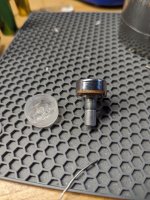
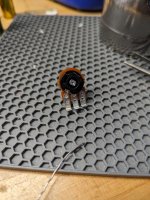
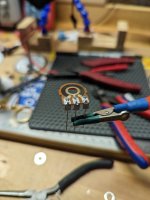
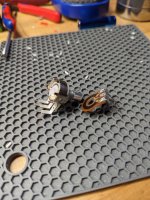

That’s very cool!I posted a build report of my effort. My effort to get more people in this thread is to post the pics of the custom dual gang pot I made for the build. I needed a dual gang 10k pot for the build but one needs to be logarithmic and the other antilogarithmic. I used two pots. The first a dual 10ka and a regular 10ka pot. Since the gang facing the board needs to be a C taper and is upsidedown we will use the single 10ka as our sacrificial lamb. Let's take the cover off and open the tabs to pull it apart.
View attachment 45288
Once the bottom is apart we now need to seperate the the wafer from the shaft. We need the slowly and carefully break away the black plastic retainer connecting the shaft to the wiper. Go slow and don't touch the track. That black ring on the wafer is the track that carries the resistance, and it scratches easily.
View attachment 45289
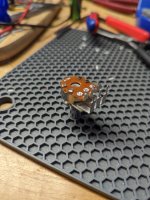
Now that it's removed I trim the legs and add diode legs that will be soldered to the board.
View attachment 45290
Now we need to open the dual gang pot and remove the bottom wafer that we will be replacing.
View attachment 45291
And now I put the new one in and close it up. Since the bottom gang is facing the opposite direction the top and they are mirrored in reverse, the A taper is now a C taper and we have made our custom dual taper 10k pot. Here it is all put together with the legs all trimmed to match.
View attachment 45292
I posted a build report of my effort. My effort to get more people in this thread is to post the pics of the custom dual gang pot I made for the build. I needed a dual gang 10k pot for the build but one needs to be logarithmic and the other antilogarithmic. I used two pots. The first a dual 10ka and a regular 10ka pot. Since the gang facing the board needs to be a C taper and is upsidedown we will use the single 10ka as our sacrificial lamb. Let's take the cover off and open the tabs to pull it apart.
View attachment 45288
Once the bottom is apart we now need to seperate the the wafer from the shaft. We need to slowly and carefully break away the black plastic retainer connecting the shaft to the wiper. Go slow and don't touch the track. That black ring on the wafer is the track that carries the resistance, and it scratches easily.
View attachment 45289
Now that it's removed I trim the legs and add diode legs that will be soldered to the board.
View attachment 45290
Now we need to open the dual gang pot and remove the bottom wafer that we will be replacing.
View attachment 45291
And now I put the new one in and close it up. Since the bottom gang is facing the opposite direction the top and they are mirrored in reverse, the A taper is now a C taper and we have made our custom dual taper 10k pot. Here it is all put together with the legs all trimmed to match.
View attachment 45292



Indeed you did.I’m definitely going to be late I bit off a little more than I could chew but I promise I will still submit something even if it’s May!

 ) hope to see some cool stuff!


