Buddy's Kit Build Journey - Show off yours as well!

With sanding done for the day, I took some time with stains. Here is what I used. The stain and dyes came from Solo Guitars. The conditioner is something I've had lying around for a while.

View attachment 51467

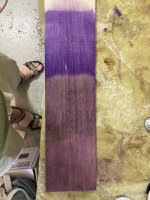
Taking my scrap basswood I also sanded it down to 800 grit. This went much faster than the body since there's less to do and can all be done with the block. I sectioned off 2 areas in pencil to try some test stains. I first used the wood conditioner on the bottom 2 sections cuz I wanted to see how stain would react without the conditioner. I mixed up a few tablespoons of the clear stain with 4-5 drops of just purple. I also wanted to try a regular water based dark stain to potentially make the wood grain pop when color is applied on top.

I'm not sure I like the results so far. I let the conditioned purple sit there for a few minute before wiping off. The wood barely took anything so I upped the dye amount in my mixing bowl. It looks better, but I think I may need another coat. The dark one I'm going to sand down and see how that does with some purple on top of it. The top purple section looks surprisingly good (ignore that massive line there. That's where I wiped off the stain. I have to be patient. More testing here is needed.

View attachment 51468
Prior to staining, I think you want to stop at 220 grit, at the finest. I think it has some effect on absorption if you go finer. https://generalfinishes.com/instructions/how-prepare-wood-for-stain and several other pages I just came across seem to agree about the 220. I haven't read much into them, so maybe the reasoning may be there too.
 
The man at Keda dyes actually recommends stopping at 150 grit, then a light wetting to raise the grain.
Keda Dyes what I've gone by when finishing a project.(even with snail mail he's close enough I can get them in 2-3 days max...)
I hit 200 grit on this 335 bass and you can see the penetration issues.... This is the same pos/pita I got from fretwire that never had a neck angle worth 2 🤬 🤬 🤬 🤬 🤬
 

Attachments

  • hb 2.jpg
    hb 2.jpg
    1.5 MB · Views: 10
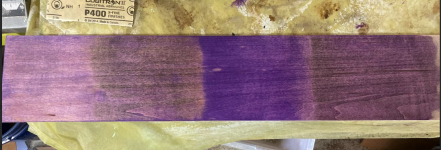
Tried a second coat of stain today. Taking @cwsquared advice I knocked everything back with just 220 grit. The deep purple is unconditioned. I’m torn between the deep purple or the middle one, but not happy with the blotchiness. I think I may need to try one more coat on the conditioned sections. Rattle cans are on deck if this doesn’t work out.
 

Attachments

  • IMG_3086.jpeg
    IMG_3086.jpeg
    425.4 KB · Views: 14
Tried a second coat of stain today. Taking @cwsquared advice I knocked everything back with just 220 grit. The deep purple is unconditioned. I’m torn between the deep purple or the middle one, but not happy with the blotchiness. I think I may need to try one more coat on the conditioned sections. Rattle cans are on deck if this doesn’t work out.
Oh, and I love that deep purple. Kinda what I was thinking for the Solo 6 string bass I will eventually build.
 
Buddy, you could try some of that stain pretreat/conditioner stuff. You coat the wood with it then do the stain and it's supposed to be more even without the blotchy coverage. I'm pretty sure the pretreat stuff is just alcohol or some kind of thinner.

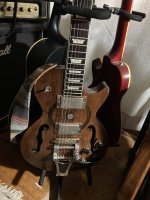
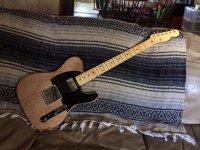
I used some Minwax stain on an alder tele body (no pretreat/conditioner) and it came out pretty even. I still have the body, but I gave the neck away to a friend for his project.

alder tele.jpg

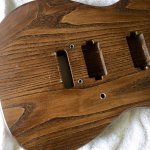
This other body was Minwax walnut stained:

11217519_10155787632190441_8142576474991344354_n.jpg

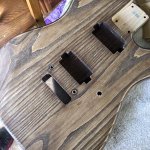
Sanded down:

11402718_10155787632335441_7526158708276914872_n.jpg

Then coated in several layers of Tru Oil with 0000 steel wool in between coats (I think, it's been almost a decade since I did it):

1554482_10155787632565441_6834982265854860764_n.jpg
 
Speaking of FIRE!
(isn't that how to get "flame maple?")

Here's my Tele project again (pics from "What's on your workbench?" thread):

b8690aa0-ba81-4cad-80a8-7a16ca45cd9b-jpeg.48277
bb8471cc-a00c-4018-92a8-84e1bc10dc53-jpeg.48281


Other than torching some more around the edge for a "torchburst" — Nothing new to report.
 
Alright, I tried one more experiment with stain that I was relatively please with. The left 2 spots were first treated with wood conditioner. The first one is just purple (2-3 coats). The second is black that was sanded back then 2 coats of purple. The right 2 spots are untreated: 3 coats purple and a knocked back black with a single coat of purple. Of these 4, I'm going with the untreated black/purple. This whole process took a while since I had to put a coat on and wait a day to resume.

1688569165895.png

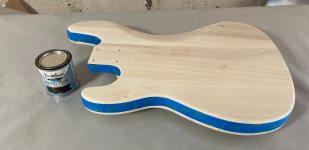
From my first kit build I remembered that the end grain, regardless of wood type, will suck up 235543634 times more stain than face grain. Since I don't really want to sand the end grain too much and start messing up the overall shape I decided to get some painters tape to keep the black away from it. I'll stain one side, retape it, then do the other side in black (or in this case ebony).

1688569465169.png
 
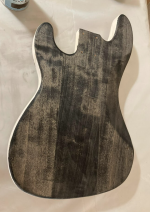
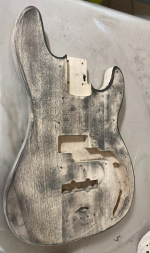
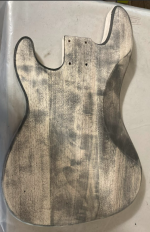
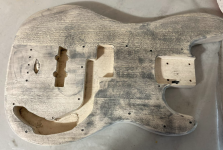
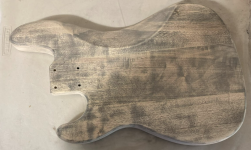
And just what I thought would happen did happen. It is very blotchy, but I'm not SUPER concerned right now since I'll be knocking it back with sandpaper (220 grit). I'll need to make sure the stain is dry enough otherwise I'll go through a whole pack of sandpaper. Sometimes you just need to bite the bullet and go with something you're not 100% sure about. Heck, it's just a kit build for me to have fun.

1688569632950.png
 
And just what I thought would happen did happen. It is very blotchy, but I'm not SUPER concerned right now since I'll be knocking it back with sandpaper (220 grit). I'll need to make sure the stain is dry enough otherwise I'll go through a whole pack of sandpaper. Sometimes you just need to bite the bullet and go with something you're not 100% sure about. Heck, it's just a kit build for me to have fun.

View attachment 51825
Outside of that middle piece of wood's bottom half, which appears to have taken dye really differently, it just looks like there is some figuring, which when top coated will get it some depth.
 
Took some more time on lunch break today to chip away at it. I'll look at it again tomorrow, but this may be good enough for the next step. It doesn't need to be perfect since color is going on top of this, plus I'm working with basswood so there will always be blotches. For the record, if I were to do another kit build (probably will at some point) I'd choose a different wood for the body. It would be worth the extra $ for more consistent stain. If I choose to stain, that is :)

1688579777597.png
1688579794128.png
 
I'll tackle the body on my lunch break today, but the past few mornings I've put some time into the neck/fretboard. It all appeared to be unfinished with the exception of the fretboard itself. As mentioned in one of the early posts here, this was the nicest looking piece of the kit and I want to let it shine in all its glory. Unfinished, it's in pretty good shape from a smoothness perspective, but AWLAYS make 1000% sure you're working with raw wood. Many times, and even if you get raw wood from a hardware store, there's a slight film or coloring on the outside and it's a good idea to take it off with some sandpaper. I started lightly with 400 grit, then moved up to 800, 1000, then 1500 even on the fretboard. This thing feels like glass now!!! That's what I did over the US holiday weekend.

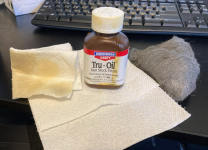
For the past few mornings this week, I've used Tru-Oil to finish it. You can also use boiled linseed oil for the same result, but I already had this from my first kit build. There are 2 methodologies to applying it from the research I've done: with your finger or with a paper towel. My first coat I used my finger and probably put on too heavy of a coat. With this stuff, less is more in terms of coat thickness. Same goes for painting a room or a piece of furniture. Lighter coats make it look better. The next day I applied it with a paper towel and got better results. With this stuff, its best to apply a coat then wait 24 hours or at least overnight to semi-cure. For every other coat I'm going to buff/knock it back with some 0000 steel wool. Today I buffed it out with the wool and applied a 3rd coat. I may stop at 5 or 6 coats, but it's really up to you how many you want. More coats = more shine and a thicker finish. I like the feel of the raw wood so 5 or 6 will be enough. Once I'm done with this process, let it sit somewhere and cure for a whole week. I hate waiting...

1688653909244.png
 
I'll tackle the body on my lunch break today, but the past few mornings I've put some time into the neck/fretboard. It all appeared to be unfinished with the exception of the fretboard itself. As mentioned in one of the early posts here, this was the nicest looking piece of the kit and I want to let it shine in all its glory. Unfinished, it's in pretty good shape from a smoothness perspective, but AWLAYS make 1000% sure you're working with raw wood. Many times, and even if you get raw wood from a hardware store, there's a slight film or coloring on the outside and it's a good idea to take it off with some sandpaper. I started lightly with 400 grit, then moved up to 800, 1000, then 1500 even on the fretboard. This thing feels like glass now!!! That's what I did over the US holiday weekend.

For the past few mornings this week, I've used Tru-Oil to finish it. You can also use boiled linseed oil for the same result, but I already had this from my first kit build. There are 2 methodologies to applying it from the research I've done: with your finger or with a paper towel. My first coat I used my finger and probably put on too heavy of a coat. With this stuff, less is more in terms of coat thickness. Same goes for painting a room or a piece of furniture. Lighter coats make it look better. The next day I applied it with a paper towel and got better results. With this stuff, its best to apply a coat then wait 24 hours or at least overnight to semi-cure. For every other coat I'm going to buff/knock it back with some 0000 steel wool. Today I buffed it out with the wool and applied a 3rd coat. I may stop at 5 or 6 coats, but it's really up to you how many you want. More coats = more shine and a thicker finish. I like the feel of the raw wood so 5 or 6 will be enough. Once I'm done with this process, let it sit somewhere and cure for a whole week. I hate waiting...

View attachment 51887

One bit of warning if you use boiled linseed oil. Soak the used rags with some water and put them in a plastic grocery bag before disposing.
They can spontaneously combust under the right conditions.
 
Back
Top