CONTEST Buddy's Summer Contest - 1 Knob? No Prob!

CONTEST
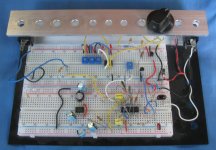
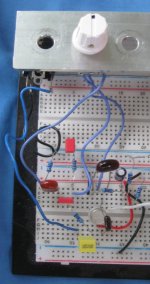
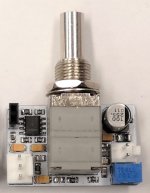
Here's the first one outta the gate. It's the best part (IMHO) of the Maestro FSH-1: the sample & hold filter. In the FSH-1, a noisy transistor and an analog sample / hold circuit generates the random staircase waveform that tunes the VCF (voltage-controlled filter). I replaced the noisy transistor & S/H with a STOMPLFO chip. The STOMPLFO's waveform is set to "random steps." The STOMPLFO chip is top center. The trimmers to the left set the STOMPLFO's WAVEFORM, OFFSET & DEPTH. They will eventually be replaced by fixed resistors. The trimmer to the right of the STOMPLFO is the Q control. That will probably remain a trimmer. The big knob is, you guessed it, SPEED. The charge pump that makes -9V is at the lower left and the LM13700 dual OTA that forms the VCF & input buffer is at the lower right. The +5V reg is at the upper right.

I call it Fish Sauce Lite. For the past few months, I've been planning a much more complex version that would have over a dozen knobs. This is that circuit stripped down to the bare bones. I'll publish the schematic in the next day or two, after I finish tweaking some component values.

Fish Sauce lite v0.1 breadboard 02.jpg

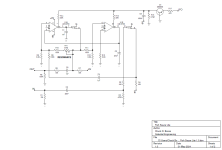
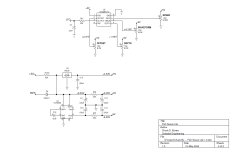
Schematic added. Use whatever charge pump you like. Voltages marked on schematic indicate current trimmer settings. The other waveforms that the STOMPLFO makes are also fun & useful.

Fish Sauce Lite v1.0 sheet 1.png

Fish Sauce Lite v1.0 sheet 2.png
 
Last edited:
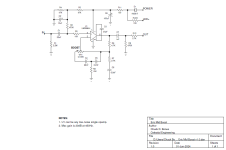
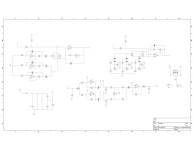
Next up: Eric the Mid Boost. This is a minimalist version of the Eric Clapton Mid Boost. It does not have a Volume control because the guitar's Volume control serves that purpose. Freq response is close to the ECMB for BOOST settings up to 6. Above that, the midrange becomes more focused. Any low-noise opamp (such as TL071) will work. For fun, I used an LM308AH.

I should add that I found two version of the Clapton Mid Boost schematic on the Internet: the ones that match the PedalPCB schematic and ones that look like they were copy and pasted from a Fender schematic. The only significant difference is the Fender schematic has a 1nF cap after the mid boost section. That cap adds treble roll-off as the BOOST pot is turned up. The circuit below was designed to mimic the PedalPCB version.

Eric Mid Boost v1.0.png


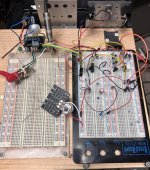
I had a little extra room in one corner of the Fish Sauce Lite breadboard, so I build Eric there.

Eric v1.0 breadboard 02.jpg
 
Last edited:
This is a silly idea I've had for awhile. The Boss HM-5: Tonestack from the HM-2 and HM-3 running in parallel. I already had the parallel and HM-
2 boards so I breadboarded the HM-3 part and it all fired up quite well! I can get it in a 125B, don't worry. :ROFLMAO:

Only the blend knob will be external. 6 trimpots inside for EQ/VOL adjustment.


Photo 2024-06-02, 13 25 10.jpg

hm-5.png
 
Last edited:
Interesting! You'll probably notice that the BLEND knob behavior is very different depending on the settings of the various trimmers because filters don't just change the amplitude, they also change the phase. That means when you parallel filters, certain frequencies will add and other frequencies will cancel. Which frequencies depends on the various tone trimmer settings. It's not intuitive.

BTW, you have a few extra components in there and the blend circuit is unnecessarily complicated. But hey, fix the one typo and it will work. (y)
 
Interesting! You'll probably notice that the BLEND knob behavior is very different depending on the settings of the various trimmers because filters don't just change the amplitude, they also change the phase. That means when you parallel filters, certain frequencies will add and other frequencies will cancel. Which frequencies depends on the various tone trimmer settings. It's not intuitive.

BTW, you have a few extra components in there and the blend circuit is unnecessarily complicated. But hey, fix the one typo and it will work. (y)

I did indeed! I turn them all to 10 anyway so it works as intended there :LOL:
 
Last edited:
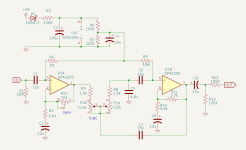
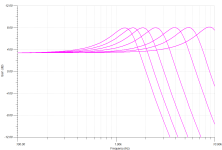
Here it goes. A pickup revoicer. One knob (RV1 is a trimpot). You can move the resonant peak wherever you want between about 1k and 10k. C7 controls the amplitude of the peak if you're not happy with the 5dB default. A little goes a long way (22nF gives a 12dB peak).

You can use a TL072 op amp if you don't mind a slightly higher noise floor and lower battery life.

Revoicer.png FR.png
EDIT:

OK, this is technically not exactly a picture of the circuit above, but it's basically the same schematic with just a few changed component values. I did build one unit exactly as above but it's not with me anymore, so this pic will have to stand in for it.

a.jpg
 
Last edited:
Nice!. Can you explain what C6 does?
Not that much. Blocks the op amp's DC offset from going through the pot.

Why 15nF, one might ask?? Well, it's a perfectly cromulent value and I already use it elsewhere, helping to keep the BOM lean.
 
Last edited:
You actually hear scratching? With C6 & R9 gone, the DC current thru the dual pot will not be more than 0.6nA. Amounts to a <12μV variation when turning the pot from end-to-end.

Nice choice of opamp! Low power & low noise. Less expensive compared to OPA2134.
 
You actually hear scratching? With C6 & R9 gone, the DC current thru the dual pot will not be more than 0.6nA. Amounts to a <12μV variation when turning the pot from end-to-end.

Nice choice of opamp! Low power & low noise. Less expensive compared to OPA2134.
I didn't do the math, but from experience, I always block any DC from going through a pot that's in the audio path. I most definitely wouldn't want to remove R9 and C6 and bias pin 5 through the pot. The wiper noise would modulate or even very briefly interrupt the DC bias, and that's bound to sound nasty.


Yeah, I love my OPAx205. Best part for the job IMO. Not $0.50, though...
 
I didn't do the math, but from experience, I always block any DC from going through a pot that's in the audio path. I most definitely wouldn't want to remove R9 and C6 and bias pin 5 through the pot. The wiper noise would modulate or even very briefly interrupt the DC bias, and that's bound to sound nasty.
Makes sense. Nice board layout. Pick & place for the surface mounted stuff?
 
Back
Top