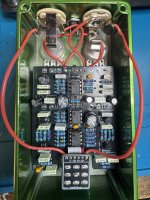
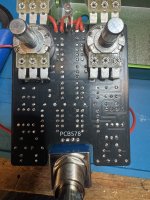
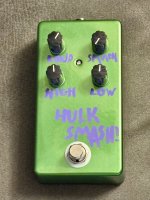
Okay, so it took a bit longer than I expected to get back to the work bench, but I've got some good news and some additional questions. First, though, here are a few answers I promised (in case anyone finds this thread down the road and wants to follow the bread crumbs):
What are your voltages on IC1? I don’t see them listed, forgive me if I overlooked them.
IC1 voltages are as follows:
Pin 1: 4.5v
Pin 2: 4.5v
Pin 3: 4.5v
Pin 4: 0
Pin 5: 4.5v
Pin 6: 4.5v
Pin 7: 4.5v
Pin 8: 9v
I'm with xconverge, you've got to find out what's going on with C8. As xconverge pointed out, you should have SOUND on all common points connecting R10, C7, R11, and C8 — this is what's known as a "node". If I recall, you've got audio on both sides of R10 so how can you NOT have it on the node-connected side of C8?
If C8 is broken or the trace around it damaged or a short of the signal to ground (unlikely), then like a dam there should only be a trickle of signal at best beyond C8 — yet you mention you've got "tone" further downstream in the signal path.
I switched my tone from a square wave to a clean electric guitar loop I found online. Running this sound through the board confirmed that I was getting sound until I got to C8 and then it didn't turn up again until leg 1 of IC1.1. I cranked the amp just to make sure I wasn't missing anything faint on the points between leg 2 of R10 and leg 1 of IC1.1, but there was no guitar sound until it popped back up on leg of IC1.1. I still don't really understand how the tone can disappear and reappear like that, but I guess there's probably a reason somewhere in an electronics textbook...
A tiny whisper of a solder-bridge is enough to undermine your circuit. Get out the magnifying glass, keep looking, keep inspecting.
Triple checked everything with the magnifying glass, and everything looked copacetic as far as I could tell.
I would use a sine wave instead of a square wave. Even more preferable for me would be to use a looper with some clean guitar going into it. Start with using a sine wave instead of a square wave if you don't have a looper laying around.
Yep, switching the actual guitar tone helped--thanks for that tip!
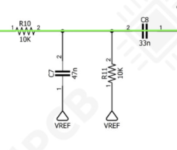
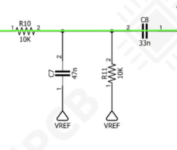
I don't know, this is where I would use continuity on my DMM. One side (the left side in the schematic) of R10 is directly (through traces) connected to IC2.1 pin 1. So put one DMM probe on pin 1 of IC2.1, and then the other probe on one side of R10. If it beeps then that is the left side of R10 on the schematic. If it doesnt, try the other side of R10 on the board. The reason I am suggesting finding that side (leg 1) of R10 is because leg 2 is the suspect one to me. You can and should then repeat the test once you know for sure which one is leg 2 (because you just found which one was leg 1). Leg 2 of R10, you can then put one probe of the meter on, and with the other probe, touch both sides of C8, both sides of C7, both sides of R11, etc to find which side of each are all in this screenshot of the single node (center point of the diagram here).
View attachment 112208
From the same diagram above... Picture the audio signal through the schematic/pedal as a meandering river. at various points in the river there are blocks/beaver dams/whatever that each alter the water in certain ways, these could be ICS, capacitors, resistors, whatever.
In the diagram above, the river flows directly from R10 leg 2 to C8 leg 2 with nothing in between. There are 2 little off-shoots of the river (streams?) that go to leg 2 of C7 and leg 2 of R11 (and then through other "things", the actual capacitor/resistor/etc).
What this means, is that in between R10 leg 2, C7 leg 2, R11 leg 2, C8 leg 2, it is all the same water with nothing in between around them.
If you oriented the components correctly, you could even just solder all of those legs together in a big blob (this is essentially the core of how "point to point" wired pedals work. The traces on the board do this already for you. SO, according to the schematic, all 4 of those leads should ALREADY be touching eachother or have continuity with the DMM.
The chances of leg 2 of R10 or the pad being broken/damaged, leg 2 of c7 also being damaged, leg 2 of r11, being damaged and/or leg 2 of c8 all or at least more than 1 being damaged is less-likely to me than just 1 of those being damaged. If you really wanted to, you could solder multiple jumper wires on, to "recreate" the traces in the board, but I think if you just solder a single jumper wire, it will reconnect the single damaged pad back with the other 3 components at the node. (As long as you are connecting it to the right leg according to the schematic, the ones that are all part of the same node/junction)
Okay, so this was the workflow I spent most of my time today working through, testing continuity and trying to sort which legs were which on the relevant components. I started by checking continuity between IC2.1 leg 1 and R10. I found that the right side of R10 (looking down at the side of the PCB with visible components) had full continuity. There was none between IC2.1 leg 1 and the other leg of R10, so I assumed that the right side of R10 is leg 1 and the left side is leg 2.
Here's where it gets interesting. When I checked continuity between R10 and C7, R1, and C8, I got the following results:
-No continuity between leg 2 of R10 and any of the other components
-A three-second(ish) continuity tone between leg 1 of R10 and leg 2 (I assume) of C7
-A short beep of continuity tone between leg 1 of R10 and leg 2 (I assume) of R11
-No continuity between leg 1 of R10 and either leg of C8
A lot of these results didn't make clear sense to me. I didn't understand why I was getting continuity to later components from leg 1 of R10 but not leg 2, and I also wasn't sure if the differences in tone length meant anything or were just symptoms of component types and their location in the schematic. Regardless, though, this all made me think that, whatever else was going on, the complete lack of continuity between R10 and C8 was the most obvious weirdness.
So, I just decided to take a shot and solder a jumper wire between leg 2 of R10 and what seemed to be leg 2 of C8. As soon as I did that, I got wildly different results from both my continuity checks and the sound probe. There was clear continuity between all legs in the R10/C7/R11/C8 node, and when I checked the guitar loop tone at IC1.1, it was much louder and had a distorted sound. I figured, okay, maybe we're onto something, and reassembled the pedal to check it with my actual amp and guitar.
The difference is night and day. The knobs all appear to be working correctly. I'm getting pure volume increase/decrease (down to no sound at all) from the LOUD knob, and both LOW and HIGH do exactly what they should. When the GRUNGE knob is turned down all the way, the pedal is still fairly heavily distorted, and as I turn GRUNGE all the way up, the sound goes from distortion to something more fuzz-like all the way to whatever's past fuzz.

Basically, I think my jump from R10 to C8 solved the problem, and I can't thank everyone enough for all the guidance to help get this sorted. My only remaining questions/concerns are whether some remaining odd behavior is due to me misidentifying the legs on some of the components, or if this pedal is just quirky. Here's what still seems off (or at least unusual to me):
First, if I've got the pedal engaged and unplug the guitar cable from my guitar, I get a sustained squeal. Not the kind that you get just when you get the tip of the cable input close to the jack, but a nonstop tone regardless of where the cable tip is in relation to the guitar or anything else. Is this normal?
Second, the pedal is very noisy with the GRUNGE knob turned up. Like, it makes my RAT sound quiet in comparison. It sounds fine when I'm playing, but the minute I stop, the noise is considerable. Is this also normal for this pedal?
I guess the only variable I'm concerned about is whether I've correctly jumped R10 leg 2 to C8 leg 2, and if I haven't, would that make the pedal noisy/squealy, or is that just the special "character" of this pedal? (I've never played an actual DOD Grunge, but some internet searching makes me think this is just how the pedal is.)
So, basically, I think this is either resolved or very close to resolved. I'll wait to mark it as SOLVED until I have a better sense of what's going on with the noise. I honestly have no idea why there was no notable connection between R10 and C8 when all of the soldering was solid, but some mysteries aren't meant to be solved, I guess!
Thanks again for all the help, and let me know if you've got thoughts on these last couple of questions!