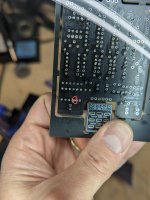
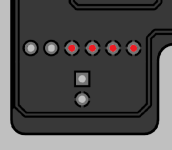
Scratching the board isn't a problem, unless:
1) an underlying trace is damaged;
2) a bridge is created where one shouldn't be.
Use your DMM continuity mode to test: find all connections that pertain to the surrounding PCB pads, and determine if any are not connected but should be (problem 1 above); and test for unwanted connections between the two pads or their related-relevant adjacent pads.
Don't forget that a pad may be on one corner of the board, but the trace may run all the way to a component-pad on the opposite corner.
I'd say compare all the above to the schematic, but I don't even know if the schematic has been released yet.
Definitely sort out your iron — there are little tubs of stuff that can recondition your iron's tip. There are plenty of videos about this:
It is considerably cheaper to buy a tub of tip-reconditioner than to buy a new iron, but depending on make/model it might be as cheap to just get a new tip. If it's a cheap-oh iron, now might be the time to invest in a solder-station (doesn't need to be expensive, even the cheap ones are generally better than pencil-irons. Bonus if you can control the heat.
Another option is to keep the damaged board, but get a new board and build the new one out. You can always go back to the old board that, even if it's damaged, may be salvageable by jumpering wire from component to component to bypass the damaged pad/trace (if there is indeed damage).
That's all I've got for now.