Distortion + vs. DOD 250…

MXR Distortion + or DOD Preamp 250

  • MXR Distortion +

    Votes: 2 28.6%
  • DOD Preamp 250

    Votes: 5 71.4%

  • Total voters
    7

Coda

Well-known member
I’m planning to build either the Distortion + or the DOD 250. I plan on adding a toggle for diodes (Ge/lift/si), and maybe a toggle for treble and or input cap. As for what goes between the mods?…not sure yet. I like what I have heard of the MXR, but the more I look into it the more I see people preferring the DOD. Now, as a preamp, something tells me that the DOD would be best I to an overdriven amp. I prefer a very, very clean amp.

So I’d like some opinions. Benefits to either or? Mods? Etc. Please and thank you’s.
 
I like the Distortion +. It is incredibly moddable for such a simple circuit. You may want to have switchable capacitors in the feedback loop
 
As far as I can tell, they are the same pedal. The main complaint with the Distortion + and the DOD 250 is the low output volume. One way to increase the output and still use Ge diodes is to string 2 or 3 in series. The diode switch will cause big changes in output volume because going from Ge to Si diodes increases the output around 3x. Lifting the diodes increases the output 20x over the Ge diodes. Put in a socket and try different opamps. You can vary the bass content by altering the 47nF cap. As buddy says, you can put various caps in the opamp's feedback loop. I suggest you breadboard it first because basically, every component value is negotiable. Hope this helps. :cool:
 
As far as I can tell, they are the same pedal. The main complaint with the Distortion + and the DOD 250 is the low output volume. One way to increase the output and still use Ge diodes is to string 2 or 3 in series. The diode switch will cause big changes in output volume because going from Ge to Si diodes increases the output around 3x. Lifting the diodes increases the output 20x over the Ge diodes. Put in a socket and try different opamps. You can vary the bass content by altering the 47nF cap. As buddy says, you can put various caps in the opamp's feedback loop. I suggest you breadboard it first because basically, every component value is negotiable. Hope this helps. :cool:
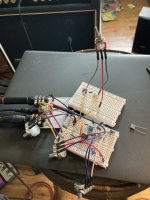
Breadboarding the circuit is my first step. I wanted to sort through the few differences between the two circuits, and audition Ge diodes. I’ll keep the volume thing in mind. I’ll also try some different LED’s. It’ll be purtier than a xmas light display…
 
R2 (1m in the build doc) controls the gain potential. The higher the value the more gain. When I breadboarded mine it sounded better using double the resistance, but that just means it's hitting the power rails that much harder. A tone filter is needed on this circuit too IMO or you can use switchable caps like mentioned above. The stock circuit is very treble-y, but back then amps were pretty dark if I remember correctly.

Brian Wampler's write up of his mods for this. You should try them out on your breadboard. If you haven't breadboarded a feedback loop like this before you may scratch your head for a minute trying to figure the layout. Jumper wires are your friend here. https://www.premierguitar.com/gear/mxr-distortion-plus-mods

This may help you too when modding the circuit http://www.generalguitargadgets.com/how-to-build-it/technical-help/articles/design-distortion/
 
I breadboarded the Distortion + this morning. After a minor troubleshoot (forgot to turn the surge protector on…) it roared to life. As is, I like it. With guitar in hand, I immediately launched into Foreigner’s Hor Blooded. It’s a great crunchy, natural OD/Distortion, mild distortion at that. After about 15 mins, I started swapping diodes. I started with a pair of D9K because they were on top of the pile. Next up were some GD859. This seemed to give. But more bite…less crunch, but more meat…if that makes sense. Next up will be taming that treble a bit…
 
Good point. I did find that the only usable position for the gain control (for me at this point) is wide open. I think I’ll try and adding the Wampler tone control.
 
Not a fan of Si so far. The Ge diodes have a squishiness that I like. Tone control works, but not much: it really only changes the tone in the first 10% of the sweep. 9’oclock to max is unchanged.

I did add the Wampler gain mod, gives a bit more hair. I like that, so I’ll keep it. It’s still a bit bright…though I am playing a Jazzmaster through a loud SS amp…
 
Last edited:
I liked red LED and 4148s for asymmetrical clipping
Have you tried an asymmetrical arrangement? I have a 250 build I really like with 2x1 1n914 for clipping.
I’ll try both. At this point I’m thinking that im gonna add a toggle for the Wampler gain mod (stock and ‘more’ settings), and the tone control…once I get it smoothed out. I’ll experiment with LED/asymmetrical clipping, and maybe add that as another toggle.
 
3C2FA6CF-B4BF-4741-AACA-38F5F76FD009.jpeg I definitely like the two gain settings (normal and boost?). Next step is to try some different diode schemes, and see if I can get more sweep out of the tone control.
 
for me, it doesn't get better than the DOD 250 reissue ($45 shipped and Harman paid for 2 day shipping) ... seems to have a little more low end to it than the grey specs I've built for others and the original early 80s yellow I owned ... it may just be me ... it's all smd so I've not bothered to trace it
 
The Kowloon Walled Bunny by Ben Adrian is based on his favourite version of the dod 250 and distortion +. I haven't played a real one yet but the 'model' of this is one of my favourite sounds in the Helix. The modelled pedal uses a germanium diode on one side and an led on the other. I keep meaning to actually build one of the damn things to try it for myself through my Princeton.
 
The Kowloon Walled Bunny by Ben Adrian is based on his favourite version of the dod 250 and distortion +. I haven't played a real one yet but the 'model' of this is one of my favourite sounds in the Helix. The modelled pedal uses a germanium diode on one side and an led on the other. I keep meaning to actually build one of the damn things to try it for myself through my Princeton.
LED’s really open this pedal up. I’m still experimenting with different colors, but red is pretty good. And my wife was fascinated how they lit up when I played…
 
Back
Top