As a kid in the late 60's with a cheap little Kay tube amp and Gibson Melody Maker guitar, I got broke quick taking that cheap amp to the repair shop. So I went to the local library and started reading up on electronics and learned that the beside the required tools for such a pursuit, soldering-as-a-skill was also top of the list of things to learn. In that library I discovered the "NASA Guide to Hand Soldering Techniques". Therein, I learned that soldering is basically two taste treats in one - a skill and an art that is learned by trial & error.
That's when I also learned how to maintain soldering iron tips. Always keep them "wet". That is, if setting a hot iron down for more than 5 minutes, clean and 'tin' the tip so it remains 'wet'. Never let it go dry (no solder on the tip) or the tip will oxidize and be reluctant to take or flow solder easily.
By the 70's, I had grown proficient at soldering and getting the most out of each soldering iron tip. After joining the Air Force, I found I could take a lot of different educational courses that the VA would cover for the tuition and took up a 2-year correspondence course in Color TV Electronics. In that course, I could earn an Electronics Certificate by completing the primary project of the course - a 25" Quazar 'Works-in-a-Drawer' color TV. After all was said and done, I completed the entire course in just 9 months, finishing that 25" color TV and obtaining a certificate in electronics. The TV was built in modular fashion, with different sections as the point of the later lessons. In the final lessons, all modules were assembled and wired together on a standard color TV frame. But it had no covering (cabinet). So, I went to the wood shop on the Air Base and learned how to create my own cabinet for that TV. A few weeks later, I had a simple, nice, stained and varnished Cabinet to mount the TV in. That TV served in my home for the next 11 years as the family television.
Without a solid soldering technique, no electronics project can succeed. Learning to solder is a vital aspect of anything electronics and DIY. Knowing how to solder enables one to DIY all kinds of repairs, including plumbing wherein the same principles are applied.
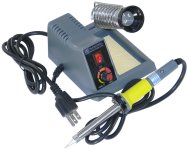
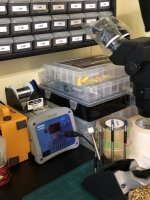
Over the years I've had a few different & expensive Weller units, but over time they all died. Today, I have and use a cheap no-name (ZD-99) $30 temperature adjustable soldering station from MPJA. I still have the one I bought from MPJA 5 years ago and have replaced the wand & chord one and have gone thru only two iron tips with several fresh ones on hand. (Just in case.) It has helped me build over 250 pedals and few other odds-n-ends in that time. With a good soldering technique and awareness of how to maintain soldering iron tips, I never saw a need to use an expensive soldering station again.
View attachment 62617
EDIT: It just occurs to me that I may have completely (and in great detail) justified why I should not receive the soldering pencil prize even if selected the winner of this neat little contest.