- Build Rating
- 5.00 star(s)
This is one that’s been kicking around in my head for a while. Delay is the foundation of time-based effects. But most guitar pedals are dialed in for a subset of these.
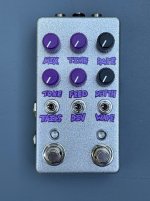
The first notable thing about this delay is the TIME knob. The first half of the rotation is < 40ms, and then after that it can get up to 2000ms.
The wide range on the short delay, along with the delay line modulation, allows you to dial in a variety of effects. Flanger, Comb Filtering, Chorus, ADT, Vibrato, trippy rainbow machine sounds…
MIX goes from all dry to all wet. TONE is LPF on the first half, and HPF on the second half. FEEDBACK has a lower max value when the TIME knob is in the first half to prevent triggering self-oscillation, which is much less usable than it is on longer delay times.
The TAILS switch has 3 modes: Tails On, Tails Off, and Kill Repeats. The difference between those last two is Tails Off allows the repeats to continue- hitting bypass again quickly will allow you to hear the tail from before the initial bypass.
The DIV switch is for the tap tempo (footswitch 2). It can do quarter note, quarter note triplet, eighth note. The WAVE switch changes the modulation oscillator between sine, triangle, and random.
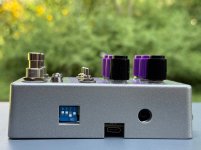
Moving on to MIDI functionality. There are 128 presets, recallable with PC messages. Expression input is accepted from either the hardware input or CC36. Each preset can have a heel-toe macro programmed for expression. One of the DIP switches can be used to change the MIDI channel the pedal listens to.
Instead of making a stereo pedal, I used the 2nd audio channel for a feedback loop INSERT. In a larger enclosure, I would use switched jacks to automatically engage the INSERT. But the lumberg TRS fits, so a DIP switch is assigned to turn it on.
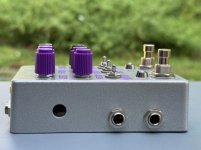
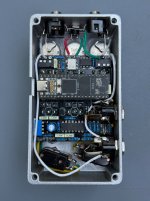
The 2nd TRS side jack is for two remote switches. I tapped into pins 9 and 10 on the DaisySeed for this. I would like to make it so you can change functions. Right now it is hardcoded for Tap Tempo, and momentary max FEEDBACK. The redundant tap tempo is so that I can set it from a more convenient location on my board.
I think that’s all it can do for now. I should probably make a demo.


EDIT: Demo added later
The first notable thing about this delay is the TIME knob. The first half of the rotation is < 40ms, and then after that it can get up to 2000ms.
The wide range on the short delay, along with the delay line modulation, allows you to dial in a variety of effects. Flanger, Comb Filtering, Chorus, ADT, Vibrato, trippy rainbow machine sounds…
MIX goes from all dry to all wet. TONE is LPF on the first half, and HPF on the second half. FEEDBACK has a lower max value when the TIME knob is in the first half to prevent triggering self-oscillation, which is much less usable than it is on longer delay times.
The TAILS switch has 3 modes: Tails On, Tails Off, and Kill Repeats. The difference between those last two is Tails Off allows the repeats to continue- hitting bypass again quickly will allow you to hear the tail from before the initial bypass.
The DIV switch is for the tap tempo (footswitch 2). It can do quarter note, quarter note triplet, eighth note. The WAVE switch changes the modulation oscillator between sine, triangle, and random.
Moving on to MIDI functionality. There are 128 presets, recallable with PC messages. Expression input is accepted from either the hardware input or CC36. Each preset can have a heel-toe macro programmed for expression. One of the DIP switches can be used to change the MIDI channel the pedal listens to.
Instead of making a stereo pedal, I used the 2nd audio channel for a feedback loop INSERT. In a larger enclosure, I would use switched jacks to automatically engage the INSERT. But the lumberg TRS fits, so a DIP switch is assigned to turn it on.
The 2nd TRS side jack is for two remote switches. I tapped into pins 9 and 10 on the DaisySeed for this. I would like to make it so you can change functions. Right now it is hardcoded for Tap Tempo, and momentary max FEEDBACK. The redundant tap tempo is so that I can set it from a more convenient location on my board.
I think that’s all it can do for now. I should probably make a demo.
EDIT: Demo added later
Last edited: