Guitar Mod Guidance/Suggestions…

Coda

Well-known member
I am planning on modding my Ibanez Artcore AF75. I plan on putting in a pair of GFS Vintage 59 (covered neck, black bobbin bridge). It already had upgraded tuners and a rosewood bridge. I am looking for some tips on the wiring…

I want to wire it with a master vol/master tone, a toggle for phase switch, and a 6position rotary with tone cap choices (poor man’s veritone). I am going to have the Vol as a push/pull for single coil mode. I am currently working off of this schematic (https://guitarelectronics.com/2-hum...volume-1-tone-coil-tap-reverse-phase/#gallery), mentally swapping the coil split to the vol, and the phase switch as a separate toggle…

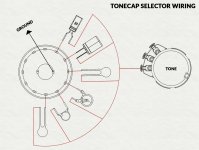
Then, I want to tack this on the tone pot:
IMG_3776.jpeg

So, I’m looking for tips/guidance/suggestions. I think I’ll go CTS for the pots and the pickup selector. What about the rotary? Any suggestions for the caps? I’ve not done this kind of from scratch before, so anything is helpful…
 

These are pretty solid while being small enough for guitars.

As far as caps go, 1uf is great for a super muddy tone if that’s something you’re after. Mose useful for bass, for getting really just a pure fundamental tone, but maybe like 470nF could be something to try?

In my 12 string I have a toggle to go between 100nF, 33nF and 7nF, with the 7nF being a really nice light attenuation of high frequencies that works well for taking harsher distortions.
I’d also definitely recommend having a position with an inductor (or a transformer used as an inductor) between 500mH and 1.5H— you can wire it so it exists in two positions; onece, and once with a cap, for both a high pass and a bandpass option
 

These are pretty solid while being small enough for guitars.

As far as caps go, 1uf is great for a super muddy tone if that’s something you’re after. Mose useful for bass, for getting really just a pure fundamental tone, but maybe like 470nF could be something to try?

In my 12 string I have a toggle to go between 100nF, 33nF and 7nF, with the 7nF being a really nice light attenuation of high frequencies that works well for taking harsher distortions.
I’d also definitely recommend having a position with an inductor (or a transformer used as an inductor) between 500mH and 1.5H— you can wire it so it exists in two positions; onece, and once with a cap, for both a high pass and a bandpass option
That’s the rotary switch I was looking at. I appreciate your guidance…even though I said “poor man’s Veri-tone”…

I’m gonna start looking at maybe doing the full on Veritone . You’ve inspired me…
 
That’s the rotary switch I was looking at. I appreciate your guidance…even though I said “poor man’s Veri-tone”…

I’m gonna start looking at maybe doing the full on Veritone . You’ve inspired me…
For the inductor, the Xicon 42TL021 is a nice low cost and compact option and the primary is 1.5H iirc
 
I was just reading through this: https://www.premierguitar.com/pro-advice/mod-garage-varitone-wiring-reloaded-and-extended

if you add a master tone control, you combine both approaches for an extremely flexible mod. Here's how to do it.

Add a 250k or 500k pot to your guitar near the Varitone switch. Loosen the connection where all the caps go to ground. Twist and solder the open ends of the caps together with a length of insulated wire. Solder the other end of the wire to the middle lug of the tone pot (Image 1). Lug #3 isn't connected to anything, and lug #1 goes to ground. Okay, you're done!

Now the rotary switch selects the tone cap, while the pot fine-tunes the settings

This is basically what I had in mind. Looking through that article, as well as the Joe Gore (naturally...as all excellent tone leads back to Joe Gore) links, I think the OG Varitone is totally doable...
 
The Varitone is a notch filter, so you definitely want one of the rotary positions to be a bypass. It's a combo of low and high pass filters.

A regular, low pass filter only, tone control is not even using the cap when the control is full up. The cap value determines how dark you want it when all the way down. A rotary for that doesn't make a lot of sense unless you want to step thru specific LPF presets and if that's the case you don't need the pot.
 
Last edited:
I was just reading through this: https://www.premierguitar.com/pro-advice/mod-garage-varitone-wiring-reloaded-and-extended


This is basically what I had in mind. Looking through that article, as well as the Joe Gore (naturally...as all excellent tone leads back to Joe Gore) links, I think the OG Varitone is totally doable...
I'd take that article with a grain of salt.

It's says:
"Another alternative is to switch between caps of the same value, but different type. One of our jazz-playing customers decided to use 0.033 µF tone caps in all his guitars....
He loves a rich, woody tone with nice overtones, so a certain cap from Roederstein is his standard. But he also wanted a warm, woolly tone as well as a slightly mid-scooped one, so we installed a rotary switch with his beloved Roederstein cap for the standard sound, a NOS paper-in-oil cap for the warm tone, and a standard “orange drop" cap for a slightly scooped sound. All three caps were 0.033 µF."

Sounds pretty sus to me. Not sure I'd take anything else he said very seriously.


Edit:

Haha...
In the article he links to there is even this disclaimer:

"Regarding capacitor material: What sounds best? Ceramic caps? Mylar? Metal film? Mica? Tantalum? It doesn't matter. In these applications, there's no audible difference between various cap materials. Use vintage-style caps if you care whether your control cavity looks vintage.
This is a controversial statement, so feel free to disagree. But don't expect to be taken seriously unless you can submit repeatable audio evidence demonstrating perceptible sonic differences between two caps of differing materials but equal value in standard guitar tone circuits. Anyone who does will receive my humble apology."
 
Last edited:

These are pretty solid while being small enough for guitars.

As far as caps go, 1uf is great for a super muddy tone if that’s something you’re after. Mose useful for bass, for getting really just a pure fundamental tone, but maybe like 470nF could be something to try?

In my 12 string I have a toggle to go between 100nF, 33nF and 7nF, with the 7nF being a really nice light attenuation of high frequencies that works well for taking harsher distortions.
I’d also definitely recommend having a position with an inductor (or a transformer used as an inductor) between 500mH and 1.5H— you can wire it so it exists in two positions; onece, and once with a cap, for both a high pass and a bandpass option

Any idea of the difference between a "shorting: break before make" switch and a "non-shorting: make before break" switch?...
 
Any idea of the difference between a "shorting: break before make" switch and a "non-shorting: make before break" switch?...
Shouldn’t really matter in this situation. I’d go for make-before-break, just since in theory it should be a bit less noticeable switching between them. With break-before-make, you’ll have periods where there’s no cap connected between switch positions, so if you have the tone rolled back and then switch positions, it’ll have a little moment where the tone effectively goes back to full.
 
Shouldn’t really matter in this situation. I’d go for make-before-break, just since in theory it should be a bit less noticeable switching between them. With break-before-make, you’ll have periods where there’s no cap connected between switch positions, so if you have the tone rolled back and then switch positions, it’ll have a little moment where the tone effectively goes back to full.
Oh, I got it. Make before break would made the next connection before disengaging the previous one? Where as the other way around would cut out while switched, correct?…
 
Ok, here’s another thing: suggestions for pot values/tapers? My gut says to go with B300k, but I can’t find a push/pull…
 
Ok. So I got everything I need (except a new nut, and some caps cause I ordered a few 600v caps by mistake). I’m now thinking about the wiring. The new volume pot (former neck volume) will be wired push/pull for single coil, and the former bridge volume will be a phase toggle for the neck pickup. No issues there…

I plan to wire the tone control to the lug 2 of the volume pot. Now, I have a question: from lug 2, I would go to the in pin of the rotary. From there I would connect one cap leg to each lug, and connect all of the other cap legs together, at the transformer…

From the transformer I go to lug 2 of the tone pot, with lug 3 going to ground. Right?…
 
Ok. So I got everything I need (except a new nut, and some caps cause I ordered a few 600v caps by mistake). I’m now thinking about the wiring. The new volume pot (former neck volume) will be wired push/pull for single coil, and the former bridge volume will be a phase toggle for the neck pickup. No issues there…

I plan to wire the tone control to the lug 2 of the volume pot. Now, I have a question: from lug 2, I would go to the in pin of the rotary. From there I would connect one cap leg to each lug, and connect all of the other cap legs together, at the transformer…

From the transformer I go to lug 2 of the tone pot, with lug 3 going to ground. Right?…

So another way to wire it is how Gibson (apparently) used to wire it: vol and tone anew wire up as normal, varitone is wired parallel to the jack. This way, the varitone effect would be audible all the time correct?…

At the same time; wiring the varitone between the vol and tone controls would only make the effect audible when the tone control is turned down, right?…

If no one sees this till the end of the day I guess I’ll have to give something away to draw some attention to it…
 
Back
Top