
You are using an out of date browser. It may not display this or other websites correctly.
You should upgrade or use an alternative browser.
You should upgrade or use an alternative browser.
Help measuring SMD JFETS
- Thread starter comradehoser
- Start date

This tester is trash, however I'm thinking of getting one just for that pad lol.Yah, I worry about the leads on mine. It looks to be made with the same quality as the cheapo Amazon jumper wires. Hmmmm.....a 1590b with some jacks for test leads. Or spring loaded speaker connectors type. And a magnetized pad on top.
Check out the little testing pad in the lower left.
View attachment 104121

MichaelW
Well-known member
Yah, I just linked it for the pad. It was a random pic. I haven't tried using that tester.This tester is trash, however I'm thinking of getting one just for that pad lol.
comradehoser
Well-known member
Oo-la-la, qu'est-ce que c'est?Has anyone considered trying a SMD vacuum pen/tool for holding these? There seem to be a few affordable options available through Amazon.

Audandash
Well-known member
See.......... Now you have me wanting something I don't really need but now I want it. I'm telling my wife it's your fault when I buy it.Has anyone considered trying a SMD vacuum pen/tool for holding these? There seem to be a few affordable options available through Amazon.

gtfields13
Well-known member
oof. I bought a couple of these adc boards (ADS1115) this summer with the idea of building an arduino or raspberry pi transistor tester. This makes me think I need to get going on putting this together and sharing out.
My first idea was just building the recording side, since I have a bench power supply that I can manually sweep.
My first idea was just building the recording side, since I have a bench power supply that I can manually sweep.

jubal81
Well-known member
Bit of an old thread, but I've been thinking about designing a tester/matcher.
I liked how Surfybear used LEDs for quick indications. One mode could simply be inserting 4 or more FETs at once, press a button and LEDs light on any FETs within matching tolerance. A more sophisticated approach for other applications would be to set the desired attributes in a UI and the LEDs light up on corresponding FETs that meet the standard.
Here's pics of the Surfybear project I saved from his DIY site years ago:


I liked how Surfybear used LEDs for quick indications. One mode could simply be inserting 4 or more FETs at once, press a button and LEDs light on any FETs within matching tolerance. A more sophisticated approach for other applications would be to set the desired attributes in a UI and the LEDs light up on corresponding FETs that meet the standard.
Here's pics of the Surfybear project I saved from his DIY site years ago:
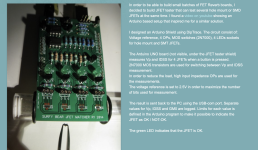

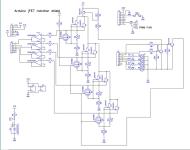
MichaelW
Well-known member
I like how he did the SMD testing pads. My method is using an adapter and pressing down with a pair of tweezers until I get a reading.

It's pretty hinkey and I wouldn't want to do a whole bunch at one time. Although the magnet does help it "jump" into place.
Doing it the upside down way at the very least would require less pressure I think.
It's pretty hinkey and I wouldn't want to do a whole bunch at one time. Although the magnet does help it "jump" into place.
Doing it the upside down way at the very least would require less pressure I think.