
You are using an out of date browser. It may not display this or other websites correctly.
You should upgrade or use an alternative browser.
You should upgrade or use an alternative browser.
How to use a switch to select different resistors
- Thread starter Guybrush
- Start date

Aleph Null
Well-known member
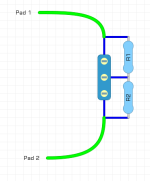
Here's How I would do it. The blue lines represent the resistor leads, the green, your wire. Using an On/On switch each resistor will be connected to an outside lug and to the middle lug, then a wire from the two outside lugs is each attached to a resistor pad on the PCB. Depending on how the switch is flipped, one of the resistors will be shorted and the other selected.


pricklyrobot
Well-known member
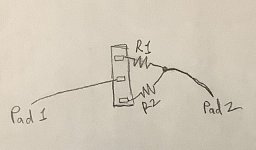
This is another way to do it.
pricklyrobot
Well-known member
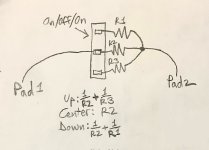
Or, if you want to get fancy, use an On/Off/On, do a little bit of parallel resistance math (it builds character!), and have three values on tap.
pricklyrobot
Well-known member
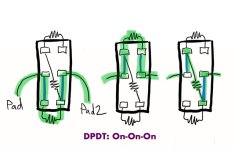
Or skip the paralleling and use a DPDT On-On-On toggle


Robert
Reverse Engineer
Here's How I would do it. The blue lines represent the resistor leads, the green, your wire. Using an On/On switch each resistor will be connected to an outside lug and to the middle lug, then a wire from the two outside lugs is each attached to a resistor pad on the PCB. Depending on how the switch is flipped, one of the resistors will be shorted and the other selected.
View attachment 110087
Agreed. This way if the switch fails (and during transition) you are left with R1 + R2, not an open connection.
Aleph Null
Well-known member
True! It also means that the legs of each resistor, as well as both wires, are attached to the sturdy lugs of the switch instead of flapping around in the enclosure.Agreed. This way if the switch fails (and during transition) you are left with R1 + R2, not an open connection.
pricklyrobot
Well-known member
Fair point.True! It also means that the legs of each resistor, as well as both wires, are attached to the sturdy lugs of the switch instead of flapping around in the enclosure.
Though my argument for the one I drew would be that it’s a little easier for a beginner to follow, visually and conceptually.
And you can certainly make it plenty sturdy with proper lead trimming/twisting and some strategic heat shrink. I’ve never made one that flapped

Re: switch failure, you could make the argument that a failure that results in an open circuit is better than one that results in the pedal sounding ‘slightly abnormal’, since it prompts you to immediately move to troubleshooting mode

Aleph Null
Well-known member
Also, true! There are multiple, perfectly good ways to do it.Fair point.
Though my argument for the one I drew would be that it’s a little easier for a beginner to follow, visually and conceptually.
And you can certainly make it plenty sturdy with proper lead trimming/twisting and some strategic heat shrink. I’ve never made one that flapped
Re: switch failure, you could make the argument that a failure that results in an open circuit is better than one that results in the pedal sounding ‘slightly abnormal’, since it prompts you to immediately move to troubleshooting mode
pricklyrobot
Well-known member
And herein lies the beauty of amateur electron wranglin’!There are multiple, perfectly good ways to do it.