Pickup winding

I was just wondering about some of this, after seeing This here video which makes it look pretty straight forward as a concept. I got plenty of projects on my plate right now, but now im really curious about this process, looks like I got some reading to do! I'd love to wire up custom pickups for some of my guitars and for friends.
If you are remotely curious you should scratch that itch - it's pretty rewarding to hear sound you've helped create at a VERY fundamental level.
 
If you are remotely curious you should scratch that itch - it's pretty rewarding to hear sound you've helped create at a VERY fundamental level.
Totally! The other day I was patting myself on the back for hearing a guitar tracked through a DIY ribbon mic through a Lola kit I built, run through a bunch of pedals I made. Time to start making the rest i guess, short of soldering a computer together (though I wonder... 😋)
 
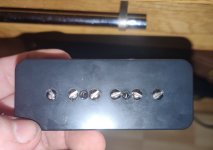
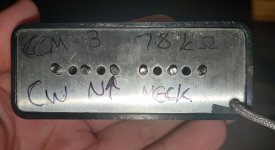
Feel like I started this thread I should be me more involved (first forum I've really been apart of so still find it weird to be involved). After the tele bridge pickup I made a pair of p90s for my modern player thinline tele
IMG_20201230_220808.jpg
IMG_20201230_220816.jpg
I did a my first reverse wind reverse polarity pair (this means that if I use the middle position they act as humbuckers and remove 60/50 cycle hum). Haven't installed them yet in the guitar, need to pot them first and install more appropriate electronics first (the guitar came stock with 250k pots on a p90 guitar? Also I'm going to wire it so instead of having 2 volume and 2 tone knobs, I'm going to have independent volume knobs a global tone knob and a global bass contour similar to the g&l and reverend guitars.)
 
Feel like I started this thread I should be me more involved (first forum I've really been apart of so still find it weird to be involved). After the tele bridge pickup I made a pair of p90s for my modern player thinline tele
View attachment 9535
View attachment 9536
I did a my first reverse wind reverse polarity pair (this means that if I use the middle position they act as humbuckers and remove 60/50 cycle hum). Haven't installed them yet in the guitar, need to pot them first and install more appropriate electronics first (the guitar came stock with 250k pots on a p90 guitar? Also I'm going to wire it so instead of having 2 volume and 2 tone knobs, I'm going to have independent volume knobs a global tone knob and a global bass contour similar to the g&l and reverend guitars.)

I hear Lollar's book is basically the bible on pickup winding. Did you read it before starting out, or did you get a winder, some wire and jump in?
 
I hear Lollar's book is basically the bible on pickup winding. Did you read it before starting out, or did you get a winder, some wire and jump in?
I read some stuff but mostly just jumped into to it headfirst like I usually do. Could post some links of stuff I "kind of listened to" if you want?
 
Last edited:
Sorry for

I read some stuff but mostly just jumped into to it headfirst like I usually do. Could post some links of stuff I "kind of listened to" if you want?
:) I know what you mean. I did the same with pedals.

Just wondering what's the first step really. I'd love to get involved down the line and make a range of handmade 'boutique' pickups that are actually affordable and not $400 a set and players get to have an input in the design process.
 
:) I know what you mean. I did the same with pedals.

Just wondering what's the first step really. I'd love to get involved down the line and make a range of handmade 'boutique' pickups that are actually affordable and not $400 a set and players get to have an input in the design process.
I get you my dude, I'll link a couple of the materials I started with. As far as videos


These are some of the videos I watched where I was like 'oh shit this is is easier than I think it is'. They are pretty detailed on the process and from common sense and more reading you can figure out from there how you start out this journey.

On top of this from what I found.

- doing hand wound pickups tenda introduces more high end. That's because the inconsistent pattern usually means lower capacitance into the coil. If you have a machine wound coil you can get a uniformly wound coil but overall you might find you you have less top end. also because of the nature of winding by hand your winds will automatically be considered scatterwound (so not neatly wound resulting in less capacitance). Which means in general hand wound pickups will typically have more treble than factory wound pickups. Although CNC wound pickups can programmed to have as much scatter as you want without the unpredictabilty of hand winding.

-42 gauge wire seems to be the standard. Thinner wire results in higher output but higher capacitance (less high end). A lot of higher output humbuckers use 43 gauge wire. The choice in magnets will also affect frequency and output (high output humbuckers will tend to use alnico 8 or ceramic magnets to help with the high end loss from a high resistance coil).

I'm still early in my journey so anyone more experienced please correct me
 
I can speak recipes pretty well after having a friend get into the pickup thing before family life took over. I had a standard recipe of 15k/a8 bridge and a 7k/a2 neck as 'the usual', but figured there's a million other variables in the game I'm not familiar with.

Someone here linked to a winder they use (thomas?) Which I was thinking of grabbing to start the whole thing and make a set for my strat. Where do you purchase wire, flatwork, pole pieces, all that shit. Ebay?

And I'm not sure if there's any other aspect of guitardom with more wankery and marketing BS than pickups. But that's ankther story.

Cheers for the links man, that's a lot to chew on.
 
Winders have their own recipe, but in my opinion since I got into winding. The most sort after pickups are the ones that were slapped together by parts laying around without a specific recipe. That people reversed engineered, analyzed the material, etc., to duplicate that sort after "tone".

Duncan and Lollar I consider the pickup experts.

Some of my first ones
8p06AzV.jpg


k5dtMco.jpg


6MUOXO0.jpg


wvhHcBh.jpg


UnCqNgg.jpg
 
Last edited:
They look a lot like pickups.

My faves were the original ibanez super 58s. Allegedly they analysed a hundred 'real' paf pickups, found the averages between them of all the variables, and made the s58 to those numbers. They're fantastic pickups. I say allegedly because that's according to their marketing literature from back in the day.

I just noticed the steel plates on the singles. Does that make a big difference?
 
I just noticed the steel plates on the singles. Does that make a big difference?
Baseplates increase the inductance of the pickup and alters the frequency response a bit depending on what material the plate is made of. Tend to find traditionally that tele bridge pickups use baseplates where as strat pickups don't. Been wanting to build a strat set and put a baseplate just on the bridge pup.
 
The plate on the telecaster pickup is called an elevator plate. It's suppose to make it "brighter" and it also it's a ground.

Here's Bill Lawrence explanation.

Explained by Bill Lawrence.

Bridge Pickup Base Plates
There is quite some confusion about the Tele bridge base plate. Everybody tries to explain the reason for this baseplate with only one function, but this baseplate has, in reality, 3 different functions:

A. Ferromagnetic functions,

B. Electrodynamic functions

C. All metal plates provide extra shielding.

#1 -- Only the steel baseplates corresponds to function A, B, and C.

#2 -- Brass, copper and aluminum baseplates have no ferromagnetic functions, and therefore, only correspond to function B and C

#3 -- Alloys of the 300 series stainless steels have neither ferromagnetic nor electrodynamic functions and therefore, only correspond to function C.


Brass Base Plate - notice that the base plate also serves as the ground for the bridge pickup.

Function A

Leo Fender used copper-plated steel baseplates on the Tele bridge pickup to stabilize and to increase the magnetic force of the relatively weaker Alnico 3 slugs. The ferromagnetic steel plate increases the inductance of the coil (like increasing the number of turns on the coil).

The steel baseplate also transmits from the steel bridge mount via the steel mounting screws some of the body vibrations into the pickup, resulting in that typical Tele twang. As a negative, this is also the cause of microphonic squealing at high volume levels.

Function B

Baseplates made of steel, copper, brass or aluminum are the cause of eddy current interference. Eddy currents shift the resonances toward the lows, resulting in a fatter, more pleasant tone, especially in the bridge position. If you don’t want to increase the inductance of the coil and the magnetic force of the magnets, aluminum and brass baseplates are ideal to fine tune the tone of single coil pickups.

These baseplates can be very effective on traditional single coil pickups with alnico slugs, but on many different designs, the result can be disastrous.

 
great discussion and an interesting topic. thanks for the links as well. it looks like you can still order the Jason Lollar book from his site for $65 or so. Why are used copies on ebay listing at over $250?
 
great discussion and an interesting topic. thanks for the links as well. it looks like you can still order the Jason Lollar book from his site for $65 or so. Why are used copies on ebay listing at over $250?
Much like the vintage guitar market - his is the holy grail for those of us wanting to do this years - YEARS - back.
 
Back
Top