moodsystems
New member
Hey all! This is my first post on this marvelous forum. Lots of brilliant minds and valuable information here. Hoping I could get some help with a PT2399-based echo circuit I've been tinkering with.
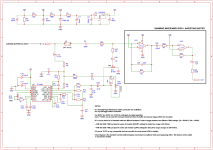
Essentially I have taken the Deep Blue Delay/Sea Urchin circuit and slightly modified it to accommodate a Cornish input buffer (which I use in practically ALL of my builds), higher cap values, a "LONG" footswitch which increases the resistance within the Delay Time network, and an oscillation footswitch. See the attached schematic to see everything at play. With the Cornish input buffer, I have essentially defeated the usual 2x Gain op-amp input stage and have moved the op-amp further down the dry path, using it only for the summing amplifier and an inverting output buffer.
The issue I am having is the overall noise floor with the circuit. When I turn the pedal on even with the Mix knob completely off OR with the PT2399 chip removed, there is a slight hiss present and I can't seem to get rid of it despite using shielded cabling and higher value caps all around. When I attach an alligator wire at the junction of the 10k mix resistors and connect the other end of the wire directly to the output jack, the noise seems to go away. So I'm suspecting there's something going on with the U3 output stages? Should I try lowering the value of the resistors surrounding the op-amp (including the R3/R4 voltage divider)?
I've replaced the TL072 with an LM833N in an effort to employ an op-amp with a much lower noise specification, but that didn't really change anything. Running out of troubleshooting ideas, hence I've come here for some help!
Any thoughts?
SCHEMATIC:

Essentially I have taken the Deep Blue Delay/Sea Urchin circuit and slightly modified it to accommodate a Cornish input buffer (which I use in practically ALL of my builds), higher cap values, a "LONG" footswitch which increases the resistance within the Delay Time network, and an oscillation footswitch. See the attached schematic to see everything at play. With the Cornish input buffer, I have essentially defeated the usual 2x Gain op-amp input stage and have moved the op-amp further down the dry path, using it only for the summing amplifier and an inverting output buffer.
The issue I am having is the overall noise floor with the circuit. When I turn the pedal on even with the Mix knob completely off OR with the PT2399 chip removed, there is a slight hiss present and I can't seem to get rid of it despite using shielded cabling and higher value caps all around. When I attach an alligator wire at the junction of the 10k mix resistors and connect the other end of the wire directly to the output jack, the noise seems to go away. So I'm suspecting there's something going on with the U3 output stages? Should I try lowering the value of the resistors surrounding the op-amp (including the R3/R4 voltage divider)?
I've replaced the TL072 with an LM833N in an effort to employ an op-amp with a much lower noise specification, but that didn't really change anything. Running out of troubleshooting ideas, hence I've come here for some help!
Any thoughts?
SCHEMATIC: