
gtfields13
Well-known member
- Build Rating
- 5.00 star(s)
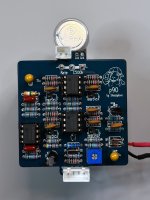
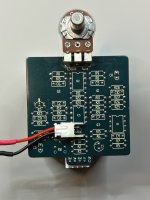
I finally finished Dave @szukalski 's Sheepylove P90 that @MichaelW was kind enough to share with me. Although I don't have a proper case, I borrowed one of my blanks, complete with extra holes (who knew that the out of 20+ cases, I have only made one case with a top-center hole for potentiometers).
With a new JFET tester and a fresh batch of 2SK208-GR transistors, I was able to select a tightly matched set (Vgs(off): 2.1573V 2.1569V, 2.1557V, 2.1566V). Everything else went together just fine. I did opt for some vintage ceramic capacitors - mostly because I have a lot of these lying around - but I also checked and selected ones that were all within 5% of nominal.


Since I am primarily a synth/keyboard player, and phasers sit in the space of the Leslie, I've put the P90 into the signal chain for a bit of organ music, with a simple Hammond sound (only a couple of drawbars, no chorus or percussion). Because I can't play jazz or rock organ for shite, though, you get something classical.
I have questions about JFET modulation and the circuit!
1. I know that JFETS need to be matched to make phasers behave. What happens when the phasers are tightly matched, as I was able to do because of the tight performance of SMD chips? Does this mean that the bias setting on the PCB needs to be set at a very specific point? Does it make the phaser very peaky in it's response to the set point.
2. In my example, and in the demo, the LFO circuit runs all the way up into low audio, which is interesting as it moves from the phasing, to tremolo, and then punches through into a more static filter. The audible effect is similar to running oscillators on modular synth from LFO into FM, but in that case it's generating sidebands and complexity, where here I think the sidebands are in the filter (and thus a bit more subtle). Given that I didn't deliberately modify any of the LFO circuits component values, is this a characteristic of the MXR Phase 90, as well? I like it, and if decide to make and sell Phase 90 clones, I definitely want to keep this characteristic.
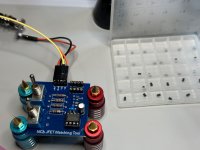
My modified version is below. I drew this using KiCad and have also posted this in my public Github, where anyone is welcome to download the KiCad files or the gerber files at JFET Matcher. As is the way with JLCPCB, I ordered a set of five, but don't need them all. If you have read this far and are interested in one, I am happy to drop one of them in the mail to share with you.

Build
The build was pretty easy; the only noteworthy element is the SMD-only JFET locations on the board. My build would have been done several weeks ago, but when I first started installing the JFETs (a matched set provided my Michael) I managed to launch the 4th one into oblivion (always the last one, never the first). At the time I didn't have reliable tester for SMD JFET measurements, so I put this on pause while I spun up a modified tester design and had it made by JLCPCB (more below). I know I could have just bread-boarded a tester and used one of the many SMD-TH adapters I have, but I wanted to try my hand at modifying the available design by Gadget Reboot.With a new JFET tester and a fresh batch of 2SK208-GR transistors, I was able to select a tightly matched set (Vgs(off): 2.1573V 2.1569V, 2.1557V, 2.1566V). Everything else went together just fine. I did opt for some vintage ceramic capacitors - mostly because I have a lot of these lying around - but I also checked and selected ones that were all within 5% of nominal.
Finish
I may get this into a Phido Sound-branded case eventually, but at the moment I just cased it up so I could test the sound, repurposing a case drilled for the Muffinator Fuzz. The nice thing about Sheepylove sticking to the PPCB standards - plus my habitual use of JST-XH headers - is that I just popped out the Muffinator Fuzz, dropped in the P90, and hooked everything up. No solder, no problems.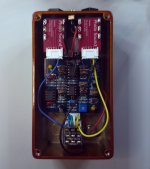
The Sound
I have posted a demo on my personal YouTube channel, and you can check this out.Since I am primarily a synth/keyboard player, and phasers sit in the space of the Leslie, I've put the P90 into the signal chain for a bit of organ music, with a simple Hammond sound (only a couple of drawbars, no chorus or percussion). Because I can't play jazz or rock organ for shite, though, you get something classical.
I have questions about JFET modulation and the circuit!
1. I know that JFETS need to be matched to make phasers behave. What happens when the phasers are tightly matched, as I was able to do because of the tight performance of SMD chips? Does this mean that the bias setting on the PCB needs to be set at a very specific point? Does it make the phaser very peaky in it's response to the set point.
2. In my example, and in the demo, the LFO circuit runs all the way up into low audio, which is interesting as it moves from the phasing, to tremolo, and then punches through into a more static filter. The audible effect is similar to running oscillators on modular synth from LFO into FM, but in that case it's generating sidebands and complexity, where here I think the sidebands are in the filter (and thus a bit more subtle). Given that I didn't deliberately modify any of the LFO circuits component values, is this a characteristic of the MXR Phase 90, as well? I like it, and if decide to make and sell Phase 90 clones, I definitely want to keep this characteristic.
The JFET Matcher
OK. I was a bit cheap and didn't want to spend the OSHPark dollars to order a direct copy of the Gadget Reboot JFET matcher. I was also curious if I understood enough to modify the circuit enough to add the ability to measure an effective Vgs(Off) in addition to the Vgs(10k). So I tweaked the circuit a bit, using 10M as my approximation for Off.My modified version is below. I drew this using KiCad and have also posted this in my public Github, where anyone is welcome to download the KiCad files or the gerber files at JFET Matcher. As is the way with JLCPCB, I ordered a set of five, but don't need them all. If you have read this far and are interested in one, I am happy to drop one of them in the mail to share with you.