Sheet metal enclosures... inspire me

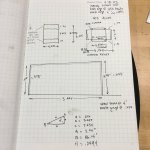
Wow! Very excited to find this thread just now! I’ve got all the right sheet metal equipment, and like a lot of folks I think, seeing the old EHX enclosures got the gears turning. I’ve just been procrastinating on working up a design. @temol - your stuff looks amazing! it looks like you’re working up your layouts in cad? I’m not really a cad guy, but I imagine that helps a lot. I’ve always struggled with working out bend allowances and sight lines for precision work like that and I tend to just waste a lot of material on trial and error before I get a working pattern. Does your cad program let you flatten your pieces into patterns and give you all the layout lines for whatever radii you picked!?
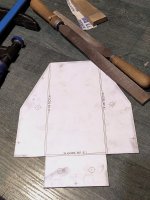
I’ve got a couple 1590bb projects in the pipeline, and I’d like to work out a slope- top enclosure in that size. Seeing all these DIY enclosures has got me fired up again. Thanks everyone!
 
Wow! Very excited to find this thread just now! I’ve got all the right sheet metal equipment, and like a lot of folks I think, seeing the old EHX enclosures got the gears turning. I’ve just been procrastinating on working up a design. @temol - your stuff looks amazing! it looks like you’re working up your layouts in cad? I’m not really a cad guy, but I imagine that helps a lot. I’ve always struggled with working out bend allowances and sight lines for precision work like that and I tend to just waste a lot of material on trial and error before I get a working pattern. Does your cad program let you flatten your pieces into patterns and give you all the layout lines for whatever radii you picked!?

Check out Fusion360. It is free for non-commercial use and has sheet metal functionality. You can unfold your parts.
But even with a computer-designed item, there is always a trial and error path.
That's how I see the process of tuning:
- make single 90 degrees bend and measure bend radius,
- design simple element taking into account the actual bending radius. It can be just C shaped piece.
- perform bending and compare the dimensions of the element with the design,
- if necessary adjust parameters (k-factor, bend radius) or bending settings (placement of the material in the bending machine.).
I design my enclosures in Solidworks. Even though I have a super-precise unfolded template, I can't use the template bend line. On my bender I have to give a slight offset from the line.
 
I’ll check out Fusion360, I didn’t realize I could get into that without shelling out $$! Still scratching it out on paper for now though.

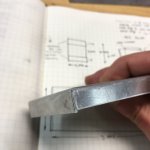
Shooting for a 1590bb sized face for ease of using a ppcb drill template, with the front edge height the same as a 125b, and the back edge 1/4 inch taller for about a 4 degree slope.

I’m gonna bend the top first and derive some of the measurements for the bottom from the final dimensions of the top.

I have some .063 aluminum on hand, so I’ll use that.

I bent a test piece where I drilled a #51 hole in the corner before I notched it- hopefully that will give me just enough relief to get nice offset/ overlapping bends between the sides and the screw-flanges.

I also need to decide what pedal it’s going to be so I can put the holes in it before I bend it…
 

Attachments

  • DE34E17F-AE56-479C-A186-195C74D8E0E3.jpeg
    DE34E17F-AE56-479C-A186-195C74D8E0E3.jpeg
    414.4 KB · Views: 13
  • 75EF2DEA-CC0F-474A-8586-1FF8AB56DA62.jpeg
    75EF2DEA-CC0F-474A-8586-1FF8AB56DA62.jpeg
    246.5 KB · Views: 13
What type of bender do you have?
You need to be extra accurate when it comes to the dimensions of the pieces and the fixation of the material in the bending machine. Otherwise there will be gaps or too short / too long walls. Draw an element in a graphic program, print it in 1:1 scale, glue it to an aluminum sheet. Use the lines on the printout when positioning the part in the bending machine.
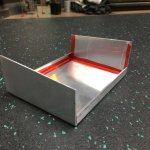
I do not use relief holes. Instead, I make small diagonal cuts in the corners (max 2mm long) - I use the thinnest saw blade I have (for a jeweler's saw). Thanks to this I have nice, full corners - see the second pic.
Drill all the holes before bending (pots, led, switch, etc).
Are you going to use self-tapping screws?

Here's an example - element ready for bending. You can see the bend lines.
IMG_20200827_195308.jpg

IMG_20220715_222037_1.jpg
 
What type of bender do you have?
You need to be extra accurate when it comes to the dimensions of the pieces and the fixation of the material in the bending machine. Otherwise there will be gaps or too short / too long walls. Draw an element in a graphic program, print it in 1:1 scale, glue it to an aluminum sheet. Use the lines on the printout when positioning the part in the bending machine.
I do not use relief holes. Instead, I make small diagonal cuts in the corners (max 2mm long) - I use the thinnest saw blade I have (for a jeweler's saw). Thanks to this I have nice, full corners - see the second pic.
Drill all the holes before bending (pots, led, switch, etc).
Are you going to use self-tapping screws?

Here's an example - element ready for bending. You can see the bend lines.
View attachment 46553

View attachment 46554
You can make an element in Fusion 360? Im new to this and want to make my own enclosures as well.

So just to reiterate you make diagonal cuts when bending the walls of the enclosure?
 
I do not use Fusion360 but from what I know - yes.
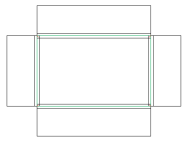
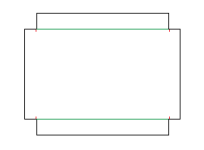
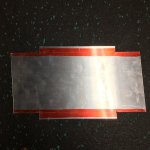
As an example -

I make diagonal cuts when making part with 3 or 4 walls. And "straight" cuts when making bottom lid with side flaps.
Here: red=cuts, green=bend lines.
1681888378897.png 1681888806481.png
1681889047475.png
 
Thank you so much for this! That makes a lot of sense I was having trouble trying to visualize this! I bought 16 gauge aluminum 5052 this is should be sufficient right?
 
16 gauge is what I use. I use 1050 grade, but I'm not familiar with 5052. 1050 bends easily, no problem with small bend radius. It sticks to the drill bits so I recommend using denaturated alcohol to fix this.

edit - looks like 1050 and 5052 are quite similar.
 
I read 5052 is very versatile and is a good candidate for bending. I will try 1050 next time.

I’m not sure what kind of aluminum the regular enclosures we buy from tayda are but I’ve come across this problem already. I found out aluminum is very sticky when it comes to drilling holes. So I should hopefully have some experience there. I’m still going to get denaturated alcohol!
 
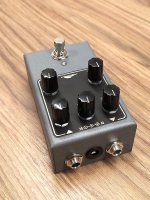
@temol - that corner on the grey enclosure is a thing of beauty!
Relief slice with a Jewler's saw is a hot tip. I have one, but I need to get some more blades for it. I have an old woodworking scroll saw that might work for that too... I think I'm going to try drilled relief holes for this
first prototype though, as they shouldn't be visible in this design if everything goes to plan.

I'm only a couple months into pedal building, but I've been collecting metal working equipment for a long time, and I've got some swanky sheet metal stuff- whitney and diacro box and pan brakes, a bar folder, a stomp shear with a digital back gauge, and a corner notcher with nice fences. Being able to work from fences saves some layout work and makes small production runs easier. When I need to work to a bend line, I usually set a scratch gauge and scribe the bend line. For more complex stuff, or if I'm making a lot of something, I'll make a template in sheet steel, and then scribe the whole outline. Templates are also handy for setting fences against.

I watched that fusion 360 tutorial video and I'm sold on that, as well as that stick-on pattern method. If I get into designing and fabricating enclosures in a real way, I'll definitely go that route.

I was planning on making all the holes in the flat. I think I should be able to punch them instead of drilling, which I can't do with cast enclosures, so that should be nice as long as I have all the right size punches.

I haven't worked out exactly what screws I'll use, but I'll probably predrill/ punch the outer element, then mark the inner element through the holes once everything is bent up.

Do you have any fastener recommendations?

@steviejr92 - unfortunately sheet aluminum seems like it's even stickier for drilling than the cast aluminum in enclosures. WD40 is usually my go-to lubricant for cutting aluminum, but I've been mostly drilling enclosures dry as I don't want to worry about stripping the WD40 residue off before clear coating. I'm also going to give alcohol a try.

The aluminum I've got is 3003 alloy which forms very nicely, but I suspect for bending up basic box shapes almost any alloy would work out okay, and whatever's cheapest or available probably wins for me.
 
Ok so some kind of lubricant should be used when drilling these holes got it!

I’m going to start working with Fusion 360 today to get proficient at it. I’m just waiting on the 5052 aluminum to come in it’s already been shipped. I also have some designs on paper that I’m going to try to recreate in fusion 360. Definitely getting that jewelers saw! Thanks alot for the guidance!
 
Aligning screw holes is quite challenging sometimes. Forget about making all the screw holes prior bending. I drill and thread only 4 screw holes, in one part of the enclosure (top piece usually). Then, with a second part - I measure, mark, measure, mark.. drill throug-holes, and sometimes they're off by 0.2-0.5mm..
I use m3 machine screws. One part has a threaded hole, another part has only hole, slightly larger than diameter of the screw.
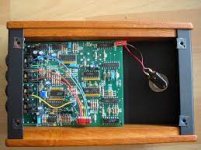
There are also self tapping screws with clips but I've never tried them. Moogerfooger enclosure as an example.
1681934405910.jpeg

Or threaded rivet nuts.
This is cool :)
 
Glad I asked about fasteners… I was thinking little tapping screws like the old ehx stuff, but threading for machine screws sounds way slicker. I think I’ll try that.

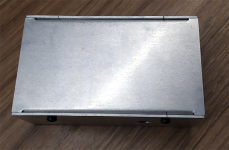
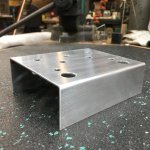
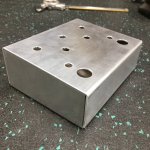
I started chopping up some aluminum tonight, the first piece went okay (the easy one), the second piece I made a bone head mistake and flipped one too many times before making the angle cut. That thing that looks like a Chevy symbol is supposed to be more trapezoid than parallelogram.

I went ahead and bent it up to check my dimensions and bending procedures. I’ll adjust the width a hair on the next attempt, but it’s close. I always expect to make some scrap along the way, so I’m happy with the progress so far.
 

Attachments

  • 1E4A07B9-572B-42C2-B636-005F1357ECCB.jpeg
    1E4A07B9-572B-42C2-B636-005F1357ECCB.jpeg
    571.1 KB · Views: 25
  • AE50D414-098C-4890-82FC-D253E0295964.jpeg
    AE50D414-098C-4890-82FC-D253E0295964.jpeg
    680 KB · Views: 21
  • F6C3A8B1-36D1-4A21-B629-3B9BEF0F4F90.jpeg
    F6C3A8B1-36D1-4A21-B629-3B9BEF0F4F90.jpeg
    494.4 KB · Views: 24
  • 465F0FC7-AC3D-4634-BBF5-83DC23147982.jpeg
    465F0FC7-AC3D-4634-BBF5-83DC23147982.jpeg
    654.6 KB · Views: 25
Your enclosure looks super elegant!
I design this type of enclosures so that the upper element is wider than the lower one by two sheet thicknesses (1.5mm on each side). Then I don't have to worry about possible minor bending errors - there is no risk that the side walls will protrude.
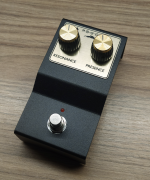
 
Your enclosure looks super elegant!
I design this type of enclosures so that the upper element is wider than the lower one by two sheet thicknesses (1.5mm on each side). Then I don't have to worry about possible minor bending errors - there is no risk that the side walls will protrude.
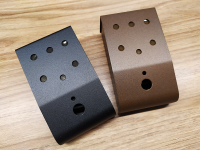
Thanks! The only commercial pedal I have in a sheet metal enclosure is a Boss Rc10-R looper, and that's how they do it too - with the top overhanging slightly, and it looks great. I need to shorten that dimension a little anyway, so I'll subtract a little extra just to be safe.

I tested out tapping some material for #4-40 machine screws, (pretty close to 3mm) and there seemed to be plenty of thickness to hold them, so I think that's going to work out too as long as I can get the alignment right. I guess that's another good reason to implement an overhang - it would be a bummer to get everything flush, and then get pulled off due to screw alignment.

I drilled this for a ppcb Sproing Deluxe, and I just ordered the board this morning (good timing with the 20% off sale) hopefully I like it!

I just now realized that the angled top is going to be a challenge to letter with my usual system... I've been thinking about trying to etch some faceplates, so maybe this will be the place to try that...
 
Back
Top