Simms-Watts AP100 mkII 1972

New PT and 4H choke with 400mA rating arrived today, but pity me about figuring PT lead as no tap markings on this one. DC resistance readings only confused, because secondary has HV taps with bias and center tap there too.

I know I could power it with low AC trough another trafo, but there’s also extra lead on supposed primary side and I’m not sure what it is. That lead wasn’t mentioned on specs. Shield maybe?

So only choke goes in today and gonna email Uraltone about color coding on PT leads. Better to be safe than sorry.
 
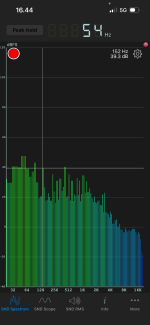
Okay, choke went in as planned and when I was chassis open had a thought to add ceramic 100pf bypass caps for V1 anode resistor. It helped with excessive hiss taming and the choke tamed down 50Hz hum FINALLY, but there wasn’t such thing as free lunch here. Hiss and 50Hz hum were masking 150Hz hum which came audible. Thats’s for sure better than the rumble I had earlier.

Did some freq analyzing with my phone yeasterday (good typo, won’t fix it!) after rehearsals. Channel volume or master down the amp is completely silent, but as soon either is opened the 150Hz creeps more audible as pot is turned.

IMG_8801.png

This volume pot turning led me to realize, I’ve made a mistake with grounding stages for their own separate stars. I’ve not followed hooking grid leak resistor gnd side to stages cathode on preamp. Neither with vol&tone pots. Gonna fix that next!

Also choke did gooood, amp is meaner than ever and low chord transients really push air.
 
Saga of The hum which bothers continues!

Most recent tweaks:
  • Redid input stages component layout, changed vol pots for sturdier ones, used twisted pairs in/out from pots and made sure things on grid are referenced to following cathode.
  • Changed B+ dropping resistor strings values to 15/22/22 kOhm and it alonr raised filament elevation to ~ 43VDC. More gain on preamp too.
  • Looked along B+ resistor/cap junctions with DMM for AC ripple. Cap before choke had 10-20mV, but after choke barely detectable and readings were either under 10mV or no reading at all.
Results:
​
50Hz - I think this is mostly solved. Speaker cone isn’t vibrating anymore, not even when dimed and inputs shorted.​
​
100/150Hz - lowered, but gets more audible if feedback amount (variable on pot) is reduced. I have it more there than Model T has. 15K resistor and 100K pot on OT sec speaker lead feeding 4.7K on PI. 5-10% turn from potentiometers min setting immediately brings more hum in.​
​
Hiss - it comes in naturally if channel volume is raised input shorted. It was canceled before with lower freqs and now it drowns 150Hz away.​
​
Suspect to rule out:

Rectifying has ultra fast soft recovery diodes, but haven’t tried snubbing ’em with diodes with RC parallel. Maybe try 47r+10nF parallel with each diode? Do you have any suggestions on snubber values?​
 
Update:

IMG_8840.png
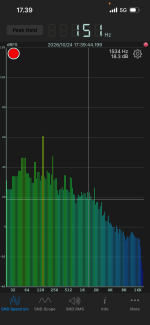
Different speaker, but it’s getting better Hz by Hz and dB by…you got the idea.

So what caused this LF reduce?

Went in and changed variable speaker side feedback circuit. Now it’s 15K resistor leading to 10K pot and both are parallel with 470pF cap.​
​
Also snubbed rectifier AC side with 10n mlc, but gonna try RC snubber 1Kohm+1nF near future as that’s what R.G.Keen was suggesting for snubbing out diode+trafo ringing.​
​
PIs first cathode resistor change from 470r->990r​

And I accidentally shorted PI supply node to its cap body. Pre-node 5W resistor cooked some ink and made it go away as magick steam. No excessive damage and no burnt fuses as resistor didn’t short and chassis is ALWAYS connected to protective earth gnd with 3-prong cable.

Thought what the heck and deassembled PIs supply node, removed cooked 15K resistor, 47uF F&T e-cap and replaced both with 22K/5W and a 40uF poly motor run cap. Fugly it is, but so is what’s played with this amp.

Pictures inside chassis: 404
 
A choke is always good if you have the room in the chassis. Good call on that.

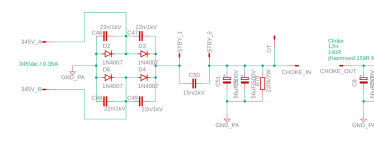
As for the snubbers, I think if you go for ultrafast diodes in a bridge you need that to avoid ringing. I personally stick to old school diodes now, they are sufficient usually. And even with this, some amps just get snubbers anyway: the VH4 uses 22n in parallel with the 4007 and a like 10H choke too. (That is my schematic for my 50W build but you get the drift). A lot of old school amps use RC but at least in my simulations I didn't see a benefit.

1793452141400.png
 
A choke is always good if you have the room in the chassis. Good call on that.

As for the snubbers, I think if you go for ultrafast diodes in a bridge you need that to avoid ringing. I personally stick to old school diodes now, they are sufficient usually. And even with this, some amps just get snubbers anyway: the VH4 uses 22n in parallel with the 4007 and a like 10H choke too. (That is my schematic for my 50W build but you get the drift). A lot of old school amps use RC but at least in my simulations I didn't see a benefit.

View attachment 126998
If I think back, the hum may have started when I replaced stock BY328 diodes on the rectifier with more modern ones. I’ve tried 5408 and FR307 before the most recent bridge with UF4007. Maybe all these modernish diodes are too fast and efficient causing mischief with amps enormous power trafo. I have single piece 1000V/15A bridge to try out if snubbing experiments fail. Next bench sessions gonna include doing heater wiring over, just to be sure.

Did rehearsals today and I’m not sure if change in PI bias resistor from 470r to 1k made amp any better. Needed to push master vol much more with 1K and the sound of distorted amp wasn’t so ruthless. Maybe back to 470r or try 680r…
 
Back
Top