Sometimes little changes have big results

HamishR

Well-known member
I was thinking about this after reading Coda's post about his Epiphone Les Paul. While working my way through modding a Protein Blue style pedal I learnt a few things about how pedals work. So when I played my Tim clone recently it occurred to me that I could use something I learnt from that experience. Chuck has shown me that in some op-amp-and-clipping-diode overdrives there is a resistor which goes from pin 3 of the chip to V-ref which has control over the low-end of the circuit. It doesn't really matter the technical details are; I just found that if I reduced the size of that resistor in my Tim I could get rid of the excess bassiness of that circuit and make the bass strings of my guitars sound clearer and much more to my taste. It has turned the pedal from being one of my "sometimes" pedals into perhaps one of my most used overdrives. It has made a huge difference to my options, and now I will be using this pedal a lot more.

This is what I love about building pedals. It's what makes this place so wonderful. I have learnt that by swapping one resistor in a pedal I liked I can turn it into a favourite. That's gotta be a win!
 
Ok help me out here (anyone). I’m not seeing how changing the R (originally 510k) from pin 3 to Vref reduces bass. I can see it lowering the input impedance, and if it gets really small creating a noticeable HPF with the 47n input cap (if the R becomes around 30k or lower) But I doubt you’re talking about going that low? Or is there something else about how big that op amp bias R that reduces bass content?
 
Last edited:
It does though... how do you think @Chuck D. Bones knows his stuff?

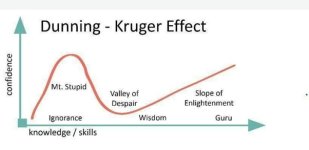
Knowledge is almost always a good thing. You gotta get through the Valley of Despair first.View attachment 24110
Well I meant it doesn't matter for my story! It matters a lot for my pedal!

Phi1 I really have no idea why it does what it does, but by changing that 510K resistor to 390K the low end has tightened up. It sounds like the bass below the range of the low strings has been removed so there is no boominess or unnecessary fluff affecting the way the signal breaks up.

I believe that the 510K resistors acts as a filter with the input cap (47nF). Reducing either will raise the point where the bass frequencies are attenuated before hitting the chip. I think there is more to it though!

Spi the slope of enlightenment on your graph is way too steep in my case!
 
I believe that the 510K resistors acts as a filter with the input cap (47nF). Reducing either will raise the point where the bass frequencies are attenuated before hitting the chip. I think there is more to it though

That's pretty much it. You shift the knee of the high-pass filter curve from 6.6Hz to 8.7Hz by changing the resistor from 510k to 390k (got this by using http://www.learningaboutelectronics.com/Articles/High-pass-filter-calculator.php, with the cap at 47n).

That's a really subtle change, well below the low E string of a guitar, so I'm surprised it's even audibly different. I even found this article that quotes Paul C saying at one point changed the input cap: "The input cap was changed from 47nf to 39nf. That changes the low end roll off from -3db @6.3hz to -3dB @8hz which really is no change. That was done years ago when there was a shortage of 47nf for a few weeks from all my vendors. Since it made no difference in performance I just stuck with the 39nf which I used in another spot."
 
Last edited:
That's pretty much it. You shift the knee of the high-pass filter curve from 6.6Hz to 8.7Hz by changing the resistor from 510K to 390K (got this by using http://www.learningaboutelectronics.com/Articles/High-pass-filter-calculator.php.

That's a really subtle change, well below the low E string of a guitar, so I'm surprised it's even audibly different. I even found this article that quotes Paul C saying at one point changed the input cap: "The input cap was changed from 47nf to 39nf. That changes the low end roll off from -3db @6.3hz to -3dB @8hz which really is no change. That was done years ago when there was a shortage of 47nf for a few weeks from all my vendors. Since it made no difference in performance I just stuck with the 39nf which I used in another spot."

Funny I was also thinking about that Paul C message on thegearpage or the madbeanpedals forums!
Totally agree with your message. This small HPF change should be absolutely inaudible.
 
This is where I say you have to try it. I have found that there are some things that on paper make no sense but in practise do. And vice versa. I have tried lots of things like different brands of caps in pedals, different ICs, different kinds of resistors - can't really hear a difference. But in this case there is definitely a difference! I am a Gretsch player and I'm very fussy about my twang. Even if the difference shouldn't be audible with a Gretsch it really is! It makes playing bass runs on my Jet or 6120 sound so much more fun. The notes have more bark and less fluff and boom.

This morning a friend of mine brought his Tim (which i had built for him) around. I had told him that I had a mod I could do for him if he liked it. I didn't tell him what it did, instead I put my modded Tim next to his, set them up as closely as I could and played through both. Immediately he said "oh wow - the mod really tightens up the bass strings!" He's a Gretsch player too.

There's another pedal I have been working on for a while. It had a 1M resistor in the same place and sounded nearly fantastic and I was trying to put my finger on what was bugging me about it. So I tried an 820K instead of the 1M and that made me realise what was bugging me - it sounded just a tiny bit congested. So I swapped it out for a 1M2 and voila! That was it! All of a sudden it sounded "just right". Chuck was sceptical that I could hear any difference but sometimes it's more a case of feel. No it didn't sound hugely different but it definitely sounds just right. I had made a couple of these pedals so tried one I had made with the 1M and no, it didn't sounds as good.

I'll never die wondering. I'm one of those guys who just loves to try things. Many changes get put back again pretty quickly! And sometimes you try something which shouldn't work but does.
 
Glad you’re enjoying it, that’s all that matters. For anyone else who’s curious, I just gave it a try on my Timmy build, using Les Paul neck and middle position to make sure there’s plenty of bass. Guitar straight into pedal, straight into amp. All knobs at noon.

I set up some alligator clips and put another 510k in parallel with the 510k from pin 3 to vref (effectively 255k). I wasn’t able to hear any difference going back and forth a bunch of times. It’s only one test with one guitar /amp combo, but I tried to make it as scientific as possible with no other variables possibly changing.
 
It may well be that it's less noticeable with different guitars. I'll try with my Les Paul. It's very apparent with my Duo Jet. Thanks for trying it!
 
hmm... I'm glad you like the pedal now, but I will say I'm skeptical of the difference being much more than a placebo effect unless you accidentally changed something else while performing the mod or if your input cap is off by a significant figure or two (though you surely would have noticed the tonal effect of that before performing the mod if it was crazy enough). the frequency range effected by that resistor change is so low that not only is it multiple octaves below the absolute lowest lows of a standard-tuned guitar, but its also more than a full octave below the absolute bottom threshold of what humans are capable of hearing.
I'm curious if you could check the input cap value, because perhaps the cap value is a fair bit smaller, and thus puts the HPF in the audible range. would certainly be a worthwhile thing to try replicating in that case.
 
I got into building pedals through building amplifiers. And one of the things I have concentrated in my amplifiers is in making them clearer, making them tighter in the low end while keeping a full sound. I like the whole range of the guitar to be represented but hate any muddiness or flab in the lows.

In a 5E3 tweed Deluxe one of the main complaints is the way the massive amounts of low end allowed through by over-sized coupling caps leads to a muddy sound. The coupling caps are way too big for the frequencies a guitar produces and as a result the low end is muddy and makes the distortion overly compressed and fuzz-like. By reducing the size of the coupling caps you can improve the clarity and response of the amp considerably. And without robbing the guitar of its range.

Similarly a Big Muff can generate huge amounts of low end, way below the range of a guitar. By reducing the amounts of sub-audible low end frequencies you can make a Big Muff a lot more articulate - Skreddy does this in the P19 and it sounds great.

I admit my knowledge is limited, and I know that there is a very good chance that I am wrong! But if changing the 250µF V1 bypass cap in a tweed Bassman to 25µF can help clean up the overdrive in that amp why can't reducing the size of some caps in the sub-audible range in a pedal have a similar effect? According to your logic it should have no effect but it does. I think there is more to it. Even playing a tweed Bassman clean with a 250µF V1 bypass cap you can hear the difference vs a 25µF.
 
If I've learned anything in all my trips around the Sun, it's that everything about the human body is different from person to person, I knew a guy that stuffed foam rubber in the springs of his Strat to deaden the sound of them, claimed it drove him crazy, when I first started playing, I couldn't tell if I was in or out of tune or even on the right chord! My ear has improved greatly through many years of trying, but I sure don't hear on the level. It may be some folks hear frequencies the rest of us don't, and yea of course there is always confirmation bias
 
Maybe confirmation bias it what I'm experiencing. I dunno! I do have an extra powerful sense of smell which is a PITA! Apparently about 10% of the population can smell things the rest can't, and I appear to be in that 10%. You would think it would be a blessing but it really isn't. I don't need to be able to smell everyone's perfumes and deodorants. If meat is even slightly off I will smell it - handy I guess but very unpleasant.

I can usually smell if someone has a cold. Aftershave drives me crazy, as does old ladies' perfumes. I do hear things my wife can't at either end of the spectrum like high pitched beeping or the rumbling of road work. Just last night I asked my wife if she could hear a rumbling sound outside and she couldn't hear anything. So we went outside and could hear some night work being done on the railway at the end of our street. But I don't think I have any better hearing than the average person. I suspect my wife's hearing has deteriorated over the years.
 
Maybe confirmation bias it what I'm experiencing. I dunno! I do have an extra powerful sense of smell which is a PITA! Apparently about 10% of the population can smell things the rest can't, and I appear to be in that 10%. You would think it would be a blessing but it really isn't. I don't need to be able to smell everyone's perfumes and deodorants. If meat is even slightly off I will smell it - handy I guess but very unpleasant.

I can usually smell if someone has a cold. Aftershave drives me crazy, as does old ladies' perfumes. I do hear things my wife can't at either end of the spectrum like high pitched beeping or the rumbling of road work. Just last night I asked my wife if she could hear a rumbling sound outside and she couldn't hear anything. So we went outside and could hear some night work being done on the railway at the end of our street. But I don't think I have any better hearing than the average person. I suspect my wife's hearing has deteriorated over the years.
Fortunately, I don't smell things that well, but I do have the extra taste bud only a small percentage of the population has, can't stand Cilantro for instance, it tastes like soap to me.
 
What I take from this point @HamishR and what I really agree with is what is so great about DIY is that you can take a circuit and really make it your own by tweaking it and not just building part for part as the build doc says. Tweaking the resistor in the feedback loop of an op amp or changing input caps will make a circuit work “better” for you.

Could the mod you be describing be changing the impedance and that is something that works for your rig of your gretsch and your amp and that’s why it can’t be reproduced in @phi1 experiment?
 
I’m at the top of the world! Mt Stupid!

I’m at the top of the world, Ma!

~~~~~~~~~~~


Sometinker to thinker about — the low end changed by that simple resister-swap isn’t just about the fundamental, there’s also the upper harmonics which affect greatly how we perceive bass — AM radio anyone?

Alter the fundamental that you can’t hear well and you alter the next-order harmonics that the ear does effectively pick up on.
 
I think there’s two ideas here. 1 is that rolling off the sub guitar frequencies cleans up the bass of a clipped signal. I’ve not personally experienced this, and without calculations I don’t know that the P19 or bassman examples are sub-audible frequncy cuts making the difference. It would be interesting to study, I don’t know why it would have an impact, but I wouldn’t rule it out.

The 2nd is that your specific change, which is calculated as a change in the position of the -3db knee from 6.6Hz to 8.7Hz is making the audible change. That’s the part I find surprising (and wasn’t able to replicate with my test). Unless we’re thinking of the calculation wrong.

2 thoughts moving forward, 1: I’m not sure if this Resistor mod was tested back-to-back on a switch to make sure there’s no variables (knob position, time elapsed between trials, part tolerances between different builds). That’d be a sure way to confirm the effect (if not done already).

2nd is we’re calculating roll off at around 8.7Hz. You could roll off a lot more sub-audible bass to see if that tightens it up more. I wouldn’t do this by lowering the R (lowering the input impedance), I’d change the 47n cap. For example, with 510k R, changing to 4.7n cap would put the knee around 66Hz.
 
Back
Top