The power of suggestion

HamishR

Well-known member
I recently revisited the Greer Lightspeed overdrive because a few friends had mentioned how much they liked it. I heard them say things like "transparent" and mention how well the tone knob swept through the frequencies... Curious, I looked at the schematic and also a few Youtube videos of it. It seems that everyones calls the Lightspeed "transparent". What on earth is that supposed to mean? The whole thing about it is that it has a pleasant little midrange thing which helps it sound better when breaking up. And the "Freq" control is simply a well voiced treble cut. You know, how 99% of tone knobs are.

But it seems that by calling the pedal an "organic overdrive" it suddenly has magical transparency characteristics and that by calling your treble cut "freq" players assume it does more than just cut treble. We are a gullible lot aren't we? Maybe we really do want our new pedals to have something that our last one didn't. I like the Lightspeed. I don't mind that it's a dumbed down Timmy because it's dumbed down quite well. I think it does sound better to me than a Timmy, so that's cool. But I don't need to give it mystical powers that it doesn't have. It's just a decent overdrive. Nick Greer has been quite clever with his nomenclature - players are telling themselves that the pedal has more than other overdrives just by the what he calls things. It's not being deceptive - it's all about the power of suggestion.

I think from now on if I label my pedals then a tone control will have to be called "Opacity Tuning". If I have a bass pot (because all ODs should have a bass pot) it should be called "Resonant Freq". Gain can be "Harmonic Generation" and Volume "Response Ability".

I'm sure you guys can come up with better names for controls than I can. (BTW I did add a bass control to my Lightspeed. It wasn't hard because the circuit in its Timmy form already had one.) What could we call bass and treble so that players would attribute magical powers to them?
 
It doesn't take much to alter a Lightspeed Transparent pedal.
It gives you more without changing your Amps core Sound!
Look at its twin, the Southland, Gnarly & Bright not so favorable pedal! basically same topology but twice the Gain, TL072 Opamp versus OPA2134.
Sounds nothing like your Amps core Sound ???
 
Yeah I don't get it either. Some people think the klon is transparent too and that has a hell of a mid hump on it 🤷‍♀️
Agreed, but it was compared to other pedals 20 years ago, now you can have 3 band eq Klons!
I remember the Bondi Effects Sick As being the had to have Transparent pedal, basically a Klon with Bass & Treble controls.
Version 2 with Charge pump was the closest then they went relay bypasss V3 & they kept popping when you turned it on or off!!!
V4 SMD, no thanks!
 
I recently revisited the Greer Lightspeed overdrive because a few friends had mentioned how much they liked it. I heard them say things like "transparent" and mention how well the tone knob swept through the frequencies... Curious, I looked at the schematic and also a few Youtube videos of it. It seems that everyones calls the Lightspeed "transparent". What on earth is that supposed to mean? The whole thing about it is that it has a pleasant little midrange thing which helps it sound better when breaking up. And the "Freq" control is simply a well voiced treble cut. You know, how 99% of tone knobs are.

But it seems that by calling the pedal an "organic overdrive" it suddenly has magical transparency characteristics and that by calling your treble cut "freq" players assume it does more than just cut treble. We are a gullible lot aren't we? Maybe we really do want our new pedals to have something that our last one didn't. I like the Lightspeed. I don't mind that it's a dumbed down Timmy because it's dumbed down quite well. I think it does sound better to me than a Timmy, so that's cool. But I don't need to give it mystical powers that it doesn't have. It's just a decent overdrive. Nick Greer has been quite clever with his nomenclature - players are telling themselves that the pedal has more than other overdrives just by the what he calls things. It's not being deceptive - it's all about the power of suggestion.

I think from now on if I label my pedals then a tone control will have to be called "Opacity Tuning". If I have a bass pot (because all ODs should have a bass pot) it should be called "Resonant Freq". Gain can be "Harmonic Generation" and Volume "Response Ability".

I'm sure you guys can come up with better names for controls than I can. (BTW I did add a bass control to my Lightspeed. It wasn't hard because the circuit in its Timmy form already had one.) What could we call bass and treble so that players would attribute magical powers to them?
I thought the names you came up with were great!

I agree that "Transparent" is overused to the point of abused, and there is something to be said for labelling controls what they are. If you're going to have a theme and label the controls something outside of the conventional, ideally the control-names should still be intuitive enough to figure out what does what. Like when a writer coins a new word, the reader should be able to figure out what the new word means within the context of its surroundings. If I say it's a really good "flibblecacker" — WTH does that even mean?
If I build a heavily modded SHO with a blendable input-cap and master volume with a control labelled "crack-pot", well, most pedal-people would get the reference.

I get bored when things are called simply "volume" "tone" and "gain", 🥱 especially if there's a good (or bad) theme to the pedal.


Off the top of my head, a theme, call the pedal: "Hell Bat" or maybe "Hellfire"
So what Controls? How'bout:
"Brimstone"
"Sin"
"Damnation"

One of those control-names I don't like, and I'd give it more thought, toy with the theme, do some research ...

Of the three Which one is Gain, Tone and Volume?
Would the layout of the controls help reveal which was which?

🕛 🕕
? 🕡?
?​


I don't know what to call Bass and Treble different than what they are on their own, but if it was for a pedal called "Take the Skinheads Bowling" then bass would be "Gutter-Ball"
and treble would be "Loft". Maybe "English" for gain and "Velocity" for volume? What if it's a Tremolo and not another dirt pedal?


Lastly, when I saw your thread title, I thought it was a great name for a Band: "The Power of Suggestion".


This post brought to you by...
Insomnia
 
I think most people can’t hear variations/amplitude variations in mid frequencies too well because it’s the most common kinda tone we hear in our day to day life. Oversaturation can lead to difficulty differentiating. Truly transparent OD is just a flat boost with some grit lol
 
Well yeah - a truly transparent overdrive would sound exactly like the clean tone! Or if it did add some dirt then it probably wouldn't sound very good. You need to attenuate some lows and highs (which effectively means the mids are more apparent) otherwise the sound gets nasty in the high end and boomy in the lows. Assuming that a pedal does this without being noticeable it would still probably sound a bit nasty. We really don't want something "transparent". The whole point is to change the sound and feel.

But what surprised me was that merely by calling the tone control Freq people assumed that it wasn't just a treble cut. It is a very nice tone control but it is just cutting high frequencies as most tone controls do.

I'm not bagging Mr Greer. He obviously knows what he is doing. I'm just surprised that people are reading so much more into what they are hearing than is there. The Lightspeed is a good sounding pedal and easy to like. If it had come out 20 years ago it would be selling for stupid amounts of money now. It is clearly a nicely modified Timmy and that doesn't bother me in the slightest. It's what players seem to read into it which amazes me. It makes me realise that the names we call things are more important than I ever would have thought.

From now on I am only building organic overdrives. I wonder which organs I should donate? I don't have a Hammond on hand.
 
Brian Wampler had a video about how “transparent” drives are really not transparent, i.e., they don’t actually have a flat frequency response. It was a pretty interesting one, as most his videos are.
 
FWIW, I did build the Mach One because it was highly praised on here and on reddit (well, Lightspeed obviously). So I'm not immune to hype.

But FWIW I did find the pedal to be a great transparent overdrive, and I was delighted with how the tone control sounded without even realizing it's named "Freq" until now. I think it's just very well tuned and works awesome no matter what it's called (I actually left labels out of mine completely).

To me, it does sound "like my tone, but just with some extra added grit". That's a transparent overdrive to me.

I think getting too hung up on "well a clean boost with some grit should be the most transparent because of the definition of the words" is not very useful. Yes, like you said, that's not what people want when they hear "transparent overdrive". And with the Lightspeed in my opinion the average guitarist gets what they think is "transparent overdrive". And that's what they actually want.

I thought the names you came up with were great!

I agree that "Transparent" is overused to the point of abused, and there is something to be said for labelling controls what they are. If you're going to have a theme and label the controls something outside of the conventional, ideally the control-names should still be intuitive enough to figure out what does what. Like when a writer coins a new word, the reader should be able to figure out what the new word means within the context of its surroundings. If I say it's a really good "flibblecacker" — WTH does that even mean?
If I build a heavily modded SHO with a blendable input-cap and master volume with a control labelled "crack-pot", well, most pedal-people would get the reference.

I get bored when things are called simply "volume" "tone" and "gain", 🥱 especially if there's a good (or bad) theme to the pedal.


Off the top of my head, a theme, call the pedal: "Hell Bat" or maybe "Hellfire"
So what Controls? How'bout:
"Brimstone"
"Sin"
"Damnation"

One of those control-names I don't like, and I'd give it more thought, toy with the theme, do some research ...

Of the three Which one is Gain, Tone and Volume?
Would the layout of the controls help reveal which was which?

🕛 🕕
? 🕡?
?​


I don't know what to call Bass and Treble different than what they are on their own, but if it was for a pedal called "Take the Skinheads Bowling" then bass would be "Gutter-Ball"
and treble would be "Loft". Maybe "English" for gain and "Velocity" for volume? What if it's a Tremolo and not another dirt pedal?


Lastly, when I saw your thread title, I thought it was a great name for a Band: "The Power of Suggestion".


This post brought to you by...
Insomnia
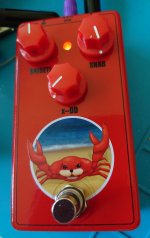
How about a decade old meme?
DSC_2420.JPG
I usually try to use normal labels for things where the controls are not obvious, but with drive pedals where the controls are Vol - Tone - Gain (tone on the bottom), I sometimes leave them out or use whatever. I build pedals for myself, so I know that's how it works in those cases. If it was Gain - Tone - Vol or something, I would label them.

Technically the Chop Shop is Vol - Sag - Gain, but it's close enough to the normal layout and worked well with the meme so I went with that in this case.
 
I have no knowledge of the crab-seal(?) meme, none whatsoever. Cool pedal, though, @Fama

When it comes to most 3-knob pedals, you really don't need labels; if a person can't dial in a sound on a Vol Tone Gain pedal, and maybe even figure out while dialling in a sound that it's a Gain Tone Vol config... well, that person should go BCA or GCA.
 
Remember most people’s frame of reference for an overdrive pedal is a tubescreamer, which is very not transparent at any setting. Almost anything sounds ‘transparent’ in comparison to a tubescreamer.

Also my experience with flat response clean boosts is that they tend to sound a bit bassier and looser as they boost more signal, as the low frequencies tend to distort first. So if I want ‘the same tonal balance but more gain/grit’ that will usually necessitate some slight low end cut and potentially midrange boost.
 
Back
Top