I hope it's fine that I ask a non-Wah inductor question here.
I am planning on an amp build with an inductor based Depth setting. I'd need 500mH about, 2 pins, that's about all the info I got. My instinct was to look at some Wah inductors but the readily available dunlops are pretty bulky and 4 pins (?). A lot of straight inductors are 150mH max and I'm not feeling putting 3-4 in series. Would you guys have any recommendation were to look for a suitable inductor for this use?
Not sure about 2 pins but the Carnhill VTB 9048 has a 500mH tap, also a 200, 300 and 760. A shift switch from 2-3 option could be musical? Or a push pull pot. AML (UK) stocks them but I'm sure they're elsewhere CAPI has a 1H
Or just get a stickductor
Any of the commercially available inductors will work for this purpose: even the ones that are 4 pin only tend to use two of the four.
The only rub is the value. Most of the commercially available wah inductors are gonna veer closer to 600mH.
The ME-6 is a great value, but its also in the 600+mH range.
If you're looking for something a bit more accurate, mine are *very* available. And affordable. Hit me up over DM and we can talk about my get rich quick scheme.
Do you have a requirement for inductor resistance or self-resonance? How inductance tolerance? How large is the AC signal that you plan to apply across the inductor? Do you plan to allow any DC current to flow thru the inductor? There are no "perfect" inductors; we have to take all requirements into account to obtain the inductor we need.
Do you have a requirement for inductor resistance or self-resonance? How inductance tolerance? How large is the AC signal that you plan to apply across the inductor? Do you plan to allow any DC current to flow thru the inductor? There are no "perfect" inductors; we have to take all requirements into account to obtain the inductor we need.
All good points. My stuff is just aping what works in a wah pedal. If your electrical and temperature considerations are too far outside of that then you're gonna have a bad time.
All good questions @Chuck D. Bones . It’s to place in the non of a tube amp between the depth knob and ground so it will see very low current and voltage unless something blows up. Actual resistance should be low that’s about it but I am hoping for some decent accuracy (20%?). Some people have built it with a Dunlop inductor (4 legs) it seems but it feels like a hack job. Maybe I should just put 2 1H mesa ones in parallel or better, get one from @Stickman393 and say « diy yo ».
Any chance you would want to look at an Ernie Ball Wah? The furthest I've gotten with mine is that it uses a J201 input buffer and three 2N5089 NPN in the signal. The inductor looks to be sealed in a can so I have no idea what style it is, however it says 420 on the top so I'm assuming that's the inductance.
Any chance you would want to look at an Ernie Ball Wah? The furthest I've gotten with mine is that it uses a J201 input buffer and three 2N5089 NPN in the signal. The inductor looks to be sealed in a can so I have no idea what style it is, however it says 420 on the top so I'm assuming that's the inductance.
So, their inductors measure on the low end of things. Honestly, I think they overall have an excellent take on the wah...with a couple of exceptions.
First off, they've got an extra resistor in line with the inductor. It makes the peak wayyyy too wide. I pull that thing and jumper it.
The J201 input buffer is a great addition, but the 2N5089s are too gainy for my tastes. I typically swap those for a couple BC109bs, or a 2n3638s, or 2N2905s. The third one, IIRC, is an output buffer. Good to leave as is.
The inductors are *weak*. Not a fan. I throw my own in there. The two I've worked on measured way below what they're marked as being.
You can get a great-sounding wah out of it. It just takes a little work to get there.
@Stickman393
Any recommendations for an inductor that will fit? I am using this on bass so I am modding it in general to bring the range down so that resistor pull is a good starting point.
Okies, found a little photo of one of the EBMMs I've done. I haven't really built or touched my wah pedals in like...6 months here. Focus shifted to germanium transistors and like...hoarding all of those. Apparently.
Anywho, gotta get back into it. Maybe do a GE wah just to be a real asshole about it.
So, here's the circuit board:
I like swapping out poly caps for polypro. PPS, polystyrene, or C0G MLCCs, depending on what fits. At least when it comes to coupling caps. And anything that has to do with tone-shaping. It's overkill, but it's just what I do cause reasons. Apparently I just really like desoldering.
The 12n's on that board are coupling caps for the input. One is before the J201 buffer, the second is after. Increasing the size of those will contribute to a slightly increased low end response...but it will most likely be a relatively subtle thing.
The 220s are the caps on either side of the potentiometer. The EVH pedal increases one of these to like 680nf...it's a fun little swap that does *something* that I can't put my finger on. Truthfully, you're probably stuck with an x7r with space restraints here. I had to swap the two on this board with a pair of c0g 220nfs cause I didn't have enough vertical clearance for the PPS caps. This is why it's silly to fuck around with caps so much.
The 22nf next to the inductor is the range cap. Typically, that's the cap you want to increase the size of in order to make the pedal behave better with a bass guitar.
The resistor that is in series with the inductor is right above the inductor...IIRC.
Also...depending on the flavor you want...you might be better off with higher gain cleaner transistors in a bass wah. Like the 2n5089 or the MPSA18. The higher gain in Q1 leads to an extension in the high frequency ranges that I find unpleasant on a guitar, but for a bass that might be just the ticket.
Honestly, though, all I can speak to is what I've found in the two bass crybabies that I've acquired up to this point, as well as the EHX crying machine that is sort of a dual-use device. Larger range caps is a given, the rest is kinda up in the air. Good to experiment.
Still gotta see what inductors match the pin spacing.
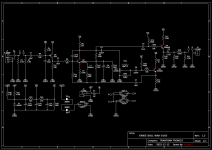
I took the time trace my Ernie Ball Wah, so here it is for anyone who wants to mod it. As a warning I may have mixed up the 1K resistor with one of the 10K resistors when I was pulling components.
EDIT1: R11 is 1K and R30 is 10K.
EDIT2: Fixed the schematic.
EDIT3: Better schematic.
A'ite, I checked out the lead spacing on those EB wah inductors.
Any of the eleca-made inductors will work. Wilson, sabbadius, or eleca.
The eleca model, you'll probably need to strategically cut a few of the terminals. Which...all you need are two. It's a simple component. Just a length of wire wrapped around a ferrite core. Just find the terminals where they soldered the ends of the wire, and the rest can be snipped.
I have been looking for the footprint for wah inductors for a while and I can't seem to find any that I can use, I use KiCad to make circuit boards and I want to make some up to experiment with a tube driven wah.
Is there any chance someone can drop some drawings of the inductors here ?
Pin spacing and the overall size looking down on the PCB is all I need, I notice that most DIY PCB's have a footprint and lots of holes to suit a variety of inductors so the more info the better.
Thanks
Mick
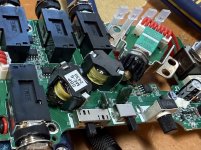
I don’t know about inductor footprints but this thread bump reminded me that I took apart my cheap Hotone soul press II and it looks like it’s got one of those SBP ME-6 inductors stock! (The installed one is on the right in this photo). The wah function on this thing does sound pretty good except the pot taper is terrible. Idk if this is useful for the Grand Inductor Ledger.
I have been looking for the footprint for wah inductors for a while and I can't seem to find any that I can use, I use KiCad to make circuit boards and I want to make some up to experiment with a tube driven wah.
Is there any chance someone can drop some drawings of the inductors here ?
Pin spacing and the overall size looking down on the PCB is all I need, I notice that most DIY PCB's have a footprint and lots of holes to suit a variety of inductors so the more info the better.
Thanks
Mick



 .
.