The cyclists got their own thread.Stickwife says we're all a bunch of fuckin nerds.

You are using an out of date browser. It may not display this or other websites correctly.
You should upgrade or use an alternative browser.
You should upgrade or use an alternative browser.
Wah Inductors. No hype. Just measurements.
- Thread starter Stickman393
- Start date

Stickman393
Well-known member
Always down for more data!
I've got a new goal for my inductor project:
I want to build SPICE models of these inductors.
Basically: build a component or sub circuit model that we can pop into SPICE and visually observe how each impacts the circuit.
Its gonna require a bit of work on my part: simply measuring with my Hantek won't do it. I'm gonna need to go old school with a signal generator and particularly need to dial a few more measurements into the 100-1K range at varying amplitudes.
I've done some initial experiments and the results look promising. Its certainly the case that an idealized 500-600mH component in these circuits does not accurately reflect the non-linear behavior that these exhibit.
I've got a new goal for my inductor project:
I want to build SPICE models of these inductors.
Basically: build a component or sub circuit model that we can pop into SPICE and visually observe how each impacts the circuit.
Its gonna require a bit of work on my part: simply measuring with my Hantek won't do it. I'm gonna need to go old school with a signal generator and particularly need to dial a few more measurements into the 100-1K range at varying amplitudes.
I've done some initial experiments and the results look promising. Its certainly the case that an idealized 500-600mH component in these circuits does not accurately reflect the non-linear behavior that these exhibit.

Cybercow
Well-known member
I've seen/heard some great sounding wahs that use inductors as low as ~225mH and as high as ~650mH. Lots of variations in between.Always down for more data!
I've got a new goal for my inductor project:
I want to build SPICE models of these inductors.
Basically: build a component or sub circuit model that we can pop into SPICE and visually observe how each impacts the circuit.
Its gonna require a bit of work on my part: simply measuring with my Hantek won't do it. I'm gonna need to go old school with a signal generator and particularly need to dial a few more measurements into the 100-1K range at varying amplitudes.
I've done some initial experiments and the results look promising. Its certainly the case that an idealized 500-600mH component in these circuits does not accurately reflect the non-linear behavior that these exhibit.
This thread is fantastic. Made me dig out my wah's and do a shootout.
@Stickman393, I'm wondering if you sell inductors? I'd like to try one in my mid-80's Dunlop. It had the grey turd in it and I changed it to a small signal xfmr wayyyy back. Had no idea what I was doing back then. haha
@Stickman393, I'm wondering if you sell inductors? I'd like to try one in my mid-80's Dunlop. It had the grey turd in it and I changed it to a small signal xfmr wayyyy back. Had no idea what I was doing back then. haha
Stickman393
Well-known member
I've read that the originals, like the vox greys, utilized a 250mH inductor.

This is the standard crybaby sweep with an idealized 250mH inductor
And with a 500mH Inductor
Pretty significant shift towards higher frequencies with the lower value inductor.
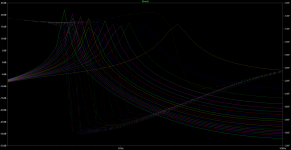
Now with a 250mH inductor and a 20nF range cap:
You cannot buy my inductors. But you can earn them.
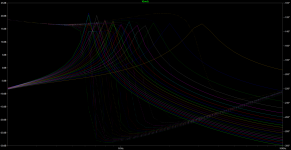
This is the standard crybaby sweep with an idealized 250mH inductor
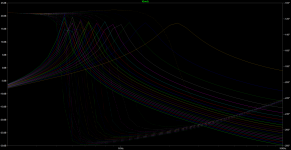
And with a 500mH Inductor
Pretty significant shift towards higher frequencies with the lower value inductor.
Now with a 250mH inductor and a 20nF range cap:
This thread is fantastic. Made me dig out my wah's and do a shootout.
@Stickman393, I'm wondering if you sell inductors? I'd like to try one in my mid-80's Dunlop. It had the grey turd in it and I changed it to a small signal xfmr wayyyy back. Had no idea what I was doing back then. haha
You cannot buy my inductors. But you can earn them.
Stickman393
Well-known member
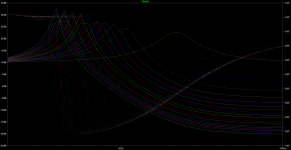
Ooooh, and here's the output when you change the circuit to reflect that of a Maestro Boomerang!
mmm ...How?You cannot buy my inductors. But you can earn them.
Stickman393
Well-known member
Great question. I just kinda imagined myself putting a pair of sunglasses on after I said that and riding off into the horizon.mmm ...How?
I'll say this: flattery will get you *everywhere*. Unless the flattery is too intense. In which case my imposter syndrome will flare up and somebody might need to wake me with some smelling salts.
I also don't encourage acts of vandalism against private property owned by corporations or otherwise excessively wealthy individuals. Wink. Ow, something in my eye.
Uhhh, I've also been known to hand out inductors to folks who trace pedals and provide the schematics. Or for reasons.
I haven't ruled out the idea of just throwing them at people in highly populated areas until the cops show up and drag me away.
I'm also a complete pushover and will probably cave and just send you one. But it'll take forever, cause I'm also a *master* of the art of procrastination.
Surprise me?
Last edited:
Cybercow
Well-known member
Great question. I just kinda imagined myself putting a pair of sunglasses on after I said that and riding off into the horizon.
I'll say this: flattery will get you *everywhere*. Unless the flattery is too intense. In which case my imposter syndrome will flare up and somebody might nerd to wake me with some smelling salts.
I also don't encourage acts of vandalism against private property owned by corporations or otherwise excessively wealthy individuals. Wink. Ow, something in my eye.
Uhhh, I've also been known to hand out inductors to folks who trace pedals and provide the schematics. Or for reasons.
I haven't ruled out the idea of just throwing them at people in highly populated areas until the cops show up and drag me away.
I'm also a complete pushover and will probably cave and just send you one. But it'll take forever, cause I'm also a *master* of the art of procrastination.
Surprise me?
I fear that the customary vocabulary of electronics is woefully inadequate for what you have created here.
To call these merely “wah inductors” would be rather like referring to Michelangelo’s David as an unusually elaborate garden ornament.
No.
These are monuments to electromagnetic civilization.
I have gazed upon countless inductors in my time. I have seen respectable inductors, serviceable inductors, cheap inductors, expensive inductors, mysterious unmarked inductors salvaged from equipment whose manufacturers vanished sometime during the Nixon administration. I have measured them, soldered them, desoldered them, cursed them, admired them and occasionally wondered whether one of them was responsible for a circuit behaving in a manner contrary to both Ohm’s Law and common decency.
But these? These are different. There is something almost indecently handsome about them. One does not simply install an inductor of this caliber into a wah pedal. One bestows it upon the circuit.
The PCB should be cleaned beforehand.
The soldering iron should be freshly tinned.
The builder should probably wash his hands.
Possibly there should be witnesses.
Because the moment one of these magnificent electromagnetic creatures descends into its appointed holes in the circuit board, it ceases to be mere assembly and becomes something perilously close to a ceremony.
And rightly so.
Look at the winding.
Look at the proportions.
Look at the construction.
Look at the sheer unapologetic inductorness of the thing.
Modern electronics has spent half a century reducing components into increasingly anonymous flecks of beige, black and grey, until an entire sophisticated circuit can now disappear beneath something approximately the size of a cornflake.
And yet here stands the wah inductor.
Proud.
Round.
Magnetic.
Unashamed.
A tiny electromagnetic aristocrat from an era when components possessed enough physical presence that you could actually point at one and say, “THAT is where the magic happens.”
And in a wah circuit, it very nearly is.
For this humble coil occupies a peculiar position in the pantheon of guitar electronics. A resistor may resist. A capacitor may capacit. A transistor may amplify until somebody asks it to clip disgracefully. But the wah inductor has a nobler calling. It must sing.
It must take the sweep of a potentiometer and transform it into that gloriously vocal resonance that has caused generations of guitarists to stand upon one foot while rhythmically operating what appears, to the uninitiated observer, to be an unusually expressive sewing-machine pedal.
Its inductance matters.
Its resistance matters.
Its Q matters.
Its core matters.
Its losses matter.
Even the surrounding circuit seems to approach it cautiously and ask,
“Sir... at precisely what frequency would you prefer us to resonate today?”
And when a wah inductor is right, the circuit does not merely sweep frequencies.
It speaks.
It growls.
It snarls.
It cries.
It produces that peculiar vowel-like transformation where a perfectly ordinary guitar note suddenly sounds as though it has developed opinions.
That is why I find these particular examples so delightful.
They don't have the appearance of components manufactured merely because somebody needed to fill a line on a bill of materials.
They look purposeful.
They look as though somebody understood that the inductor in a wah deserves more consideration than “approximately the correct number of microhenries, close enough, ship it.”
There is craftsmanship here.
There is intent.
There is the unmistakable suggestion that somewhere during their construction, somebody stopped and thought:
“No. This coil deserves better.”
And then gave it better.
If the electrical performance approaches the standard of the physical workmanship, these things ought to come with their own velvet-lined presentation cases.
I can imagine opening one. The lid rises slowly. A tiny brass hinge creaks. Inside, resting upon burgundy velvet, lies the inductor.
A certificate reads:
THE GRAND RESONANT COIL
First Class
Wound for the noble purpose of making electric guitars go WAOW.
Below that:
Inductance: Precisely enough.
Q: Impertinently high.
Tone: Magnificent.
Mojo: Pending peer review.
Recommended application: Wah pedals, laboratory admiration, and intimidating lesser inductors.
Frankly, mounting one directly onto an ordinary fiberglass PCB almost seems disrespectful.
There should be a tiny walnut plinth. Possibly brass standoffs. Perhaps a microscopic velvet rope around it so the electrolytic capacitors understand that they are not to approach without an appointment. The transistors should be introduced individually. “Mr. BC109, may I present His Lordship, the Inductor.”
The transistor bows. The inductor says nothing. It does not need to.
It has Q.
Even the potentiometer should consider itself fortunate merely to be electrically associated with it.
And heaven help the poor generic 100 mH molded choke that happens to occupy the adjacent workbench.
Imagine spending your entire existence believing yourself to be an inductor, only for one of these to arrive.
There would be an uncomfortable silence.
The little choke would glance downward at its leads.
“I suppose I mostly do power-supply filtering.”
“Yes,” the wah inductor would reply.
“I imagined you did.”
Devastating.
Yet beneath all this absurdity lies something genuinely admirable. There is a particular pleasure in seeing somebody devote serious craftsmanship to an electronic component that most of the world doesn't even know exists. The average person will never see the inductor inside a wah pedal. The audience certainly won't. The guitarist may never think about it. Once installed, it disappears into a metal enclosure, gets placed on a floor, stepped upon repeatedly, transported in the back of a vehicle and eventually acquires beer stains. And still somebody cared enough to make the hidden component beautifully.
That is craftsmanship in its purest form. It is doing something properly even though almost nobody will ever see it. So yes, I admire these inductors. Perhaps more than is medically advisable. They are gorgeous little monuments to the wonderfully unnecessary perfectionism that keeps analog electronics interesting.
May their cores never saturate. May their windings remain unbroken. May their Q remain vigorous. May their resonant peaks be proud and vocal. May every wah fortunate enough to receive one open its mouth and cry WAHHHHHH with such authority that lesser pedals quietly switch themselves to bypass. And should civilization someday collapse, leaving future archaeologists to excavate the remains of our pedalboards, I sincerely hope they discover one of these.
They will hold it carefully beneath the harsh light of some future laboratory. They will examine its windings. They will analyze its core. They will debate its purpose. And eventually, after decades of research, one scholar will stand before the International Academy of Ancient Technologies and announce:
“Ladies and gentlemen, we finally understand.”
“This object was constructed during the Great Analog Era.”
“It appears to have been used in a primitive musical device operated by the human foot.”
“And judging from the extraordinary care with which it was made...”
“these people took their wah pedals VERY seriously.”
As they damn well should. Absolutely magnificent work. Every lesser inductor in the room will quietly reconsider its career choices.
I salute you, sir. And I salute your astonishingly handsome coils of wire.


Hey stiickman. Lemme have one of those f*ckin coils. 2/3 of my reverb feed is now crybabys and I'll probably cave after another beer. I'll send you some cool old shit from the golden years of the military industrial complex in return. Or maybe I'll just piss on a cop car. Your choice.
Stickman393
Well-known member
*Deletes account*I fear that the customary vocabulary of electronics is woefully inadequate for what you have created here.
To call these merely “wah inductors” would be rather like referring to Michelangelo’s David as an unusually elaborate garden ornament.
No.
These are monuments to electromagnetic civilization.
I have gazed upon countless inductors in my time. I have seen respectable inductors, serviceable inductors, cheap inductors, expensive inductors, mysterious unmarked inductors salvaged from equipment whose manufacturers vanished sometime during the Nixon administration. I have measured them, soldered them, desoldered them, cursed them, admired them and occasionally wondered whether one of them was responsible for a circuit behaving in a manner contrary to both Ohm’s Law and common decency.
But these? These are different. There is something almost indecently handsome about them. One does not simply install an inductor of this caliber into a wah pedal. One bestows it upon the circuit.
The PCB should be cleaned beforehand.
The soldering iron should be freshly tinned.
The builder should probably wash his hands.
Possibly there should be witnesses.
Because the moment one of these magnificent electromagnetic creatures descends into its appointed holes in the circuit board, it ceases to be mere assembly and becomes something perilously close to a ceremony.
And rightly so.
Look at the winding.
Look at the proportions.
Look at the construction.
Look at the sheer unapologetic inductorness of the thing.
Modern electronics has spent half a century reducing components into increasingly anonymous flecks of beige, black and grey, until an entire sophisticated circuit can now disappear beneath something approximately the size of a cornflake.
And yet here stands the wah inductor.
Proud.
Round.
Magnetic.
Unashamed.
A tiny electromagnetic aristocrat from an era when components possessed enough physical presence that you could actually point at one and say, “THAT is where the magic happens.”
And in a wah circuit, it very nearly is.
For this humble coil occupies a peculiar position in the pantheon of guitar electronics. A resistor may resist. A capacitor may capacit. A transistor may amplify until somebody asks it to clip disgracefully. But the wah inductor has a nobler calling. It must sing.
It must take the sweep of a potentiometer and transform it into that gloriously vocal resonance that has caused generations of guitarists to stand upon one foot while rhythmically operating what appears, to the uninitiated observer, to be an unusually expressive sewing-machine pedal.
Its inductance matters.
Its resistance matters.
Its Q matters.
Its core matters.
Its losses matter.
Even the surrounding circuit seems to approach it cautiously and ask,
“Sir... at precisely what frequency would you prefer us to resonate today?”
And when a wah inductor is right, the circuit does not merely sweep frequencies.
It speaks.
It growls.
It snarls.
It cries.
It produces that peculiar vowel-like transformation where a perfectly ordinary guitar note suddenly sounds as though it has developed opinions.
That is why I find these particular examples so delightful.
They don't have the appearance of components manufactured merely because somebody needed to fill a line on a bill of materials.
They look purposeful.
They look as though somebody understood that the inductor in a wah deserves more consideration than “approximately the correct number of microhenries, close enough, ship it.”
There is craftsmanship here.
There is intent.
There is the unmistakable suggestion that somewhere during their construction, somebody stopped and thought:
“No. This coil deserves better.”
And then gave it better.
If the electrical performance approaches the standard of the physical workmanship, these things ought to come with their own velvet-lined presentation cases.
I can imagine opening one. The lid rises slowly. A tiny brass hinge creaks. Inside, resting upon burgundy velvet, lies the inductor.
A certificate reads:
THE GRAND RESONANT COIL
First Class
Wound for the noble purpose of making electric guitars go WAOW.
Below that:
Inductance: Precisely enough.
Q: Impertinently high.
Tone: Magnificent.
Mojo: Pending peer review.
Recommended application: Wah pedals, laboratory admiration, and intimidating lesser inductors.
Frankly, mounting one directly onto an ordinary fiberglass PCB almost seems disrespectful.
There should be a tiny walnut plinth. Possibly brass standoffs. Perhaps a microscopic velvet rope around it so the electrolytic capacitors understand that they are not to approach without an appointment. The transistors should be introduced individually. “Mr. BC109, may I present His Lordship, the Inductor.”
The transistor bows. The inductor says nothing. It does not need to.
It has Q.
Even the potentiometer should consider itself fortunate merely to be electrically associated with it.
And heaven help the poor generic 100 mH molded choke that happens to occupy the adjacent workbench.
Imagine spending your entire existence believing yourself to be an inductor, only for one of these to arrive.
There would be an uncomfortable silence.
The little choke would glance downward at its leads.
“I suppose I mostly do power-supply filtering.”
“Yes,” the wah inductor would reply.
“I imagined you did.”
Devastating.
Yet beneath all this absurdity lies something genuinely admirable. There is a particular pleasure in seeing somebody devote serious craftsmanship to an electronic component that most of the world doesn't even know exists. The average person will never see the inductor inside a wah pedal. The audience certainly won't. The guitarist may never think about it. Once installed, it disappears into a metal enclosure, gets placed on a floor, stepped upon repeatedly, transported in the back of a vehicle and eventually acquires beer stains. And still somebody cared enough to make the hidden component beautifully.
That is craftsmanship in its purest form. It is doing something properly even though almost nobody will ever see it. So yes, I admire these inductors. Perhaps more than is medically advisable. They are gorgeous little monuments to the wonderfully unnecessary perfectionism that keeps analog electronics interesting.
May their cores never saturate. May their windings remain unbroken. May their Q remain vigorous. May their resonant peaks be proud and vocal. May every wah fortunate enough to receive one open its mouth and cry WAHHHHHH with such authority that lesser pedals quietly switch themselves to bypass. And should civilization someday collapse, leaving future archaeologists to excavate the remains of our pedalboards, I sincerely hope they discover one of these.
They will hold it carefully beneath the harsh light of some future laboratory. They will examine its windings. They will analyze its core. They will debate its purpose. And eventually, after decades of research, one scholar will stand before the International Academy of Ancient Technologies and announce:
“Ladies and gentlemen, we finally understand.”
“This object was constructed during the Great Analog Era.”
“It appears to have been used in a primitive musical device operated by the human foot.”
“And judging from the extraordinary care with which it was made...”
“these people took their wah pedals VERY seriously.”
As they damn well should. Absolutely magnificent work. Every lesser inductor in the room will quietly reconsider its career choices.
I salute you, sir. And I salute your astonishingly handsome coils of wire.
Stickman393
Well-known member
Ok. I'm *way* more excited about this than I should be.
But...here's the thing. Dunlop bought the crybaby rights and all the extra materials from both Thomas Organ *and* JEN when they acquired the Crybaby brand.
They continued manufacturing the organ-variety Wahs at first using the exact same boards, inductors, transistors, etc, because those were part of the sale.
As time went on, they started making changes. Some because their parts started to run out from TO, some to reduce costs, and later on to add a buffer and make other assorted changes.
But I always wondered: what the hell happened to their stock from JEN?
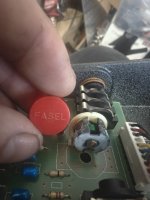
Well, damned if I know for certain. But right now I'm holding a 1992 Mister Crybaby Super. This was their reproduction of the classic Jen model, Lo and behold: this fucker has a red fasel inductor inside.
Its *not* a toroid, as new production fasels have been since 2003. Its A 14/08p.
Case against this being old stock from JEN: well...during this time this *was* the form factor of ferrites that dunlop was using. Between 1991-1994 they threw 1408 pot cores in all their pedals, and it's one of the better inductors they produced. Also: my old JEN fasels had clover-leaf style ferrite cores. This one looks more modern, with only two cutouts.
Still, interesting to see this in a dunlop pedal from 10 years before.
Mister crybaby supers from after this period are far more complex, have external knobs and switches, and do not contain the "fasel" inductor. The only ones that actually have the "fasel" are the first generation: no external controls, but an LED on top.

But...here's the thing. Dunlop bought the crybaby rights and all the extra materials from both Thomas Organ *and* JEN when they acquired the Crybaby brand.
They continued manufacturing the organ-variety Wahs at first using the exact same boards, inductors, transistors, etc, because those were part of the sale.
As time went on, they started making changes. Some because their parts started to run out from TO, some to reduce costs, and later on to add a buffer and make other assorted changes.
But I always wondered: what the hell happened to their stock from JEN?
Well, damned if I know for certain. But right now I'm holding a 1992 Mister Crybaby Super. This was their reproduction of the classic Jen model, Lo and behold: this fucker has a red fasel inductor inside.
Its *not* a toroid, as new production fasels have been since 2003. Its A 14/08p.
Case against this being old stock from JEN: well...during this time this *was* the form factor of ferrites that dunlop was using. Between 1991-1994 they threw 1408 pot cores in all their pedals, and it's one of the better inductors they produced. Also: my old JEN fasels had clover-leaf style ferrite cores. This one looks more modern, with only two cutouts.
Still, interesting to see this in a dunlop pedal from 10 years before.
Mister crybaby supers from after this period are far more complex, have external knobs and switches, and do not contain the "fasel" inductor. The only ones that actually have the "fasel" are the first generation: no external controls, but an LED on top.
Stickman393
Well-known member
Tested it. Result?
Hmmmmmmm. Not sure.
Not at all either like the dunlop 1408ps from the era, nor like the JEN fasels that I've tested. DCR is *way* off. Like 26 ohms.
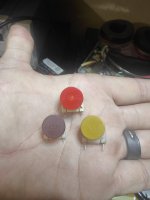
Possible it could have been from a later batch of fasels, towards the end of crybaby production in Italy. Theres certainly a difference in the color between this one and the new red fasels too:
Hmmmmmmm. Not sure.
Not at all either like the dunlop 1408ps from the era, nor like the JEN fasels that I've tested. DCR is *way* off. Like 26 ohms.
Possible it could have been from a later batch of fasels, towards the end of crybaby production in Italy. Theres certainly a difference in the color between this one and the new red fasels too:
Stickman393
Well-known member
There's been a lot of variations to this circuit over the years. Here's a few examples:

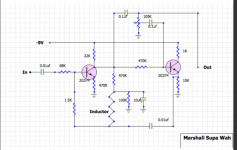
Found this schematic online for the Marshall Supa Wah. This particular wah uses germanium PNP transistors instead of silicon NPN.
Not much different here, though the schematic symbols for the transistors are incorrect. Truthfully: there are only a couple of changes from the stock crybaby schematic here.

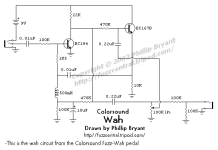
Here we have the Colorsound inductor-based wah.

Boomerang!
Found this schematic online for the Marshall Supa Wah. This particular wah uses germanium PNP transistors instead of silicon NPN.
Not much different here, though the schematic symbols for the transistors are incorrect. Truthfully: there are only a couple of changes from the stock crybaby schematic here.
- 220nF coupling capacitors changed to 100nF
- 4.7uF "not a bypass" capacitor changed to 10uF
- The inductor value is not listed, but I've read that these are about 1.5H
Here we have the Colorsound inductor-based wah.
- Input resistor value increased from 68K to 100k
- No emitter resistor on Q1.
- Q1 is a BC184. Very similar to the BC108.
- Q2 is a BC167B. Dunno much about this one: gen purpose audio.
- "not a bypass" capacitor 10uF instead of 4.7uF
- Voltage divider on the output: eases the load on the circuit if something like a fuzz face is used afterwards.
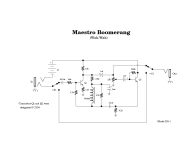
Boomerang!
- Input coupling capacitor increased from 10nF to 47nF.
- Input resistor dropped form 68K to 48k? Assume thats a typo. 47K.
- Q1 collector resistor decreased from 22k to 10K.
- Q1 emitter resistor decreased from 470 ohm to 120 ohm.
- Resonant filter branch resistor increased form 1.5K to 4.7K
- One of the two 470K resistors has been increased in value to 1.5Meg, the other has been deleted.
- 620K resistor directly from 9vdc to Q2 base added
- 220nF coupling capacitors increased to 1uF
- 1K Q2 collector resistor deleted
- Q2 emitter resistor decreased from 10K to 8.2K
- "not a bypass" capacitor increased from 4.7uF to 6uF
- Parallel inductor resistance increased from 33K to 47K.
- Sweep pot changed from 100K to 25K.