Wah Inductors. No hype. Just measurements.

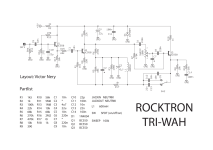
That would be perfect for what I am looking for, any chance I can have it ?
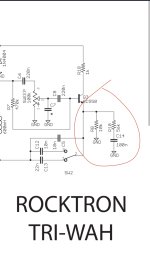
Otherwise just a drawing would be great as well, I am used to making my own footprints in KiCad.
Thanks
Mick
 
Sorry for the Hijack here, I mean...you can go hi-tech or you can just go lo-tech sometimes

....I can't intellectualize by the numbers.

For me, it all came down to the tone pot.

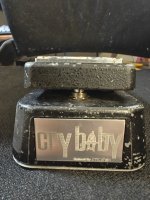
Years ago I modded my first Dunlop Crybaby following the 'stinkfoot' wah mods...dug through the parts drawer and gave it a shot.

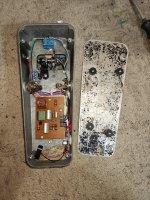
Upgraded to a 3PDT, and bypassed the buffer
(***One thing for sure, I now need to plug a JFET buffer after the Wah pedal in the chain, or it barely works.*** )

changed a few resistors and capacitors. That seemed to darken things, and tamed the shrill high end.

...Upgraded with the 'Red Fasel' inductor from the stock coil. That changed the voice!!

That made a pretty noticable difference in the sound, nice, a lot more 'authentic' tone? Ok maybe that's not the correct word here, as we know the Red and Yellow Reissue fasel induction coils are not the original, Induction me into the Rock and roll hall of shame then.

But something wasn't quite right yet....The Travel on the pedal just didn't seem to be right, something was still missing I don't know.

I played around with the 'travel' a bit and tamed the ear drilling highs, but there was something in the mids I wasn't getttin yet...Shrieking high dropping down to a pretty flat bottom end. Underwhelming.

The Crybaby came stock with a 100K pot, and during research I randomly read on the google somewhere that Hendrix had a 250K pot, honestly I looked everywhere and could NOT find a 250K tone pot for a wah, hmmmm that's very suspicious....I wondered for awhile maybe this is some kinda well hidden secret sauce or something?!?!? Only one way to find out.

Lo and behold I tried ordering a Wah tone pot from mojotone, It was not a 250K pot, but a 200K I think?


Right off the bat it Crackled worse than anything, no amount of de-oxit was working!

I took it apart and saw the graphite was totally Scored and damaged somehow!!!? Unbelievable, there was NO WAY I did that, it looked like a factory defect!!!!

The part was a dud!!! Wow.

I politely notified them and was met with a muted response. They did not reply to my message, and those Wah parts had just mysteriously vanished from their site next thing I know. HM ok...Fine. I just paid about $25 bucks for this part. Great...Grand.

Out of sheer 'I AM AHAB!!!!!!!' towering force of will to power....I went down to the old local ma and pa guitar store a few towns over, bought a generic 250K tone pot for a guitar for a whopping $6 dollars.

Did some serious reaming and straight up Jammed the Wah pedal gear on it, stuck it in..Bam!!!

Who needs a freakin' specialized Wah pedal tone pot..., let's see what we can do.


YARRRR THAR BE THE SECRET TONE YE BE WANTING MATIES!!!

No way, I'll be dipped....There it is.

That Raw and gnarly midrange that just tears at you ferociously. When you make that 'OOoOOOOoooo' Face. Jumping out at me!!!


It really really made all the difference!!! Honestly, that was the secret sauce right there. It's alive.

.....that my ears perk up!!! right here, that's....Eureka!!! There we go.

Now If I could only just do something about those horrendous 6 pin Quarter inch Jacks they're using in their modern Crybabies. UGH!!!

For me the induction coil was only half the battle tone chasing the elusive dragon....You might hate the sound of my wah pedal, I mean, different stokes different folks, sometimes a Stock Crybaby will do just fine, you know? I'm not saying I made it better or anything.

I could have probably just built a better wah from scratch and tossed the original guts in the trash where they will do more good.

Can you tell I had fun at least?

So what tone pots are you guys using in your wah pedals?
 
Last edited:
Oh shit! Joe found my thread!

Whatttt. I'm not worthy. I'm not worthy!
awesome thread


rossbalch said:
I picked up these pots and the associated bobbin https://nz.mouser.com/ProductDetail/871-B65661W0000R030


What's the best way to calculate how many turns you need for a given inductance?

Looks like you got larger ferrites than are standard. Still usable, mind you!

My experience with N30 as a ferrite grade is that winds of around 20-35 ohms work well for achieving around 500mH. 40AWG is a decent starting point.

Magnet wire is pretty predictable, you can guesstimate how much length you'll need and there are, ways to calculate how many winds that translates into. I'll see if I can dig up that info.
 
Last edited:
I have the inductance and ohms of a few inductors, if you want that info. I have an N30 gold text from a 1994 limited edition V847G, a Wilson Effects halo, a Dunlop yellow, and a couple black inductors from the 90's. I measured them with my EXTECH LCR meter.

As for measuring and logging your pots. If you can build a fixture to spin two or more pots at the same time, you can do the following.

You can use the Innovate Motorsports SSI4 to data log and/or view up to four pots in real-time. The SSI4 requires 12V to power it, and it has a 5V output you can use to power a linear pot. I wouldn't use its 5V power output for both pots because it would parallel them, so you'll need another regulated 5V supply for the other pot. The 12V supply, and the 5V supply share the same common ground. Likewise, the additional 5V supply must also share the same common ground, so the two pots will accurately reference the same ground. Basically, tie the negative of everything together.

It is designed for Automotive data logging, but you can use it for this purpose. Check the manual, but you can probably power it with a 9V battery, or a 9V adapter.

Anyway, the SSI4 has four 0-5V inputs. You connect the wiper and the negative lug of the linear pot to input 1, and the wiper and the negative lug of the second pot to the second input.

In the LogWorks software, each channel will have its gauge. So pot 1 will have its voltage displayed, and pot 2 will have its voltage displayed.

Use the voltage at the min extreme, and the max extreme for each pot, that is being displayed on the screen to set the 0% and 100% parameters for each pot, and give them a name. Linear for the linear pot, and Hot Potz 1 (etc...) for the other.

If the actual readings end up being something different at each extreme of the pot's rotation than 0V and 5V, and they probably will, like 0.00V, and 5.2V, then 0.0V would = 0%, and 5.2V would = 100%.

You input that info into the fields, and the software updates that gauge for you. You have to do this for each pot, turning each pot to its extremes to get the voltage for each pot, to set the parameters for its gauge.

It has been about 15 years since I did this, but this is how I remember it working. I did this for sensor data on an ATV to tune it. For example, the TPS was at 1.12V at 0% throttle, and the wide open throttle (WOT) was something like 4.65V. So I inputed 1.12V = 0%, and 4.65V = 100%. I called the gauge TPS with those parameters, and it worked excellent.

With this, you'll be able to compare the wah pot against the linear pot based on percentage. I think you can also plot gauges/channels against each other to compare the sweep of the pots on a graph.

You will know if you are turning them accuratly if they all start at 0% together, and end at 100% together. They'll all be different within that, but they should begin at 0%, and end at 100% at the same time.

Do you have plans on having a pot manufactured? If so, I hate high torque pots. I want the wah to move quickly, and freely. Inductors make their impact, but, IMO, the pot is the most critical part of the sound, and its feel shouldn't get in the way. Leave that to the axle/hinge pin tensioner.

By the way, what are some 100k pots that actually have the correct Icar taper?
 
I guess I should elaborate on why I asked the question, what pots "actually have the correct ICAR taper?"

I have tried two different pots that claim to have the ICAR taper, and both are extremely different. One is great, the other is not. I have never used an old ICAR pot, but of these two that claim to have the ICAR taper, one nails the sounds we all know and love, and is very vocal and satisfying under foot. The other is more like a bass/treble on/off switch, with very little vocal mids.

A thought came to me after my post about data logging the pots. Since the pots are turned counter clockwise to brighten, and we think of them as increasing as the toe goes down, I think it would be better to make 5V = 0%, and 0V = 100%. Then, turn the pots down during the test, so LogWorks will show it as an increase.

Well, actually, after thinking about it even deeper, it would be best to set the voltage you get with the pot set at the ohm with the heel down as 0%, and the voltage you get with the pot set at the ohm with the toe down as 100%. This will increase resolution, so your eyes can see what your ears hear. Isn't that what we are most interested in?

If you perform this experiment with the SSI4 and LogWorks, since we have pots that crowd their best sound/wah sweep off center towards the treble end, and others that have their best sound/wah sweep better centered, I think it would be best to NOT test the full range of the pots. That wouldn't be a good comparison. Instead, I think it would be best to set each pot for its best sound in the wah, ohm the min and max, then set the pot up to sweep within that range during the test. Then, when you overlay the sweep, you'll get a much better comparison of their taper.

Also, after thinking about it, I don't think using a linear pot to compare against would be very helpful. Using a pot we all know would be the best baseline. I think the Hot Potz 2 would be the best option, since it has a broad linear feeling sweep under foot.

If using different wahs to setup each pot for its best sound before the test in LogWorks, each wah needs to have the same component values, inductors, and even the same bump stop lengths. Then when conducting the test with the SSI4 and LogWorks, set each pot up to turn only within its best sounding range, and you will have the best overlay comparison possible.

You could also compare the full rotation by making 5V = 0%, and 0V = 100%, just to compare the full track, but I think the best sounding range of the track is more useful for comparison.
 
Imma gonna need to go over that post a few more times to really absorb it all, but from a first glance:

Interesting idea. I'm not sure I'd go with that specific device...I'm sure I can figure out a similar setup with an arduino. Those have 5v outputs and can deal in 5v natively. Probably just need a CLR to protect both the pot and the board.

I, honestly, don't have the foggiest clue as to how I would get a potentiometer made. All I know is that I lack the ability to make one.

I only have the one Icar pot right now (read: probably ever): unfortunately I'm at the mercy of a very small sample size when I test it. Too many unknown factors at play: the original pots likely had a tolerance of around 10-20%, no telling how much wear it has and how that's impacted it's response, yada blah. Which is to say the experiment I want to perform is gonna be pretty non-scientific. I'll only have the sweep of one ICAR pot.

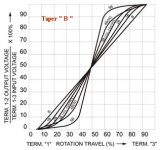
From what I've seen, what folks refer to as an "Icar" taper seems to be similar to what I've seen alpha refer to as a "4B" or "5B" taper.

Now...I'm a guy who likes to hang out in the realm of "objective data". I don't trust my ears. I am a hack and a fraud, so I don't believe my ears are going to be any less hacky and...erm...fraud...y. So I won't make any pronouncements about what's gonna give ya the best wah sweep.

BUT...when it comes to pots, there's not as much mystery to be had. It's a fairly simple, passive, resistive device. Any pot should be able to replicate the full range of any other pot...but the crybaby shell is *limited* in its actual, usable range. Partially because your foot can do a lot of damage to a potentiometer if you try to push it past its end point.

As I've said before, I like to draw out the vowel-y sweep of the wah when I play. In truth I'd prefer something like a thinner version of the rocktron utopia wah case with a straight-up linear potentiometer for my use. Folks that prefer quacky, fast-paced wah use will tend more towards a more compressed taper.

Here's a little graph from alpha:

1000058917.jpg

The graph from the McCon-O-Wah potentiometer page:

1000058920.jpg

I still plan on doing this experiment, but it took a bit of a back burner after I ran to the hills, screaming, when Mr. Gagan found my thread and decided that I needed to learn other things like how to refret a neck as I calmed myself.
 
HAHA, I'm a hack when it comes to engineering. lol Yeah, Joe has had a very nice impact. One of his best, and I think it is his mod, I may be wrong, is an input volume for the octavia. It takes it from a very narrow window of use to a broad range of use by attenuating the input so the circuit isn't over saturated. It makes the octave track much better.

Believe it or not, I'm blind, not black blind, but I can't see anything with any detail, so I can't see the graphs. These are ideas I was mostly hoping to help you with, and yeah, for my own selfish desire to help you develop a very nice pot too. I assume, with a taper plotted out, CTS or Alpha would be willing to build it, if you buy enough of them. lol

My favorite pots are the Hot Potz 1, and the BYOC ICAR taper pot. Which I prefer all depends on where I have the wah in the chain. If it is after fuzz (and I use fuzz as a warm preamp boost), I prefer the BYOC ICAR taper pot. If it is before octave and fuzz I prefer the Hot Potz 1 when I cover Jimi's BOG songs.

The Hot Potz 1 is warmer through more of its throw, so it sounds better with octavia. However, going into fuzz and octavia, the difference between pots is less noticeable. After my warm preamp fuzz, the difference is very noticeable, because the wah is much more expressive. I keep two wahs in the chain because I use wah both ways.

Which wah I use depends on how much I want to have to move my foot for the wah and the riff, and how expressive I want the wah to be. The BYOC ICAR taper requires less movement to get that vocal vowel, and it has a longer upper mids than the Hot Potz 1, whereas the Hot Potz 1 is a bit more broad, with a shorter upper mids of its sweep. They both feel good under foot. I think a pot that lands somewhere between them would be nice.

Something I do hate about the Hot Potz 1 is how it has its useful sweep crowded down into the treble/counter clockwise end of its rotation. Its useful sweep should have been better centered within its range. I always set the gear one tooth back from the full counter clockwise treble extreme, then clock the pot a bit. As you mentioned about limited gear range, you have to leave some pot travel for the front bump stops to compress, so you can latch the footswitch without breaking the gear.

Some people like to remove the front bump stops, then latch the footswitch with the treadle and set the gear in its last tooth. You have to loosen the nut and clock the pot to do this, because it needs a slight bit of wiggle to ensure you don't break the gear. If you do this, the footswitch is the bump stop, so it is impossible to break the gear this way, but I don't like it quite this bright, and I always end up accidentally toggling the footswitch at some point, so I always install the Dunlop 3/8 long front bumpstops, if they have been removed.

I have a McCon-O-pot in a wah, and it sounds good, but I don't like the stiff high torque feel (it impedes movement), and it doesn't have as nice of a vocal feel under foot. However, I do still have the stock .193 long bump stop in the heel of the treadle of that wah, and that is limiting the treadle's sweep. It may have a better vocal quality if I extend that range a bit with a shorter rear bump stop. I do have the wah set center of the sweep, and I'll recenter it by clocking the pot once I increase the treadle's sweep range.

By clock, I just mean to loosen the nut, turn the pot, then resnug the nut. It gives a finer adjustment than moving the gear by a full tooth. I always try to set the wah in the center of the treadle's sweep. I almost never leave the solder lugs facing straight up. I usually install a shorter rear bump stop too, to increase the sweep range.

All I've ever used are Dunlop Crybabies, and recently I started buying 90's V847's. I now have six of them. lol Those have chassis mount jacks (not PCB mount like the GCB95), through hole components, and no goofy battery door on the bottom plate. They are easy to work on. They typically only need some paint sanded off around the jacks, the pot, and the footswitch to get them well grounded to reduce noise, and swap in a good pot, if it is worn out, to get them up and going. We always true bypass them too, and we ground the input and the output of the circuit when the switch is bypassed.

We install a 3/4 x 1/8 neoprene pad with contact cement, with a 3/4 x 3/16 heavy duty felt furniture pad stacked on it to reach the short bushing 3PDT footswitch. I had already bought these pads and they weren't long enough alone to reach the footswitch, thus the 1/8 neoprene idea under the felt pad. A .250 thick neoprene pad, or a 1/8 neoprene pad, with a 1/8 felt pad would reach. I use the LMS low profile footswitch Joe recommends.

We have swapped in the Wilson halo in a couple, which by the way, is great, but the Wilson pot is the one I do not like, at all. The Wilson pot has almost no vocal mids. It is almost like a bass/treble on/off switch. It is good for the intro of Voodoo Child, when played the way Jimi stabbed the toe end down while he vibratoed the string, but to play it rocking the treadle like SRV did, it sounds shrill and nasal past mid sweep. Nasal when moving back from toe down.

 
I was searching for my old SSI4 and I couldn't find it. So I asked Gemini what else could be used and it too recommended an Arduino. I don't ever remember hearing of one of those (shows what an electrical engineering hack I am), but I understand how it would work due to my use of the SSI4. I was thinking about sending my SSI4 to you, but I must have left it installed on that ATV. I thought I had removed it.

Anyway, according to Gemini, it can help write the code, so it shouldn't be too hard to do. It says you can overlay the pot tapers on a graph. You would use percentage to show the taper, just like I described before.

IMO, I still think it would be best to ohm the heel extreme and toe extreme of the pot while it is in the wah (resting on the bump stops), then remove the pot, connect it to the arduino and power it, see what the voltage is at those two ohm settings, and write the code as the heel voltage equals 0%, and the toe voltage equals 100%.

This will give the best resolution. You should do this for each pot, using wahs that all have the exact same treadle range (bump stop lengths) to maintain an equal range for the pot group.

When you turn the pots, you would need to turn them counterclockwise, and all simultaneously within this range, from their 0% heel setting, to their 100% toe setting. Then, you could overlay each of them on a graph. Your eyes could then see what your ears hear.

I think having the full range of the pot from extreme clockwise to extreme counterclockwise graphed would be useful too, but I think graphing only the best sounding range is the better comparison.

However, having the full rotation from extreme to extreme graphed would show how far off center of the pots range a pot like the Hot Potz 1 is, and how moving its taper to the center would improve that pot. That would be the benefit of having that data too.

To code the Arduino to log the full range of the pots you would just measure each pot turned full clockwise, that would be around 5V, and input that voltage as 0%. Then turn it fully counterclockwise and it should be at 0V, so enter 0V = 100%. This would give you the full range.

I read on page 8 you were interested to know the Wilson halo inductor measurements. Here they are, using my EXTECH Instruments LCR meter for the inductance, but I use my DMM for the DCR, because my old LCR meter can't measure DCR. I just learned last night my LCR meter can measure the Q too. Shows what a hack I am. lol

Wilson Effects halo
507.8mH at 1kHz
28.0R

BYOC halo
671.8mH at 1kHz
30.4R

Gold text N30 from the 1994 V847G
759.1mH at 1kHz
18.3R

Black inductor from 1996-1997 V847
513.8mH at 1kHz
17.7R

Black inductor from 99-00 GCB95
567.2mH at 1k Hz
18.0R

Yellow inductor from 2023
658.7mH at 1kHz
16.0R

Yellow inductor from 2026
666.0mH at 1kHz
15.5R

By the way, I have a couple Whipple pots in the mail. Hopefully I like them. When the Chase Tone pot is available, I'm going to try it too. Hopefully it doesn't require as much torque to turn as the McCon-O-pot. I don't even have the hinge pin tension spring in my wahs. I want them to move freely. I don't need it to park. I just need enough tension it doesn't feel cheap and floppy, so I'm going to make my own adjustable split clutch tensioner. I don't like how the spring tensioner, or how the Eleca tensioner load the boss/bearing/hinge pin interface. My heavy foot is enough load.
 
Back
Top