What’s on *YOUR* workbench?

Yeah hand drilling is definitely the worst part of etching. I still need to try out a soldermask, I've never actually done one on a board I've made. Is it as easy as the people selling the stuff try to make it sound?
Once you get a few things together, it's easy. Exposure time, proper blacks on the transprencies, separating foil to which the soldermask doesn't stick. You have to think about when to apply the soldermask. Because now you'll be plugging holes with it. It would be better to mill the traces, apply the soldermask, drill holes. You can also mill the traces, apply and cure soldermask, mill the soldermask openings, drill holes.
 
Last edited:
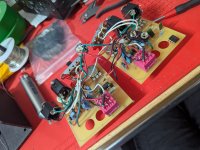
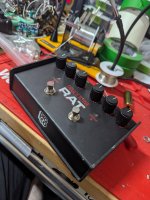
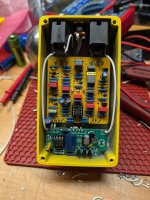
I’m building BAT Destroyer-like combo pedal. Originally it’s Ritual (YAFF) into Oath (knobless Pharaoh aka YABM), but I replaced Ritual with Mammoth Bender (TBmkII+Woolly Mammoth tone control). Got bender side working, but Oath gives me mostly static. Q1-3 VDC readings are fine and circuit continuity is ok, but I noticed layout I used doesn’t have input resistor to Q1 as Pharaoh schem shows. I have audio probe, but haven’t really gotten the mood for probing biz. Maybe I just depart current Oath verovoard and start a new one…
 
Once you get a few things together, it's easy. Exposure time, proper blacks on the transprencies, separating foil to which the soldermask doesn't stick. You have to think about when to apply the soldermask. Because now you'll be plugging holes with it. It would be better to mill the traces, apply the soldermask, drill holes. You can also mill the traces, apply and cure soldermask, mill the soldermask openings, drill holes.
I've seen a couple tutorials where people apply solder mask after the board is complete and use a laser engraver to etch away the mask on the pads, I may try that method. I have a couple boards that were just tests, I'll experiment with those before I try things on a board I actually need.
 
Whatever happened to the P in Printed Circuit Boards? I want to put a blank board in a printer, hit Print, and out comes a proper PCB. Is it too much to ask? Why can't someone make this happen? Canon? Epson? HP? Hello?
 
I've seen a couple tutorials where people apply solder mask after the board is complete and use a laser engraver to etch away the mask on the pads, I may try that method. I have a couple boards that were just tests, I'll experiment with those before I try things on a board I actually need.
Looks too perfect and too clean for me (on their videos).
 
IMG_2104.jpeg
IMG_2105.jpeg
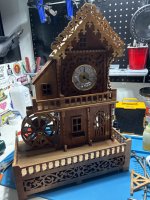
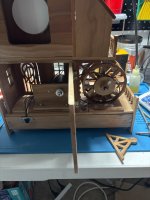
The wife always finds something weird for me to fix, the little water wheel on this clock stoped working, had a broken solder joint at the battery pack needed new batteries, then the wheel kept binding up and throwing the belt so I had to break some more stuff to fix it, re aligned the wheel then cleaned and lubed the bushings, works now… why did we need another clock? I don’t know but what ever makes the woman happy right?

 
I’m building BAT Destroyer-like combo pedal. Originally it’s Ritual (YAFF) into Oath (knobless Pharaoh aka YABM), but I replaced Ritual with Mammoth Bender (TBmkII+Woolly Mammoth tone control). Got bender side working, but Oath gives me mostly static. Q1-3 VDC readings are fine and circuit continuity is ok, but I noticed layout I used doesn’t have input resistor to Q1 as Pharaoh schem shows. I have audio probe, but haven’t really gotten the mood for probing biz. Maybe I just depart current Oath verovoard and start a new one…
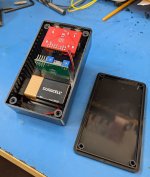
Just a friendly reminder for future me. DON’T rely on sticky double sided tape holding vero board on enclosure when you’re blasting some low Hz loudly. Back into bench it goes. :D
 
It looks suspiciously like I'm making a pedal :eek: Is it still a pedal if there's no stomp switch? I might put one in eventually though.
I even made my own I/O/Power module so I don't have to pay Robert $2.50 for his :LOL:.
Nah, I would have gladly bought it, but I wanted one that can also do stereo out on a TRS and has support for battery power.

PXL_20250606_211124541.jpg
 
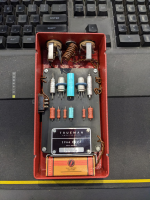
Trimpots turned up for the Trueman. Got it working then bit the bullet - removed the original bias knob, conventionally biased both stages, and fitted a fuzz control with only one trace cut/one resistor removed. Sounds even better than the original and totally reversible - other people I've seen modding them tend to add a volume pot on the side which I wanted to avoid.

Also fitted secret polarity protection to prevent anybody accidentally plugging in the wrong power supply (schottky hidden underneath the heatshrink on the input jack).

Sounds pretty good!

1749258051305.png

1749257808558.png
 
Why can't a printer print the solder mask too? And the silkscreen?
When I get my new UV printer (it was an accident, I swear) I plan to print the silkscreen on my DIY boards, but I hadn't thought of printing a soldermask with a UV printer. That is certainly a possibility, just use a nice thick coat of ink, leaving gaps for the pads, and then print the overlay in the same go.
 
Whatever happened to the P in Printed Circuit Boards? I want to put a blank board in a printer, hit Print, and out comes a proper PCB. Is it too much to ask? Why can't someone make this happen? Canon? Epson? HP? Hello?
For that you should talk to Voltera, they have you covered. Prints conductive inks onto a blank substrate.

If you have a vastly higher budget (my last job bought one and it came to around $150k) you should look at Dragonfly, which uses two printheads for printing a resin that becomes the substrate and a conductive ink that becomes traces/pads. It can do weird things like embedded components, plated through-holes, and multilayer (highest we ever tried was 16-layer) boards.
 
For that you should talk to Voltera, they have you covered. Prints conductive inks onto a blank substrate.

If you have a vastly higher budget (my last job bought one and it came to around $150k) you should look at Dragonfly, which uses two printheads for printing a resin that becomes the substrate and a conductive ink that becomes traces/pads. It can do weird things like embedded components, plated through-holes, and multilayer (highest we ever tried was 16-layer) boards.
*Saves search terms at govdeals.com*
 
I've seen a couple tutorials where people apply solder mask after the board is complete and use a laser engraver to etch away the mask on the pads, I may try that method. I have a couple boards that were just tests, I'll experiment with those before I try things on a board I actually need.
Oh, and one more thing - in my experience, soldermask sticks better to copper than laminate. I mean large areas. Sometimes, after UV curing, when removing the protective film, the paint comes off with the separating film.
 
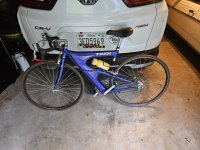
Been looking for one of these bikes for a year. They're becoming collector's items and the prices range from $1,200 to $2,000 on ebay. I lucked out and got this from a lady in Baltimore.
20250606_200451.jpg
Frame fits great and it is clean for its age as a 1997 model. But it needs love. I am going to upgrade all the parts.

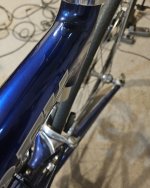
Going over it a noticed that the top coat is not well done. There is orange peel throughout. I think they shot a thick coat, used some polishing compound and called it a day. At the time Trek was pushing the boundaries of carbon manufacture before it all went to China and they didn't focus on the finish as a way to cut costs.

So, I wet sanded a portion of the top tube and hit it with polish. BAM. Instant depth of finish and a deep metallic glow.

20250607_013614.jpg
 
Back
Top