

You are using an out of date browser. It may not display this or other websites correctly.
You should upgrade or use an alternative browser.
You should upgrade or use an alternative browser.
What’s on *YOUR* workbench?
- Thread starter Bricksnbeatles
- Start date
PunchySunshine
Well-known member

DeadAirMD
Well-known member
I finally, finally finished up this ‘69 stones drive, biased it by ear, running at 18v. It’s very good. At the rate I’m going, I’ll get a build report up in about a month and my interface game is shit, so some risk inherent in trusting someone else’s ears and gears, but I think this one is well worth building.
Put C10 and C18 on dpdts and make C10 47n and C18 22n, and ya got yourself the Diamond Drive.
I love both of those pedals, they sound great. I also put another cap on a toggle to change the amount of gain, between high and low, but I can't remember which one it was. I can take a look later if you're interested.

swelchy
Well-known member
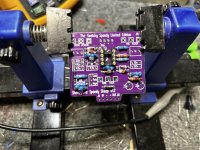
Working on a speedy sheep @szukalski …, Lost the dang break out boards he sent as well… For the life of me cannot find them.. Took a sick day today because I was feeling under the weather all night… Got board from doing nothing so I’m putzing around at the bench…. Not sure How I’m gonna do the switch for gain yet… Spdt on/on?


 .
. 

KR Sound
Well-known member
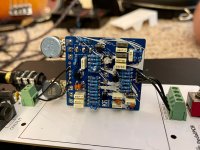
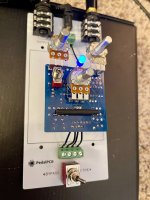
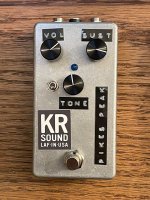
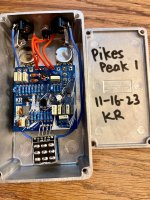
I made JAFBMP and when laid it out, for whatever reason the clipping diodes didn’t come over  so I had to put them on after the fact.
Regardless, it sounds pretty damn cool! Used a combination of the Triangle and some of Skreddy’s values for a nice midrange, non-muddy cross between fuzz and distortion. I dig it.


so I had to put them on after the fact.Regardless, it sounds pretty damn cool! Used a combination of the Triangle and some of Skreddy’s values for a nice midrange, non-muddy cross between fuzz and distortion. I dig it.

szukalski
Well-known member
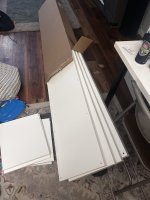
Kallax.. the cupboard of champions!The wife went to IKEA today.

Feral Feline
Well-known member
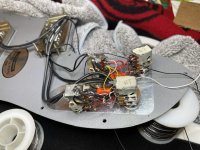
Friend's Orchid Tele is back.
I changed it to '50s wiring, we reassembled and then there was bleed through from the neck pup through bridge... back it came.
Opened it up and lost signal to both pups.
Turned out one of the flimsy switch-wires had broken off the switch (switches were untouched in the 50s rewiring).
So I soldered the wire back on the switch and regained activity from bridge pup, but neck pup's signal is still AWOL.
Help me Obi-@MichaelW-Telekenobi, you're my only hope...

Cybercow
Well-known member
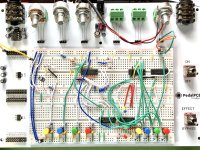
Redesigning the logic switching for our RMS X100 pedals so there will be one stomp for each of the four modes. The logic all works. I just need to rework the LED driver section with AND gates instead of NAND gates so it will pair up with the tied-low switch logic. Waiting on some CD4081 chips now.

Last edited:

Harry Klippton
Not Interested
Why can't I just be normal 
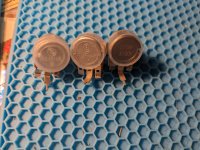
benny_profane
Well-known member
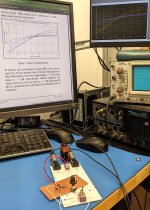
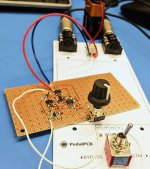
Nice! Glad to see you’ve got it verified. Are you digging it?One Knob Squeezer, based around the THAT 4316. Expectations vs Reality
I gave up on trying to build this on a breadboard. Looks like breadboards and I really don't mix. I'm done with them forever.
View attachment 60726View attachment 60727

JTEX
Well-known member
First impressions: if you crank it all the way up, it compresses way, way too much (trying it with a pretty hot bass). At minimum, it still compresses a bit (I'd like 1:1). I'll try getting rid of the 6dB gain in the buffer, that ought to bring it into a better range. It responds very naturally to loudness, I definitely dig the RMS response. I haven't implemented the auto attack/release (the non-linear capacitor in the RMS detector). I will do that next, to see if it makes sense with typical bass playing. If not, why burn more power for that extra op amp?Nice! Glad to see you’ve got it verified. Are you digging it?
EDIT: Total current draw is about 4mA*, so it's onboard-worthy!
*once I subtracted the ridiculous 3.5mA quiescent of the 78L05 regulator that I will replace with a low quiescent part. Or even better, use a stepdown switcher to bring 9V down to 5.
Last edited:
benny_profane
Well-known member
I thought that was a clever part of the application note. But, I’ve never built it without it. I’d be interested to hear your thoughts about it in/out of the circuit.I haven't implemented the auto attack/release (the non-linear capacitor in the RMS detector). I will do that next, to see if it makes sense with typical bass playing. If not, why burn more power for that extra op amp?
JTEX
Well-known member
Clever indeed, but I have a hunch that it makes more sense on a full mix than with a single instrument. We'll see.I thought that was a clever part of the application note. But, I’ve never built it without it. I’d be interested to hear your thoughts about it in/out of the circuit.
benny_profane
Well-known member
I figured it was doing some of the lifting in making the circuit work well with bass, i.e., not getting overwhelmed by lower frequencies and balancing the response across the frequency range.Clever indeed, but I have a hunch that it makes more sense on a full mix than with a single instrument. We'll see.
JTEX
Well-known member
That's what the pre-squeezer onboard EQ is forI figured it was doing some of the lifting in making the circuit work well with bass, i.e., not getting overwhelmed by lower frequencies and balancing the response across the frequency range.

benny_profane
Well-known member
I’ve gotta get a look at that!That's what the pre-squeezer onboard EQ is for
Normal is highly over rated my friend. You just be Harry Klippton please.Why can't I just be normal