
temol
Well-known member
Congrats on your new tool. I have very similar brake. Soon you'll discover its limitationsIts incredible! The bends i can get out of it are levels above in quality over my last brake!


Congrats on your new tool. I have very similar brake. Soon you'll discover its limitationsIts incredible! The bends i can get out of it are levels above in quality over my last brake!

Looks like the typical shitty analogman pedal insideNot on my bench, but a friend sent me a pic of his MXR Duke of Tone. Looks worse than 95% of the builds on here.
View attachment 63218




Where the heck are the jacks?Not on my bench, but a friend sent me a pic of his MXR Duke of Tone. Looks worse than 95% of the builds on here.
View attachment 63218

I’m not there yet so far everything I’ve thrown at it I’ve been able to do!Congrats on your new tool. I have very similar brake. Soon you'll discover its limitations
The disadvantage and advantage at the same time is a very small bending radius resulting from the sharp tip of the brake fingers. You can see that aluminum changes its structure at the bending edge. Also, it would be nice to have some indicator of the bending angle.I’m not there yet so far everything I’ve thrown at it I’ve been able to do!

Thats an awesome tip!!! I havent played with the different finger configurations yet.The disadvantage and advantage at the same time is a very small bending radius resulting from the sharp tip of the brake fingers. You can see that aluminum changes its structure at the bending edge. Also, it would be nice to have some indicator of the bending angle.
And it is quite troublesome to return to the default settings after changing the sheet thickness or generally after turning the side adjustment screws. Easy to change settings, not so easy to set correctly
Try not to leave a gap between the fingers larger than 3-5 mm. Sometimes you can see on the bending edge that there was no pressure along the entire length. I'm talking about a situation when one wide finger is too wide (does not fit between side walls) and a narrow one is too narrow. Then you can use two narrow ones, leaving a gap between them. It is best to plan the width of the bends taking into account the sizes of individual fingers. This applies to the bend of 3 or 4 walls - e.g. a box.
Different radius = new set of the brake fingers, with a different edge. You can try to cheat a little and set the edge of the fingers away from the bending edge, but it won't always work.As for the bend radius, I would like to add that the actual changing of the bend radius is a little cumbersome. Having to undo a screw then adjusting with a separate tool adds more time than i would like.
Is it possible to buy fingers with different edges? That would add a whole new layer of customization....especially for wider bends!Different radius = new set of the brake fingers, with a different edge. You can try to cheat a little and set the edge of the fingers away from the bending edge, but it won't always work.

You can make different radius by taking a small piece of sheet metal of different thicknesses the length of the throat and bending in the shape around the “fingers “ to place over the edge of the fingers giving you a larger radius for proper set back and bend radius… it’s cheaper and quicker to change out, just slip them on and off. Super easy.Is it possible to buy fingers with different edges? That would add a whole new layer of customization....especially for wider bends!
Ahhhh this is an awesome tip! Ive seen something similar with tubing that was welded on but i didnt want to go that route. Thanks for this! Now im going to be experimenting all dayYou can make different radius by taking a small piece of sheet metal of different thicknesses the length the the throat and bending in the shape around the “fingers “ to place over the edge of the fingers giving you a larger radius for proper set back and bend radius… it’s cheaper and quicker to change out, just slip them on and off. Super easy.

Dude this is gold....Bookmarked!I found the thickness that worked for me were .010”, .032” , .040” but if you want bigger radius go thicker
This absolutely will prevent this, that’s one of the main reasons for it.Thanks! I'll be playing with that too.
I'm also wondering if that would help limit the issue @temol brought up about finger edges marking the bend line. My main finger brake has led a hard life. The finger alignment isn't perfect, and sometimes it shows.
It depends on the manufacturer. Good (i.e. expensive) machines have different types of fingers available. And ours... probably not. I ordered mine from a company that specializes in metalworking. But I also have 3D printed ones.Is it possible to buy fingers with different edges? That would add a whole new layer of customization....especially for wider bends!

I’m sure I’m not the first person to think of this, but I just went to bend one of these radius spacers, and I realized if I flange the back side it can double as a back-gauge for making repeated bends at the same depth. Works mint.This absolutely will prevent this, that’s one of the main reasons for it.
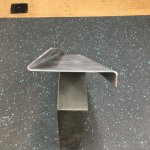
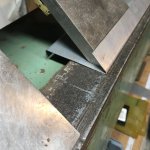
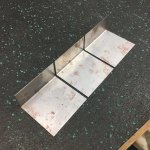
the brake I used had a wheel on the side for adjustment that you could do very easily, if the brakes you guys are using don’t have that I could definitely see that being a pain.It depends on the manufacturer. Good (i.e. expensive) machines have different types of fingers available. And ours... probably not. I ordered mine from a company that specializes in metalworking. But I also have 3D printed ones.
The method suggested by @Paradox916 is OK, I've used it. But it requires moving the fingers back (by the thickness of the insert). In the case of custom fingers you just replace them, no further adjustment necessary.