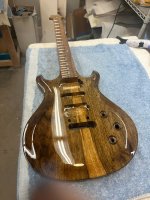
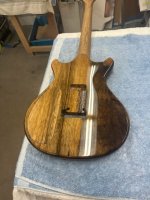
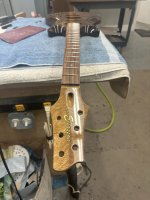
What’s on *YOUR* workbench?

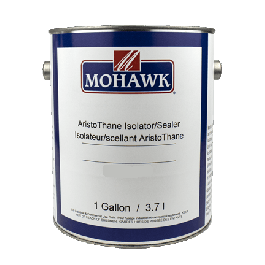
Do you think this will effect the tone and resonance?
Oh boy. Short answer, nope.

Long answer,

The claim that polyurethane (poly) finishes have a detrimental effect on tone is often rooted in tradition, perception, and the marketing of vintage instruments. Here's why these claims persist despite the lack of solid evidence from double-blind studies:

Historical Context: Many guitarists idolize vintage instruments, which often had nitrocellulose finishes. Nitro finishes are thinner and have been associated with a more "open" or "resonant" tone, though this is largely subjective. When polyurethane finishes became more common in the 1970s, some players perceived a difference in tone, which led to the belief that poly finishes were inferior.

Marketing and Tradition: Guitar manufacturers, especially those producing high-end or vintage-inspired instruments, often appeal to tradition. They market nitro finishes as superior based on historical usage and perceived tonal benefits. This creates a narrative that poly finishes are "worse" for tone, even if the actual tonal difference is minimal or non-existent.

Physical Differences: While there is a physical difference between poly and nitro finishes—polyurethane tends to be thicker and more durable—whether this has a significant impact on tone is debatable. Some believe that the thicker poly finish can dampen vibrations and reduce resonance, but this hasn't been definitively proven in controlled studies.

Subjective Experience: Tone is highly subjective, and guitarists often believe they hear differences based on factors like finish type, even if those differences aren't measurable. This creates a feedback loop where the belief in tonal differences reinforces itself.


The claim that poly finishes are detrimental to tone is more about perception and tradition than scientific evidence. It's a belief that has persisted in the guitar community, but without rigorous, controlled studies to back it up, it remains largely anecdotal.
Come on Jimi. The toan is in the strings and the resonance is in the gain pot.
In all seriousness, wiith neck through, I bet it sustains very well. :)
The neck is glued in, so set neck, not neck through 🙃.
 
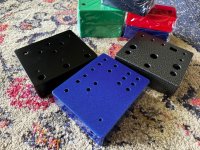
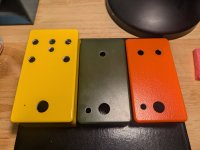
Good Tayda colors today. Drilling the 1590b by hand is a fun exercise in not mucking it up.
is that the Orange Sand coating? I have the darker, red sand enclosure about ready. I screwed up the "print" I was trying to do with the laser engraver deal, so I'll probably either repaint and light sanding, or ...something.


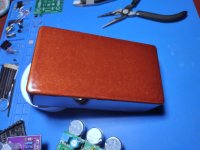
Forgot to post, but a week or so ago I got a big order in. This Candy Copper is the perfect shade of BROWN for the Promenade (bass balls) I'll hopefully have completed soon.

1000007592.jpg
 
is that the Orange Sand coating? I have the darker, red sand enclosure about ready. I screwed up the "print" I was trying to do with the laser engraver deal, so I'll probably either repaint and light sanding, or ...something
It is indeed. I am curious as to how a graphic will adhere. I think my initially purchased black sand from Tayda was much more gritty but this one seems to be much less textured. I recall that I purchased this for a phaser but mistakenly got the 1590B by accident. So now it will be my own limited edition Distortion +

Embrace the mistakes. It's he only way forward.
 
I am curious as to how a graphic will adhere. I think my initially purchased black sand from Tayda was much more gritty but this one seems to be much less textured.
Heh, it kinda does from the pic. I was a bit skeptical when I had Tayda do the print so I doubled up on the white. Came out really nice.

Embrace the mistakes. It's he only way forward.
The next couple I'm hoping to do non-UV, so that'll be an adventure 😬


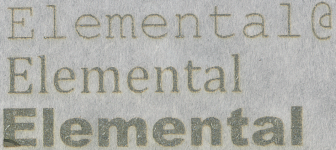
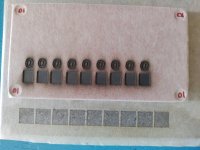
I actually did a test to just make a mask and laser cut it. The first few tests came out really ...weird. The adhesive on the paper-backed vinyl transfer tape didn't burn away. Took me a couple more tries to test a theory: the bare aluminum was interfering/deflecting/etc the laser so it just wouldn't burn properly. Tried some progressively more powerful passes as well:

1724510135103.png
Hard to tell from a scanner, but at the right angle you'll see a shine—the adhesive is still there. I thought, okay, I'll also do some cross-hatch/second burn next time, and on a coated surface to see if I was right. Some of the more powerful burn-ins could be taken care of with some oil, but it also fouled the rest of the paper, but I had a feeling it was indeed something else.

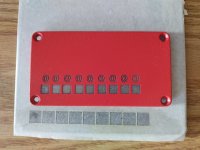
Good thing I did the experiment on an enclosure that I already borked… The boxes here (and @ symbols on the red one) are the same progressive laser power/speed settings steps, and it's very dramatic the difference a coating makes. Also tells me I don't need to go that slowly… I think by the end it was 550mm/minute at 100%. Granted it's a 5W diode laser.

1000007582.jpg

After a bit of iso alcohol it cleaned up well:

1000007585.jpg
Cleaned out a bit more of the "@" with a toothpick on the last one. During the etch I got a whiff of the same VOC (probably) odor from when I attempted paint/coating etching last year, but didn't think it was stronk enough to go through the powder coating.

I was not intending this to be an actual burn-through on this run, just a cut of the paper. It's definitely progress, though.

If anything it proves another point I'd seen elsewhere about laser cutting: the tape helps prevent burned marks on the wood (in the example case in the video I watched). Might be doing the same thing here with the powder coat.
 
First thing I've built from a schematic, and first project on a breadboard, and it actually works, doesn't sound great yet, but it works. Hybrid Si/Ge Meathead Dark. I think I just need to swap some bias resistors/trimmers and find good values and it'll be pretty good. Using low/mid gain 2n2369 and MP38a.
hiRLRbL.jpeg
 
Back
Top