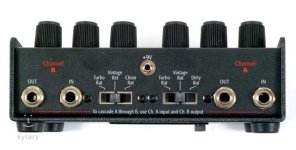
What if we killed off the 1/4 / 6.35mm jack?

Pie in the sky thinking is great, but I live and grew up in the Silicon Valley. I've grown to hate the "Fake it till you make it" "move fast and break things" "I'm a rich entitled asshole that worships Steve Jobs and think that willfully blinding myself to facts is the secret sauce that leads to success."
I meant to touch on this sentiment too. So many startups in the tech world are just a solution that is looking for a problem.

One of my favorite examples is when Walgreens used the tech from Cooler Screens. Let’s replace the window of a cooler with a big-ass heavy screen that puts out a bunch of heat. It can display the contents of the cooler before you open it. Truly innovative over low-tech solutions like a glass window.

Or maybe the app that told you how much propane there is in the tank connected to your grill. Much better than attaching a basic gauge to it…

Oh and also the juice company that sold a $600 juice extractor. So nice that it could squeeze that proprietary pouch. Never-mind that you can just squeeze the pouch directly with your hands.

That’s the kind of shit you get when you don’t factor in the real world.
 
Several years ago I decided to make all my DIY pedal jacks LTR. As a lefty, my guitar cable comes from the left, and it's reading order. But there have always been a couple Boss pedals I won't give up, and now my 16yo uses some of those old pedals and it's a shitshow. Inertia is working harder, even though LTR is objectively better, disregarding handedness.
I've done a number of amps and pedals with "reversed" control sets; the RTL pedal convention is a total PITA for some of the stuff I build, same as so-called top jacks. But other windmills beckon more winsomely...:poop:🌈🦄
 
I don't see how 3.5mm plugs are a mechanical problem in pedal-to-pedal connections on a pedalboard. And most of my experience has been fairly chaotic shows with stage diving and IDGAF behavior all round. You need something stronger guitar-to-board, and maybe board-to-amp, for sure.

Definitely for guitar-to-board and board-to-amp you want to use a 1/4" jack. Personally, I like to use locking 1/4" connectors as dedicated "board in", "board out" and "amp in" jacks. Neutrik type D stuff.

Trust me: you don't want to use the thinner cable assemblies like the Mogami W2314 for long connections, which is what you would need to use for the 3.5mm plugs. I love using that cable for pedalboards because it's *very* easy to work with and tends to be quite flexible. But I wouldn't trust it at all as something that rolls around underfoot. Our cables take a lot of abuse that would make many other types of cables wince: there's a reason you don't see folks soldering up installation-grade coaxial cables to 1/4" jacks: it would technically work, but they would not survive the environment they exist in.

I'd want to hear a high gain pedal with input & output cables parallel to each other and so close together on a TRRS cable, but it would absolutely be worth the experiment.

This is possible as well. Studio rack equipment quite often uses TRS 1/4" jacks for both send *and* receive signals. It's incredibly convenient, as one can simply use a single cable to, say, add a compressor in a signal chain. You just use the normally closed switches on a switched 1/4" TRS jacks: the switched end gets a jumper between T and R. Inserting the jack breaks that connection and allows one to use T and R as send and recieve. You don't necessarily need to seperate signal grounds on these connections, a TRS will do just fine.

Studios tend to use 1/4" TRS plugs for durability and reliability reasons, because these connections get plugged and unplugged all the time. If it's a simple send/return loop you're looking to build into a pedal, it's a very convenient option.


Several years ago I decided to make all my DIY pedal jacks LTR. As a lefty, my guitar cable comes from the left, and it's reading order. But there have always been a couple Boss pedals I won't give up, and now my 16yo uses some of those old pedals and it's a shitshow. Inertia is working harder, even though LTR is objectively better, disregarding handedness.

I'm a righty, but I'm a friend of the left hand path. Hail Satan.

This is a bit of what I'm talking about though: this method of ordering pedals may make more sense to you. I can't argue with that.

But while many of the so called "romance" latin-derived languages read left-to-right, this is hardly universal across cultures. Many languages from the global East are read right-to-left: Arabic, Hebrew. Kanji and similar systems tend to be read top to bottom, and their books tend to be read from what we would think of as being the *last* page to what weould think of as being the *first* page.

So at risk of sounding like a pedant, it's not really an *objectively* better means of signal routing. I'm sympathetic to the idea as I'm American and read left to right: I get what you're saying. *Subjectively*, that makes sense to me.

The drawback is that we exist in a context outside of ourselves. All commercially available guitar gear that I'm aware of is made to adhere to a right-to-left signal path: integrating equipment that does the opposite with existing gear creates, as you have experienced, headaches.

Abstractly the idea makes more sense. In context, I'm afraid, it doesnt make any sense at all. It's an added complexity to a standardized system. This isn't always a bad thing, but there is a trade-off.

The question that one needs to make when considering such a thing is this: is it such an advantage that it is worth dealing with the headaches it creates? Is it so much better that it will cause everybody to abandon the old ways and jump on board with the new ways, therefore making the headaches short-term and insignificant? One cannot simply assume that one's ideas are so great as to overcome these obstacles.

For every Apple, you get about 10 Segways, Juiceros, and Theranos'.

Now...I'm not opposed to charting one's own path. Hell, I've adopted powercon connectors for my rack and pedalboard, even though they aren't really easy to come by in stores. I just keep a spare handy. I'm a huge fan of using 3.5mm plugs for expression cables: it just requires me to keep a few custom made cables around to integrate these devices.

And I'm not opposed to using 3.5mm plugs to connect pedals: I just question exactly how much would be gained from such a move, and how much of a headache it could create down the road.

I'm also aware of the headache of existing in a culture that simply refuses to work in the much simpler and more intuitive metric system. At work, though, I still use imperial measurements because that's what makes communication easy between myself and my peers.

 
Last edited:
The Rat Deucetone has an LTR layout. It’s like they couldn’t handle having “B” on the left side of the face

IMG_1287.jpeg

Also the Boss ES switchers. On the backside, they go the standard RTL. But on the face, the loop switches are ordered LTR. Pretty nutty IMO. Worse than the deucetone, which at least is consistent with the front and the I/O interface.
 
So far I think the schmorg is the best alternative. It’s designed just like a modular synthesizer.

The dock isn’t proprietary. It’s just an implementation for mounting, power and signal routing. And you can dock a single module into an enclosure, making it work no different than a regular pedal. Fully backwards compatible.

The tradeoff is you have to mount the circuit to the lid, and have internal connectors on both the circuit and the dummy enclosure.
Eurorack FTW!

AP1GczNUk5FnMZs7M0JWV8ZuhUd2DJic2O3SUp6oq5_WqNWNmQRBZPT5p9asJRF-ZgVucGS2XXJU2zeLN9uqdt3SAhL5Y4zgrc-JqZPQ3gFFvp_TcFVR2a2Mp-RBrCG2n0a8gyIDVs6B--KTti-JUxQSR6Zxkg=w1769-h1326-s-no-gm
 
Maybe we should start off with a clear problem definition. My guess is that innovation starts with a problem.
For what problem is ditching the 1/4 a solution?
I think the problem is the more the pedalboard grows, the bulkier and more cumbersome it gets. Reducing the size of the things that aren't the pedals is the low hanging fruit.
 
I don't see how 3.5mm plugs are a mechanical problem in pedal-to-pedal connections on a pedalboard. And most of my experience has been fairly chaotic shows with stage diving and IDGAF behavior all round. You need something stronger guitar-to-board, and maybe board-to-amp, for sure.

I'd want to hear a high gain pedal with input & output cables parallel to each other and so close together on a TRRS cable, but it would absolutely be worth the experiment.

Several years ago I decided to make all my DIY pedal jacks LTR. As a lefty, my guitar cable comes from the left, and it's reading order. But there have always been a couple Boss pedals I won't give up, and now my 16yo uses some of those old pedals and it's a shitshow. Inertia is working harder, even though LTR is objectively better, disregarding handedness.
Like I mentioned, how do you know which will be the first pedal (requires 1/4 for guitar) or the last pedal (requires 1/4 for the amp). Or if the user will only be using one pedal? If they're just for you then YEAH!
 
I think the problem is the more the pedalboard grows, the bulkier and more cumbersome it gets. Reducing the size of the things that aren't the pedals is the low hanging fruit.

Seems to me the best possible solution there would be to remove the external connectors themselves: like the euro rack example you posted earlier. Best of both worlds, really. Still mountable on a traditional pedalboard, but compact and weight-reducing.

Certain designs could wreak havoc on something like this, though. Shielding on all signal carrying conductors would be a wise design choice.

I build all mine with the mini connectors these days so they are enclosure agnostic. Red one for the power.
AP1GczO69bhCFy_2T68grSqY9s1xWReT9czDs2PyLRY5PpIWhFXtB2LgpAFF2TTp5TwilhCD51Th0F0S4S3A3roA5gmEH4qMOPtPTQfFv0HFgqvUB2uAK3eK44LAc0-I1ElbF_fyKLubUUGsRrGsN8J2U92RTQ=w982-h1743-s-no-gm

I do the same: not all designs are condusive to this approach, but it's certainly helpful.

Like I mentioned, how do you know which will be the first pedal (requires 1/4 for guitar) or the last pedal (requires 1/4 for the amp). Or if the user will only be using one pedal? If they're just for you then YEAH!
That's not so difficult: hell, I use a locking 1/4" input mounted to the side of my pedalboard. That gets routed to the first pedal on my board and could easily step down the plug size.

Would I do that, though? Nah, no way.
 
Seems to me the best possible solution there would be to remove the external connectors themselves: like the euro rack example you posted earlier. Best of both worlds, really. Still mountable on a traditional pedalboard, but compact and weight-reducing.

Certain designs could wreak havoc on something like this, though. Shielding on all signal carrying conductors would be a wise design choice.


I do the same: not all designs are condusive to this approach, but it's certainly helpful.


That's not so difficult: hell, I use a locking 1/4" input mounted to the side of my pedalboard. That gets routed to the first pedal on my board and could easily step down the plug size.

Would I do that, though? Nah, no way.
I make amps and pedals with the idea that eventually it will be someone else's property, since I'm 68 and half of my friends have already passed due to natural causes. Last checkup doc said I was going to live at least another 30 years :oops: :unsure: . Not really looking forward to being 100 tho.....
 
I make amps and pedals with the idea that eventually it will be someone else's property, since I'm 68 and half of my friends have already passed due to natural causes. Last checkup doc said I was going to live at least another 30 years :oops: :unsure: . Not really looking forward to being 100 tho.....
I'm 38 and yearn for the sweet release of death.

Just a stickman in a stick world...
 
That’s pretty sweet! Was it Dr. Who? I never know if I’m going to make it to tomorrow ;)
lol, they did an EKG and circulation test, said I have the heart and legs of a 40 year old....

Gardening..... I've had a garden every season since I was five!!! Digging, rototilling, pulling weeds, watering, fertilizing and pest control; 2 tbl soybean oil mixed with 1 tbl scent free shampoo, stir till white, then slowly add water till it's thin-ish, then add more water for a total of 2 gallons. Shampoo is based on sodium, dish soap is based on ammonia, which breaks down into nitrogen after releasing the hydrogen which can over fertilize and burn the leaves and kill the plant. Don't use dawn like so many people recommend.

Kills all bugs on contact using a pump sprayer - apply every other day for three applications - even red spider mites don't stand a chance. Great flea dip too.

At the end of every season I rototill in all the plant waste, plus compost. This rots during the winter and feeds the bugs that make soil great. Rototill again just before planting to aerate the soil and loosen it up since rain compacts it.

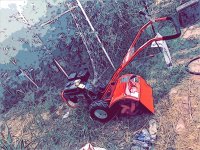
My Troybuilt:
rototiller.jpg
 
I'm using this thread to weigh the drawbacks against the benefits of freeing up space inside a pedal. In a 1590a or 'lb, a single compact connector replacing 2 standard jacks and a DC jack--well that makes the contemplation worthwhile. If I were making a 1590a board that's never gonna change, I'd totally think about maybe seriously giving it a try.

But, as has been pointed out, we change it up a lot. If I'd done that 15 years ago, I'd feel like a has-been, stuck with my Dr Boogie, Orange Squeezer and (gasp) stock-values Tube Screamer. They still sound great of course. 🙃
 
Why don’t we make contact patches on each side and use velcro to hold the pedals in place? Or create conducting velcro!
 
Back
Top