What if we killed off the 1/4 / 6.35mm jack?

jwin615

Well-known member
Just letting one of my internal thoughts escape for the sake of conversation.
What if the pedal community pulled an Apple and just decided to kill off the 6.35mm jack?
I have considered doing this myself, briefly, for my diy builds. Not a pen to paper plan. More of a thought in the shower. I would move to 3.5mm. It would open up more internal space in the pedal, cheap and plentiful patch cables, backwards compatible to 6.35 via patch cables with one sized connector on each end.
There are a lot of other possibilities as well. How about a pedal patch bay for 24 pedals that's the size of a metal zone? Or utilize 3.5mm TRRS cables and a pedal patch bay. A singular jack that carries input, output, power and ground. Make it right angle and plug into the top(face) corner and not all of you pedals(like this) can fit right next to each other. How about TRS/TRRS for stereo?

Again, not being serious here.
What are your thoughts?
What ideas do you have about a "better" way to do things?
Should everyone just Schmorg?
 
As my father always said 'You don't change horses mid-stream' but that's pretty much because you already know how your horse is gonna act and the actual change means a dump in the water.

But yea it's an interesting idea.
 
Just be glad that the industry settled on 1/4" and not XLR for instrument level signals...

I've given this some thought myself, but was pretty quickly dissuaded after considering the following:
  • What am I going to do with all these 1/4" cables I already have?
  • If/when I decide to sell something I've built, I probably won't be able to.
  • Will the wire required to use a smaller connector impact the signal quality in an appreciable way?
  • An adapter will be required at the front of the signal chain unless I run a cable the size of dental floss to my guitar.
I'm probably forgetting some, but these are more than enough for me (personally) to table the idea.
 
Last edited:
This is something which I have wondered about too. The increasing miniaturisation of technology comes up against the human interface. The first cell phones were like bricks because of the existing battery technology amongst other things. Then phones got steadily smaller and smaller until they were becoming difficult for some people to use. Then Apple came out with the iPhone and phones got bigger again. My current iPhone is bigger than the previous one. I like it because it's easier to use but still small enough to stick in my pocket.

I can build a tiny pedal but the limiting factors are the bits which I interact with. Sockets, switches and pots. One way to reduce size is to build more than one effect into the same enclosure, but then you're locked into those effect being permanently together. I've built a few dual effects to save space and then I find something I like better!

The size of the jacks is a limiting factor though which can be frustrating. The price we pay for ease of use I guess.
 
Was hoping for a little more one more thing and a little less get off my lawn.

Maybe refocus too "what if all the pedals disappeared and we had to start over"
What would you do differently.
Come on. Let's see some innovative ideas.
 
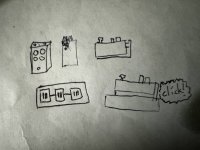
But really, I think I would like some sort of adapter that plugs into the pedal’s jacks, then has a plate on the bottom with contact points. Swapping pedals in and out would be as simple as opening a latch to remove the adapter with the pedal still connected to it, then pushing the new pedal in fitted with an adapter that just clicks into place.

Almost certainly not an original idea. Here’s a sketch I just made to illustrate.

IMG_1273.jpeg
 
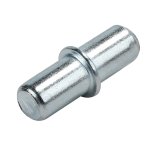
Okay! I'd say pedals should all be square shaped, and they should be connected to one another by having them side by side / in a grid. Power and sound goes in on one side, and out to the three other sides by some means that are not cable, maybe it can work with (unbreakable) pins / holes on all sides, like shelve pins? There's downsides to this (three way parallel max), but hey... Smart people along the way will figure out ways to make things better! There's plenty of downsides to this as well, but hey... Smart people along the way will figure out ways to fix those.

I am a fan of sturdy mechanical connections, as these can be fixed by you or someone you know. When it goes digital or whatever sort of future magic, it's everyone's guess how screwed you are with your dead purchase.

81dTw8FK1YL.jpg

If I could change this timeline, I would also make sure there were a lot more cicuit types being used in the past, so people wouldn't be so hung up on the same fucking sounds for decades to come, but that's an opinion for another place. And one that's not limited to guitar effects, but instruments in general.
 
Last edited:
Okay! I'd say pedals should all be square shaped, and they should be connected to one another by having them side by side / in a grid. Power and sound goes in on one side, and out to the three other sides by some means that are not cable, maybe it can work with (unbreakable) pins / holes on all sides, like shelve pins? There's downsides to this (three way parallel max), but hey... Smart people along the way will figure out ways to make things better! There's plenty of downsides to this as well, but hey... Smart people along the way will figure out ways to fix those.

I am a fan of sturdy mechanical connections, as these can be fixed by you or someone you know. When it goes digital or whatever sort of future magic, it's everyone's guess how screwed you are with your dead purchase.

View attachment 81583

If I could change this timeline, I would also make sure there were a lot more cicuit types being used in the past, so people wouldn't be so hung up on the same fucking sounds for decades to come, but that's an opinion for another place. And one that's not limited to guitar effects, but instruments in general.
There was that one build on this forum which was basically a pedalboard with switchable pedals, I think they were all built on the bottom plates and you just screwed in a new one and removed an old one. I think the power and in/out were done using something else than normal 6.35mm/2.1mm connectors, but I can't remember how to find that thread.

But to give a boring general answer: I would probably focus on reliability as #1. And when I think about it, the 6.35mm does seem like a good solution in that regard. The connectors very rarely fail, and while they do take up some space, there are quite small jacks available already. I'm not sure how reliable 3.5mm connectors are? Maybe one option could be that, but with a thicker cable like the current 6.35mm cable itself. It would look really weird, but hey, is that really an issue?

One option might also be the RCA connector, I know those are used with spring reverb tanks for example (for whatever reason?), could that be a workable alternative? The cables also suffer from being thinner, but maybe the same connector but with a thicker cable could be an option there too? How reliable are those?

I feel like power is fine, a smaller outie jack would be fine, or cheaper and reliable small innie too, the issue with those seems to mostly just be "the cheap small innie jacks are shit", which is not necessarily the fault of the connector design.
 
There was that one build on this forum which was basically a pedalboard with switchable pedals, I think they were all built on the bottom plates and you just screwed in a new one and removed an old one. I think the power and in/out were done using something else than normal 6.35mm/2.1mm connectors, but I can't remember how to find that thread.
SCHMORG!

Thread 'building a big "dummy box" SCHMORG'
https://forum.pedalpcb.com/threads/building-a-big-dummy-box-schmorg.8747/
 
If we would start all over in 2024 it would be an app
*Movie Trailer Voice (or Guitar Center Voice)*
AI driven TOAAAAN in you VR Adventure from Oculus(now Meta Quest) and Gibson USA! Perform as 130 different Artists in 72 different renowned Venues. Jimmy Page ar Red Rock. Gilmour at Pompeii. Dime ag at Alrosa Village.* Hendrix at Woodstock. Taylor Swift at Arrowhead. Syd Barrett at Kensington Olympia. Lenny Kravitz at Kwik Sak.

Immerse yourself in your Rock and Roll legacy with the JCM-8VR headset developed in collaboration with Marshall/Zound Industries.
Your TOAAN and Quest awaits.

Coming Fall. 2027.

★Neural implant required.
*Dimebag is a registered trademark of MonsantoBayerCitigroup
 
Just be glad that the industry settled on 1/4" and not XLR for instrument level signals...

I've given this some thought myself, but was pretty quickly dissuaded after considering the following:
  • What am I going to do with all these 1/4" cables I already have?
  • If/when I decide to sell something I've built, I probably won't be able to.
  • Will the wire required to use a smaller connector impact the signal quality in an appreciable way?
  • An adapter will be required at the front of the signal chain unless I run a cable the size of dental floss to my guitar.
I'm probably forgetting some, but these are more than enough for me (personally) to table the idea.
What if there is only one pedal? Hmm... lemme see 1/4 to 1/8 adapters suck how much?

1/8" doesn't have very much spring tension, you start dancing around while playing and the cable comes out.
 
Ever try soldering up a 3.5mm plug?

Lot less wiggle room in those. Would hate to have to do up a whole board.

And, ngl, I fucking hate that the 3.5mm was killed in cell phones. Just like how I hate cell phone designs in general: they're made to be all "ooh" and "ahhh" and shiny with all the latest tech with no regard for serviceability, dependability, and durability.

Basically: ohh, this phone has a screen that is near bezel-less! Ohhhh! Pretty! Well, sure hope that I dont drop it on it's extremely fragile curved edge, else I'm paying 350 dollars for a new screen.

I don't think cell phone makers have much in their design ethos that is applicable beyond tech. They're useful, sure, but their life spans do not compare to that of most instruments.

The advantage of the 1/4" jack is the fact that it's a universal interface. Specialty products will always be at a disadvantage because any new proprietary system will only have limited buy in from makers.

Dont get me wrong: I'd love to see something like eurorack for guitar effects. Pedal cases get heavy, all the custom patch cables required for re-arranging a pedalboard get cumbersome. I do think one could easily switch to 3.5mm for pedal to pedal connections on a board if they are so inclined, but that would require a lot of works for not much real benefit. Slightly reduced cramped ness inside pedals? Maybe slightly smaller builds?

What I will say, however, is that the 1/4" jack should be done away with for expression pedals. I'm down with that. But it's hard to argue with the ease of connection with the tried and true 1/4" connector for signal path.

It's fine. Unless we can find a replacement that is objectively better and easy to retrofit, I think we're stuck with it.
 
Big 1/4” is going to fight this tooth and nail.
Switchcraft has entered the chat


Hearing a lot of reasons why this is dumb, which I already admitted from the get go. Not a lot of new ideas though.
I'll add, a 3.5mm has plenty of contact to carry audio and voltage for non-tube pedals. As for solder ability, tons of jacks that are cheap and easy. Here's a familiar looking one. With a right angle connection, you have ~1/4 inch protruding so not easy to shear off.

Here's another idea.
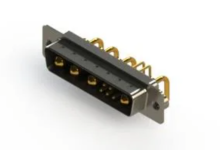
How about a pedal board that directly interfaces with the pedal via a mixed signal dsub. Thinking 9w4 here, like this one.
1000005150.png
Larger contacts provide audio in and out(including stereo). The other 5 smaller pins are ground, 9v, 12v, 18v and ?¿.
No cables, they directly interface with the pedal via a dsub on the bottom and a movable daubs within the pedalboard.

Let's see some ideas!
Now
1725884307281.gif
 
Back
Top