For the record (and I think i've said this in a previous post) you don't need to make an actual fully workable pedal (with all offboard wiring) to be eligible for this contest. I mean, if you want to build a full pedal, sure, go for it. You only need to provide a working prototype of the circuit which can include a breadboard, stripboard, or PCB and doesn't need to be boxed up. Of course, the schematic is needed too.
For the record (and I think i've said this in a previous post) you don't need to make an actual fully workable pedal (with all offboard wiring) to be eligible for this contest. I mean, if you want to build a full pedal, sure, go for it. You only need to provide a working prototype of the circuit which can include a breadboard, stripboard, or PCB and doesn't need to be boxed up. Of course, the schematic is needed too.
Cool, I've already done two 125B builds using the same size boards, just need to add one more pot now and maybe lose something else, or maybe not even. Not sure whether or not I can get to actually building one that way by the deadline, but all the board layouts and multiple circuit iterations are already vetted with various instruments and work well. And at least one of the three boards was conceived and designed after this contest started, so I think this meets the spirit of things. It's always been an open source project, so hopefully we can make it better together.
OK here's how I start all my designs, in LTSpice. I rarely breadboard anything. I get a working model that looks good to me, do a board layout, typically buy three test boards, and many times it works fine and that's it. If not...rinse and repeat! In this case, rinse and repeat since 2015, and still refining and learning new things.
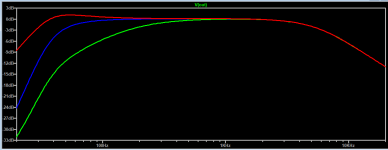
These graphs are mostly from the model for a build I finished last week. It's a preamp for a friend's upright bass in this case, with a variable frequency high pass filter, Baxandall based bass and midrange controls, three way mid frequency switch, and a variable resonance variable frequency low pass filter similar in conception to the Alembic and Wal onboard filter preamps. The left X axis is at 20Hz, so all show a 20Hz-20kHz sweep.
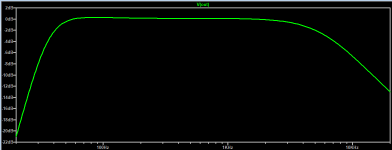
Nominal flat response, maybe not what you expected:
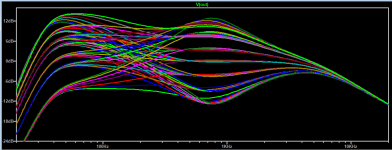
Huh? OK, nominal flat for an URB, within that instrument's passband. The HPF is set for -3dB at 38Hz and the LPF is in cut mode at the highest frequency setting, so -3dB at ~8kHz. If we leave those settings as-is and sweep the bass and mid controls over their full ranges with the mid switch at the highest frequency position, we get this mess:
I can infer a lot of useful information from this by now, but the basics are that both controls make around +/-12dB of boost/cut, with the peaks at 42 and 700Hz at full boost. I'll present individual curves later, but the interactive one actually is often a lot more useful to me.
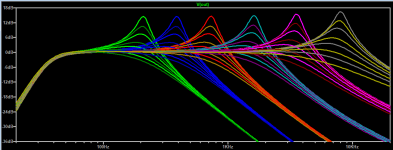
Now we'll still use the nominal flat settings, but sweep the frequency and resonance control of the LPF section across their full ranges:
This gives a range of full second order cut (12dB/octave) to +15dB of resonant gain over 200Hz-8kHz. For bass guitar something like 500-6.5k works well, but I wanted to try a new filter tuning with a broader sweep, which I accomplished by used a 50K dual pot instead of my usual 20K value. The pots are reverse audio taper and come in and out of stock at wildly inconvenient times, and most don't have right angle mounting pins like we'd want for board mounted pedal builds. Small Bear has the 50K right angle ones right now, so for this contest I'll run with that. Tayda sells 20K ones with straght pins and that's mainly what I've been using for the last couple of years.
And lastly for now, the HPF sweep from min to max, which has a nominal range of 26Hz-160Hz or so:
The HPF format is 2nd order fixed plus swept 2nd order, but it's not a classical textbook alignment and gives something like a mongrel 3rd order response at the most used settings. Why do it like that? Only uses a single gang pot rather than the standard dualie, and interaction with a boosted bass control yields much more interesting and perhaps "musical" results. I'll get to that next, along with the new gain leveling stage I've just started messing with.
And now I'm off to get properly caffeinated, that already felt like a lot!
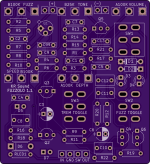
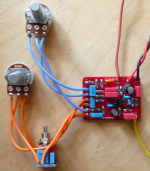
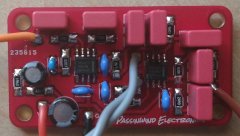
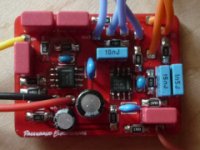
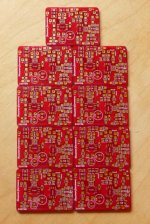
Here are the three modular circuit boards, last two are one generation back but still very similar to current ones:
Bass/Mids/Mid Switch:
Variable HPF:
Variable LPF, standalone version for onboard installs:
New variable LPF for pedal builds, with gain leveler:
And a 125B build without the gain control:
Those boards will all be available as shared fabrication files on OSHPark, I have no commercial interest beyond selling a handful of these things to a few friends. That's amounted to less than one a year so far, FWIW. There are a couple of simpler boards with all through hole parts as well, but I highly recommend going for the higher spec part-SMD ones instead.
I'm still not up to speed on pedal layouts at all yet. All the stuff I'm showing is just adapted from onboard preamps or DIY amp builds. Someone else just completed a proper 125B layout for Tayda parts as a contribution to my open source thing, and that'll be much neater and easier for most DIYers to deal with for sure. But I'm addicted to mix and match modular builds, and I have a lot of other little modules already done up that work great for custom onboard installs.
Yep, or run standalone or swapped in signal chain order. Each board has its own biasing and filtering section, so there's no codependency. The Bass/Mids board can run as Bass/Treble or just Bass by itself too, and beyond that there are three other flavors of little treble or midrange control modules, some little mixers, buffers, and gain stages. Little utility modules and breakout boards are fun, I do quite a few of them.
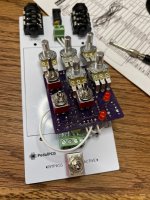
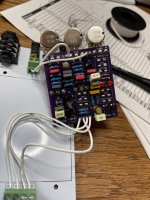
I got my board and pedal all fixed. Turns out that I had the 2N5457s backwards. Had the wrong symbol with the wrong pin outs which obviously affected that circuit. The volume knob- read my breadboard wrong and put the wrong side to ground and output.
It sounds pretty awesome and the tremolo is really cool. I’m pretty stoked!
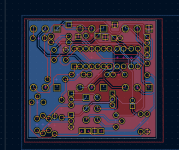
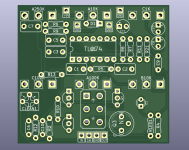
I’m reworked my board and ordered a few more from OSHPark.
The toggle switches worked backwards because I didn’t. Flip them around to the back side. And the Volume pot’s been fixed along with the wrong orientation of the transistors. I also used ground planes on both sides this time too. Oh ya, and made more room for the 1uF caps
aaaand I just realized I didn’t flip the clipping toggle around. Oh well, I’ll just label the enclosure different lol.



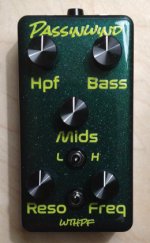


 Up is off and down is on